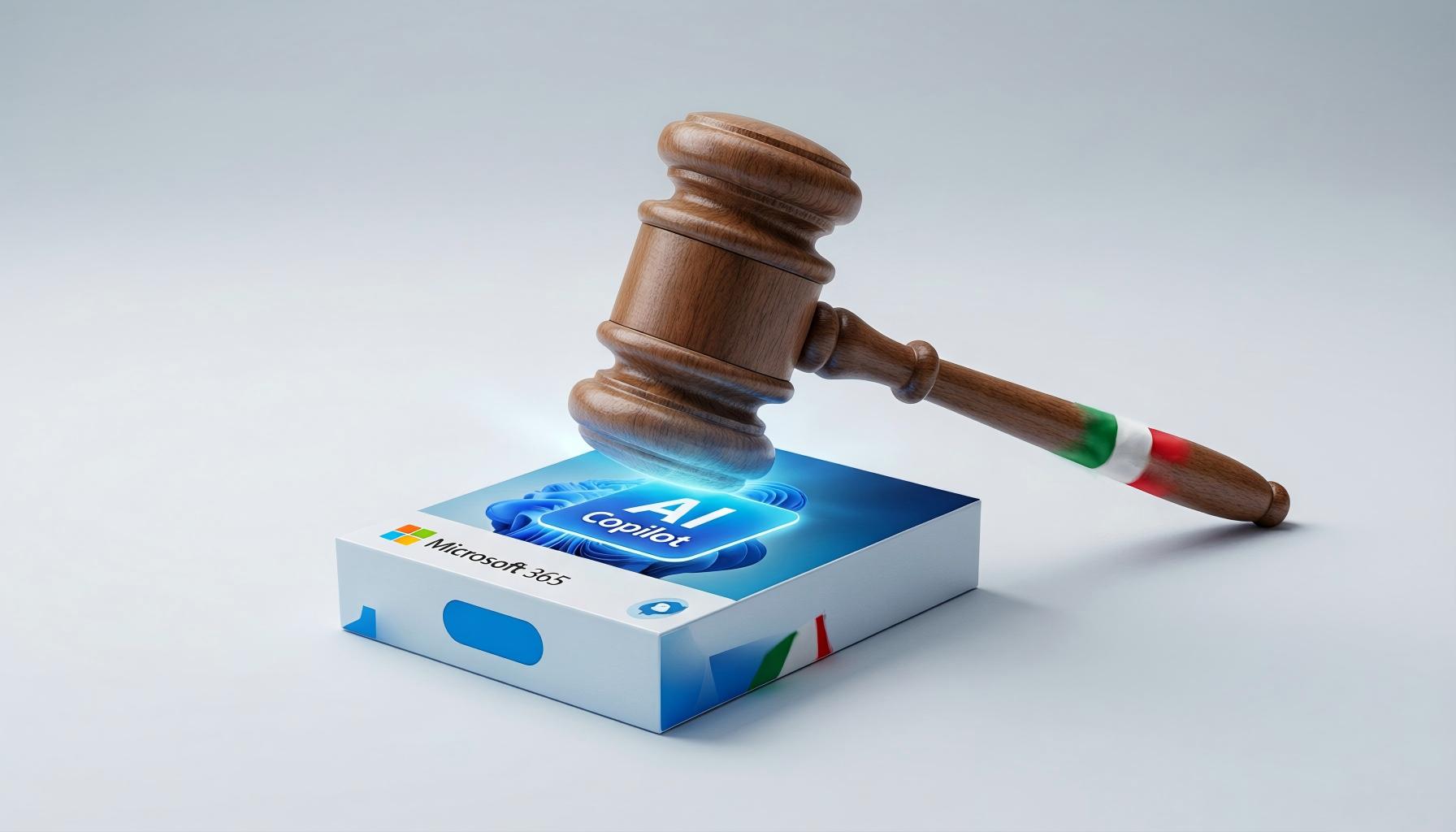
Italy’s competition authority has opened an investigation into Microsoft over the automatic upgrade of Microsoft 365 users to pricier AI-enabled subscription tiers, according to Reuters. The probe focuses on whether the software maker is pushing customers into more expensive plans without adequate consent or transparency.
The investigation makes Italy the latest European regulator to train its sights on how Microsoft sells AI. The European Commission has already opened proceedings related to Microsoft’s bundling of AI products, and Italy’s move extends the scrutiny to the consumer and small-business end of the market, where automatic upgrades can pass unnoticed.
The practice under review is familiar to Microsoft 365 users. As the company has rolled out its AI assistant across its productivity suite, it has moved subscribers between tiers — in some cases automatically — upgrading accounts to plans that include AI features at higher prices. The authority wants to know how clear that process is.
The concern is lock-in. Once a user is moved to a higher tier, switching back can be complicated, and the AI features, once experienced, become hard to give up. Regulators in several markets have warned that default settings and automatic migrations can function as a form of coercion when switching costs are high.
Microsoft’s AI push is the backdrop. The company has embedded its Copilot assistant across Windows, Office and the cloud, and it has said AI subscriptions are a core growth engine. The more aggressively it migrates users, the faster that engine turns — and the more attention it draws from regulators.
Italy’s authority has a track record with big tech. It has fined Apple and Amazon in separate cases, and it has shown a willingness to pursue behavioral remedies rather than waiting for markets to correct themselves. The Microsoft probe fits a pattern of Italian enforcement that has been among the most active in Europe.
The mechanics of the investigation will take time. The authority will gather documents from Microsoft, interview customers and competitors, and assess whether the upgrade practices violate Italian consumer and competition law. A preliminary finding, if any, is months away, according to people familiar with the process.
Microsoft has said it complies with local laws and that its upgrade processes are designed to be transparent. The company has argued that AI features add value and that customers who do not want them can opt out. Whether the opt-out is easy enough in practice is precisely what the authority will examine.
The case also reflects a broader European argument about AI and competition. Regulators have warned that the companies controlling AI infrastructure and distribution — the platforms, the models, the default apps — may extend their power into new markets. Automatic upgrades are a small piece of that picture, but a visible one.
Business customers are watching closely. Many European companies standardized on Microsoft 365 years ago and now find their license costs rising as AI tiers proliferate. A regulatory finding that forces clearer consent could change how Microsoft prices and packages AI across the continent.
Analysts said the probe is unlikely to stop Microsoft’s AI rollout, but it could shape its packaging. The company has adjusted products before in response to European pressure — unbundling its Teams app after EU scrutiny — and it may do the same for AI tiers if the investigation advances.
The European dimension matters. Several national regulators coordinate with the European Commission, and a finding in Italy could encourage parallel action elsewhere. For Microsoft, the risk is less any single fine than a patchwork of rules governing how AI features are sold in each market.
For consumers, the case highlights how quietly software economics have changed. The subscription model turned software into a recurring charge, and AI has turned the recurring charge into an escalating one. Whether users are being told plainly enough about the escalation is the question at the center of the probe.
The investigation’s outcome will take months, but its direction is already set: European regulators are treating the sale of AI features as a competition issue, not just a product decision. Microsoft, the largest seller of business software in the world, is the most visible target of that view.
The company’s response will be telling. Microsoft has the resources to fight, but its European business is too important to antagonize every regulator at once. The likely path is negotiation: clearer upgrade screens, simpler opt-outs, and a settlement that preserves the AI push while satisfying the authority’s concerns.
The probe also lands as Microsoft’s broader AI investments face shareholder scrutiny. The company’s stock has suffered its worst month since the dot-com era, according to Fortune, as investors question the returns on massive AI spending. A regulatory dispute adds one more item to a list that already includes big spending, uncertain demand and rising competition.