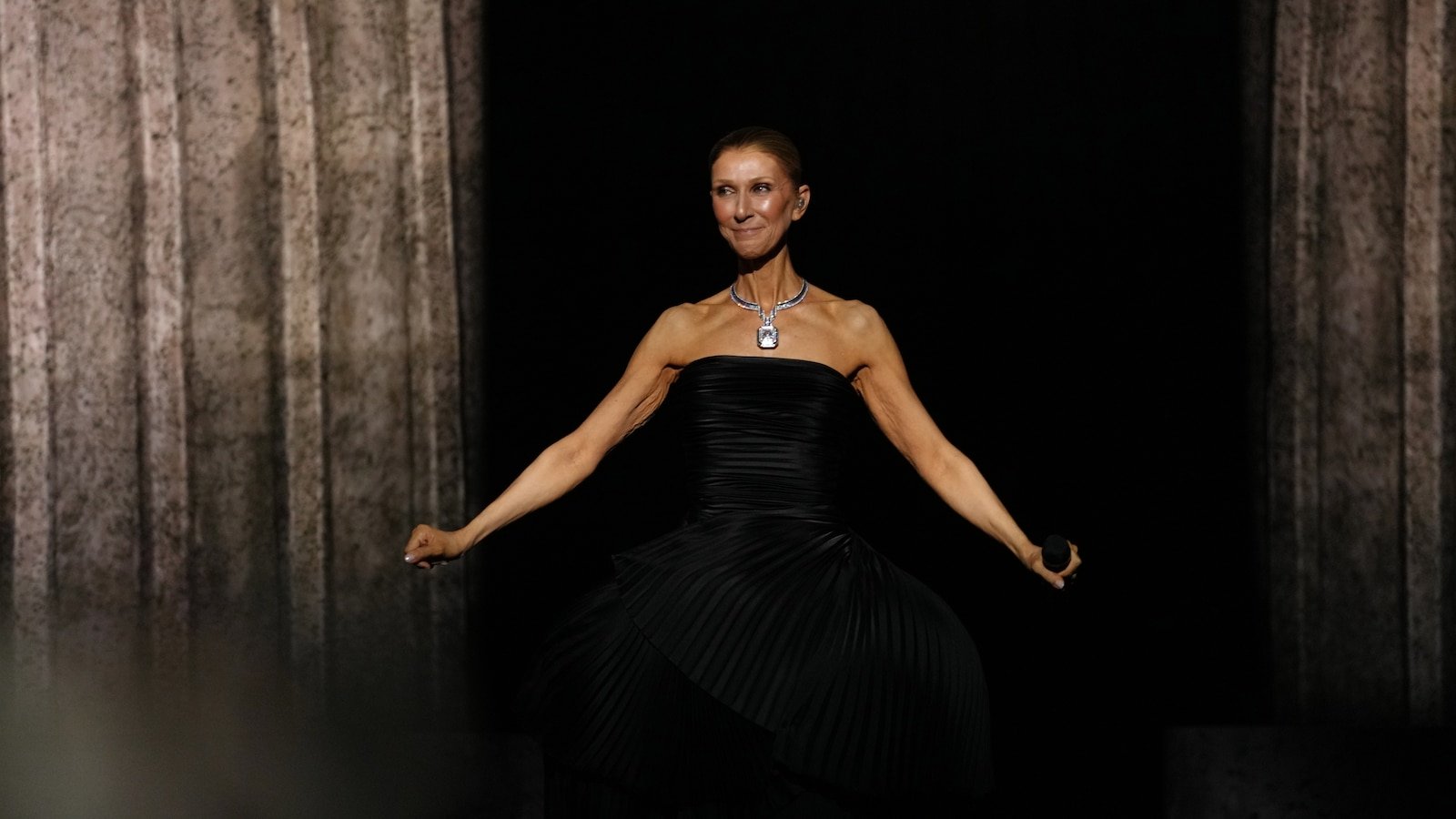
The two videos sit side by side in the public record. In the first, Celine Dion is frozen mid-spasm, her hands locked, her body refusing a command her mind keeps sending. In the second, the same woman stands on a stage again, microphone in hand, singing to a room that is on its feet. The distance between the two images is the length of her illness, and the years in which her three sons did their growing up.
Dion has stiff-person syndrome, a neurological and autoimmune disorder so uncommon it is estimated to touch roughly one person in a million. The condition causes progressive muscle rigidity and spasms violent enough, in some patients, to crack bone. It cannot be fully cured. Treatment can blunt the worst of it and slow its advance, but the disease does not reverse, and doctors still cannot say with certainty what sets it off.
For a performer whose entire instrument was her body, the diagnosis landed like a verdict. Dion described the spasms as a strangling, a rigidity that seized her throat and her limbs and would not let go. The touring stopped. The Las Vegas residency, the engine of her career for years, went dark, and she retreated to the privacy of her home and her family.
What made the return moving, in the telling of people who have followed her career, was not chiefly the music. It was the family that had changed in plain sight during the years she was offstage. Dion has three sons. Rene-Charles, the eldest, was a small boy when his mother was the biggest-selling female artist in the world. The twins, Eddy and Nelson, were born a decade later. By the time their mother reappeared, they had become a young man and two teenagers who spent their formative years inside a household arranged around a disease.
The children’s father was Rene Angelil, Dion’s manager and the man she married in 1994. He died of cancer in January 2016, when the twins were five and their older brother was fourteen. That loss left Dion as the sole parent of three boys, a role she has discussed with a frankness uncommon among performers of her scale. The diagnosis came after, and with it the withdrawal from public life.
The ordinary quality of the story is what has given it its reach. A disease that strikes one person in a million is, by definition, almost never witnessed. But a mother getting sick while her children grow up is a story millions of families recognize. Dion’s illness may be rare; the scene it staged at home, the children learning to navigate a parent whose body no longer obeyed her, is not.
Her return has been gradual rather than triumphant. She has spoken about learning to manage the condition, about the medication and the physical work that let her stand on a stage again, and about the possibility that the disease could still interrupt her at any moment. The message she has repeated is that she will not pretend the illness is gone.
Dion rose to global fame in the 1990s on the strength of a voice that seemed to have no ceiling. The ballads written for film soundtracks, the parallel careers in French and English, the sold-out residencies: for two decades she converted an extraordinary instrument into one of the most commercially successful runs in music. That career made the diagnosis feel not just personal but almost symbolic, the strongest voice of a generation silenced by a disease doctors barely understand.
She allowed the illness to be filmed. A documentary released in 2024 showed her in the rawest terms, struggling to control her own limbs, and then showed the discipline of the work that followed. The film did more than document a disease; it established that the woman behind the spectacle was still fighting, a decision that framed everything that has come since.
The three sons are now the visible measure of how long the silence lasted. Audiences who last saw a young mother with small children now see a woman standing beside grown sons. That is the arithmetic of the comeback: the illness took years, and the years took her boys from childhood to the edge of adulthood.
It is the boys’ emergence, more than any single performance, that has framed the return in the public imagination. A comeback is usually a professional event, measured in tickets sold and charts topped. This one is measured in the same units as any family’s life, and that is what has made it land differently.
For now, the woman in the two videos remains the same person. What has changed is everything around her. The story the public is watching is not only a singer returning to work; it is a mother re-entering a world her sons have been living in without her, and the years between the two images are the years those sons grew up.