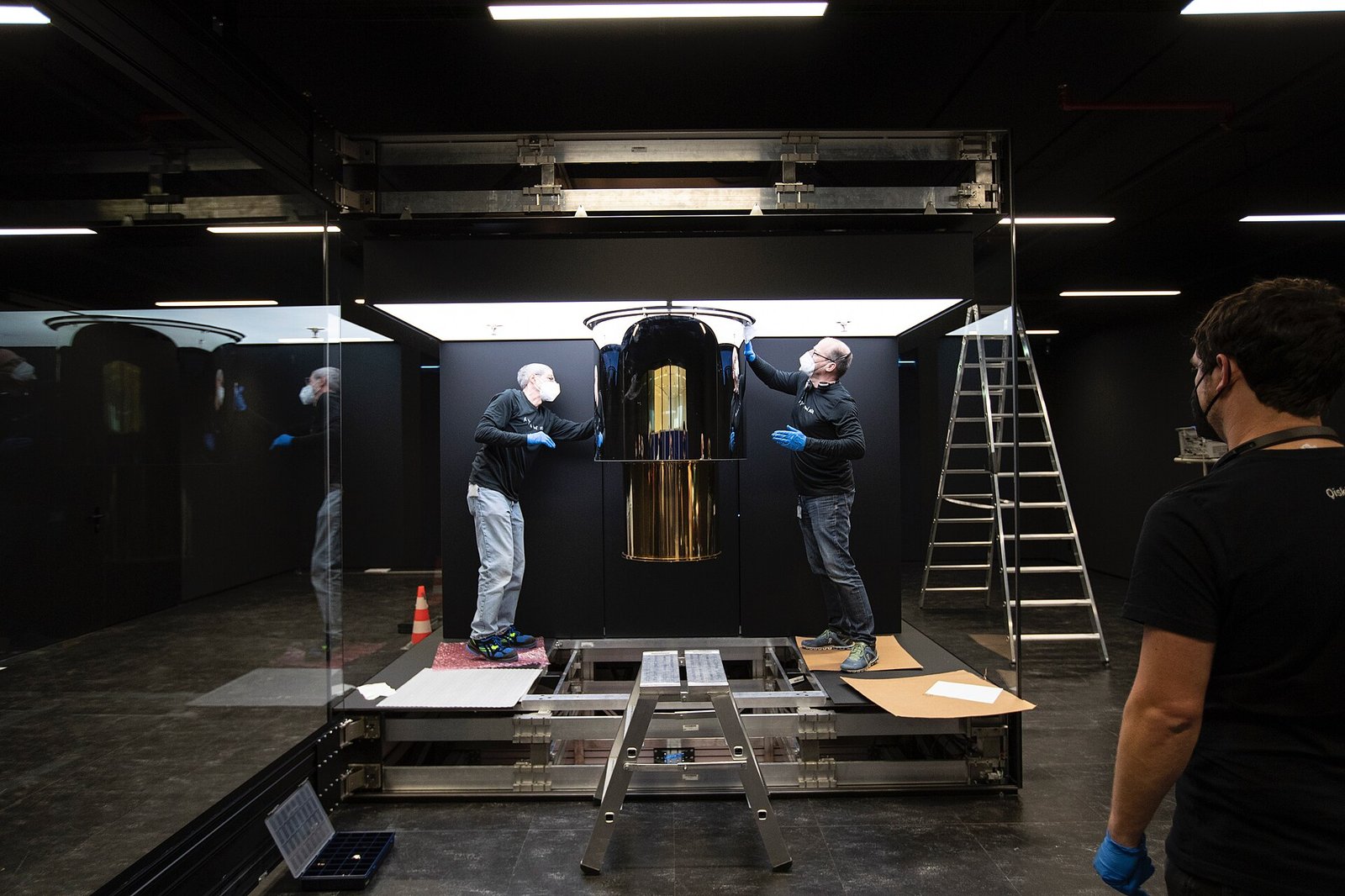
A commercially available quantum processor has completed a computation that its collaborators estimate would take a classical supercomputer about 110 years. IBM’s Nighthawk r2 processor generated one million samples of a random quantum circuit in 19 seconds, according to a preprint posted to arXiv. The experiment ran on a standard cloud-accessible machine, and its authors are describing it as the first demonstration of quantum advantage for random circuit sampling on hardware that most non-expert users can reach and repeat.
Random circuit sampling is the benchmark that launched the quantum-advantage race. A quantum circuit applies a largely random sequence of operations to a set of qubits, producing a state whose measurements are the samples. Producing the samples is easy for a quantum machine; reproducing the same distribution on a classical computer grows harder with every added qubit and operation. Google’s 53-qubit Sycamore processor first claimed the feat in 2019, and classical researchers quickly found shortcuts that narrowed the gap. IBM’s result pushes the field back out in front, and it does so on a machine anyone can rent through IBM’s cloud rather than a bespoke lab instrument. The history matters to the way the result will be read. In 2018, researchers at the University of California, Berkeley, laid out theoretical evidence that random circuit sampling was the task most likely to separate a quantum computer from a classical one, and in 2019 Google’s Sycamore chip ran a version of it that the company said would take a supercomputer thousands of years. Within a few years, classical teams had found ways to reproduce Google’s result on conventional hardware, dulling the claim. IBM’s paper is a direct answer to that cycle: it reports a task performed on a commercial machine, through the standard cloud interface, that no classical shortcut has yet been shown to match.
The specifics matter because they make the claim harder to dismiss. Nighthawk r2 is a 120-qubit superconducting processor with square-lattice connectivity, and the experiment used 61 of those qubits with native two-qubit gates. The paper’s first author, Tigran Sedrakyan, is a theoretical condensed-matter physicist at BlueQubit, an American startup, and the work lists collaborators from several institutions. Running the task through standard cloud execution, rather than a tuned experimental setup, is the point. The authors write that the result is, to their knowledge, the first quantum advantage for a vanilla random circuit sampling task on a broadly accessible processor that non-experts can easily replicate.
The result arrived in the same week that IBM secured a second, longer-horizon bet on the same technology. The Dutchess County Industrial Development Agency in New York approved a tax agreement for a $2.5 billion quantum computing lab at IBM’s existing Poughkeepsie campus, a facility of roughly 300,000 square feet that the company expects to bring online around 2031. The agreement is a 30-year payment-in-lieu-of-taxes arrangement, and it clears a local hurdle for a project IBM has positioned as the research and manufacturing home for its next generation of processors. The town of Poughkeepsie is set to receive a separate $54 million payment as part of the deal.
The two developments point in the same direction. Quantum computing has drawn more than $4 billion in investment this year, and IBM is spending on both ends of the field at once: the processors that produce results today, and the buildings where the next ones will be built. Nighthawk r2 demonstrates what current hardware can do on a narrow, contrived task. The Poughkeepsie lab is a bet that the technology will eventually do something with commercial value, at a scale that requires a dedicated campus rather than a corner of an existing one.
IBM’s longer-term answer to the skeptics is error correction. Sampling results, however large, are still demonstrations on noisy hardware, and the company has said the useful applications in chemistry, materials and finance will require machines that can correct their own errors. The Poughkeepsie lab is where that work is meant to happen at scale. A $2.5 billion commitment to a single campus is the clearest signal IBM has given that it considers the noisy intermediate stage a prelude rather than the destination.
What neither development answers is whether quantum advantage on a benchmark translates into a product. Random circuit sampling has no obvious customer, and IBM’s framing of the result has been careful. The company has spent years working toward error correction and toward machines useful for chemistry, optimization and finance, a much harder problem than sampling. The 19-second run is evidence that the hardware is progressing. It is not yet evidence that the hardware is profitable, and the distinction is one IBM’s own researchers have been careful to preserve in public statements.
Still, the combination of a headline result and a physical commitment is unusual in a field that has spent years promising more than it delivered. IBM has chosen to finance the next stage of quantum computing while its processors are producing numbers, and to do so on the same campus that has anchored its hardware work for decades. The race with Google, and now with a widening cast of startups and national laboratories, is being run on two timelines at once. The 19 seconds and the 2031 completion date are both bets that the gap between what a quantum machine can do in a benchmark and what it can do for a paying customer will close, and that IBM will be the one holding the hardware when it does.