
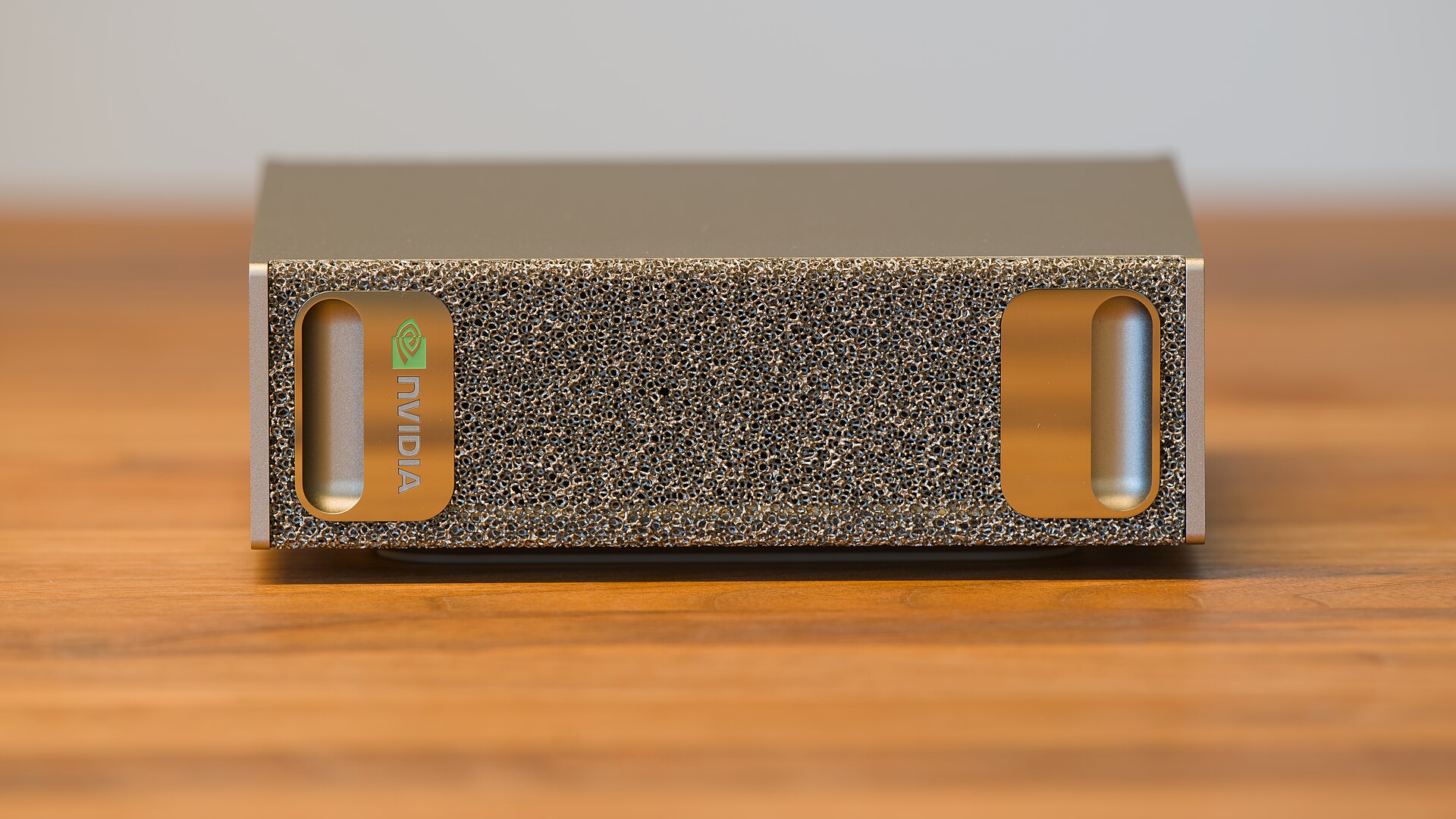
The desktop box Nvidia sells to developers now comes in a second size. On October 2, the chip maker added a 64-gigabyte version of its DGX Spark, a compact AI computer built for engineers who want to run models on their desks instead of renting time in a data center. The new configuration starts at $4,999 and reaches customers on October 23 through Acer, Asus, Dell, Gigabyte, HP and MSI.
The 64GB Spark is a price play. Memory has been climbing in cost, and Nvidia said the tier is meant to keep developers with thinner budgets from walking away while prices stay high. Two of the smaller machines can be linked with ConnectX-7 networking to behave like a single 128GB unit, which softens the trade-off for buyers who want to start small and expand later.
DGX Spark has been Nvidia’s attempt to shrink a data center into a box small enough for a home office. The machine pairs the company’s Grace Blackwell platform with enough memory to run substantial models locally, and Nvidia has marketed it to the programmers and researchers who would otherwise rent the same power from a cloud. Adding a cheaper tier extends that pitch to a buyer the company does not want to lose during a memory price cycle.
The same day, the company’s grip on the market was visible from the other direction. Cerebras Systems, the AI chip startup that has spent years positioning itself as the alternative to Nvidia’s GPUs, saw its shares fall nearly 20% on the week to their lowest level since the company went public, CNBC reported.
The trigger was a short post on X by SemiAnalysis, the semiconductor research firm. It said OpenAI’s GPT-6.1 Sol Ultrafast, the high-speed reasoning tier OpenAI had unveiled days earlier, is running on Nvidia GPUs at a low batch size rather than on Cerebras chips. The claim cut at the center of Cerebras’s pitch.
Cerebras makes a plate-sized chip, the Wafer-Scale Engine, that holds an entire neural network on a single piece of silicon. The design is built to serve models fast, because data does not have to shuffle between hundreds of separate GPUs. That speed was the reason Cerebras landed OpenAI as a customer. Cerebras has described OpenAI as its largest customer by committed revenue backlog, and the company had said it would power the Ultrafast tier of an earlier model, GPT-5.6 Sol, at 750 tokens per second.
SemiAnalysis’s report put that relationship in doubt. Running GPT-6.1 Sol Ultrafast at a low batch size on ordinary GPUs, the post argued, meant OpenAI had found a way to get the speed it wanted without Cerebras’s silicon. If Nvidia’s hardware can handle the latency these new reasoning models demand, the case for a specialized chip gets harder to make to the next customer. Nvidia’s software ecosystem, built around its CUDA platform over more than a decade, gives the company an advantage rivals have to spend years unwinding.
Investors drew the conclusion quickly. Cerebras had a difficult run as a public company, and the shares have spent much of their history below the $350 IPO price. The selloff this week was compounded by another force: the expiration of a lockup period, which freed early investors and insiders to sell shares they had been required to hold since the listing.
The two companies are now moving in opposite directions for the same underlying reason. Nvidia keeps finding ways to hold its GPUs at the center of the AI buildout, from the data center down to a box on a developer’s desk. Cerebras keeps having to prove that a different kind of chip earns a durable place next to them.
Nvidia’s budget Spark is a small piece of that picture, but it signals where the company thinks the pressure is. As memory prices rise, the developer who buys one machine today is a customer Nvidia wants to keep inside its ecosystem tomorrow, rather than lose to a cheaper rival or a cloud rental. The company said as much when it explained the new tier, framing it as a way to keep budget-conscious developers in the fold while memory costs run hot.
That framing matters because the memory market has tightened as AI data centers absorb supply that once went to phones and PCs. When the cost of DRAM rises, the bill for every machine that carries a lot of it rises too. A 128GB desktop box gets noticeably more expensive to build, and Nvidia’s answer is to offer a smaller, cheaper version rather than ask the buyer to pay more or wait.
For Cerebras, the week showed how quickly a single large customer can move the stock in both directions. The company has argued that fast inference is a growing market that will reward more than one chip design, and it has pointed to a pipeline of customers beyond OpenAI. What this week showed is how quickly the market reprices that bet when a report suggests the biggest customer has taken its fastest model somewhere else.
Nvidia added a product at the low end while investors punished a rival at the high end. Both moves tell the same story about a chip industry in which Nvidia’s position keeps widening, and every challenger’s share price carries the weight of a customer list rather than a product road map.



