
The most valuable chips in an artificial-intelligence server sit on top. Beneath them lie green slabs of circuitry called substrates, the package boards that connect a graphics processor to the rest of a machine. On Tuesday, Samsung’s components arm said it would spend nearly $5 billion to make more of them, a quiet bet on the part of the AI stack that no one photographs.
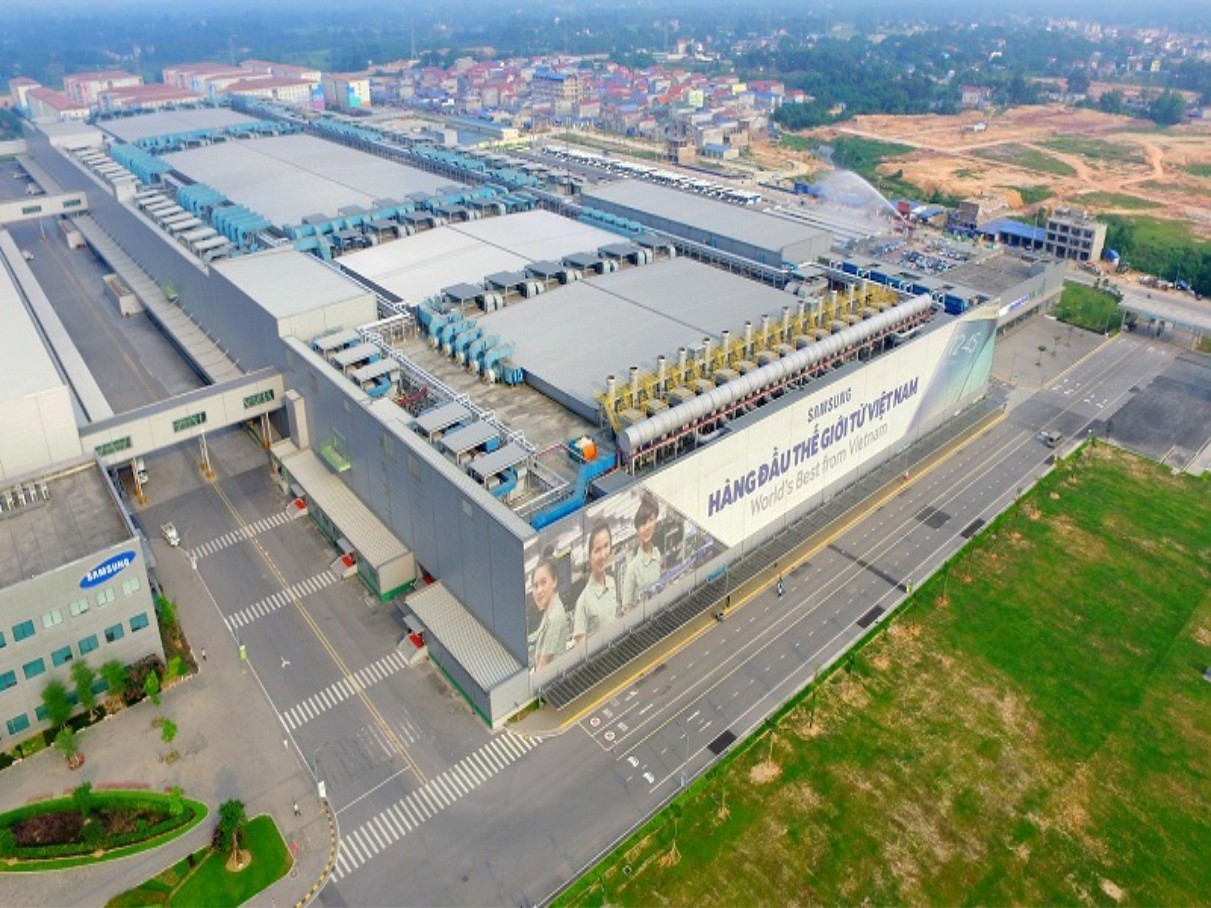
Samsung Electro-Mechanics, the electronics subsidiary of the Samsung group, announced a combined 6.78 trillion won, about $4.9 billion, in new substrate capacity across South Korea and Vietnam by 2028. Roughly 4.27 trillion won, about $3.1 billion, goes to its Sejong plant in Korea, the company’s largest investment in a single product line. The remaining 2.51 trillion won, about $1.9 billion, is earmarked for its Vietnamese subsidiary in Thai Nguyen province, where a new line is targeted to begin operations in June 2030.
The product at the center of the spending is the flip-chip ball-grid-array, or FC-BGA, substrate, a highly integrated board that carries electrical signals and power between a chip and a mainboard. These substrates are used in AI accelerators, graphics processors and server central processors, and demand for them has climbed with the same curve as the data-center build-out.
Chipmakers can design the most advanced processor in the world and still find themselves waiting on the board that carries it. Substrate shortages have throttled production before, and the companies that control packaging materials have quietly become some of the most powerful in the supply chain. The investment, reported by Nikkei Asia, lands at a moment when the highest-value substrates are rationed across the industry.
Vietnam’s role in the plan is the part that carries the wider meaning. The country has been Samsung’s manufacturing center for years, producing roughly half of the group’s smartphones along with a large share of its components. That work has long sat at the assembly end of the value chain, where labor costs matter most. Substrates are different: they are precision components that sit closer to the top of the supply chain, and putting them in Vietnam moves the country one rung up.
Samsung’s relationship with Vietnam runs deep. The group began building phones in Bac Ninh province in 2008 and has since made the country its largest manufacturing base outside Korea, employing more than 100,000 workers across plants that assemble most of its smartphones. That scale has made Vietnam central to Samsung’s global output, but the work has tilted toward assembly, where the value added per unit is thin. The substrate expansion is aimed at a different rung.
The company signaled that the shift is deliberate. Its Vietnamese unit has been designated a strategic overseas production base for meeting global customer demand, and the group framed the investment as built on medium- and long-term cooperation with global technology and semiconductor companies. A plant in Thai Nguyen began large-scale FC-BGA operations in 2024, and the new spending expands that footprint.
Samsung Electro-Mechanics is spending from a position of demand rather than experimentation. AI servers consume more substrates per machine than earlier generations, and the highest-value substrates are in short supply as chipmakers rush to add capacity. Chang Duck-hyun, the company’s chief executive, said the move should strengthen its position in AI, servers and automotive electronics.
The Korea-Vietnam split also tells a story about how global manufacturers are hedging. The company is not choosing one country over the other; it is building in both, with the flagship plant in Sejong and the overseas line in Thai Nguyen. In a period when tariffs and rules on where components are made keep shifting, spreading production across two countries is a way to keep supply stable no matter how the trade map is redrawn.
That logic now extends to Vietnam. The country has spent years courting the kind of investment that lifts it beyond final assembly, and Samsung’s substrate expansion is the clearest sign yet that the courting is working. A nation that once screwed phones together is now being trusted with the boards that hold the AI era’s most expensive silicon.
The shift is not happening in isolation. Vietnam has positioned itself as the emerging manufacturing hub of the region, and governments across Southeast Asia are competing for exactly this kind of investment, the sort that builds technical capability rather than just factory floors. Samsung’s choice to put substrates there sends a signal other suppliers will read closely.
For Samsung, the investment is also a response to a constraint closer to home. The group’s memory business, Samsung Electronics, is one of the world’s largest, and its components arm has been pushed to keep pace as AI servers pull more of every kind of chip. The $5 billion is a wager that the substrate will keep mattering, and that whoever controls the boards beneath the chips controls a bottleneck the market has only begun to price.



