
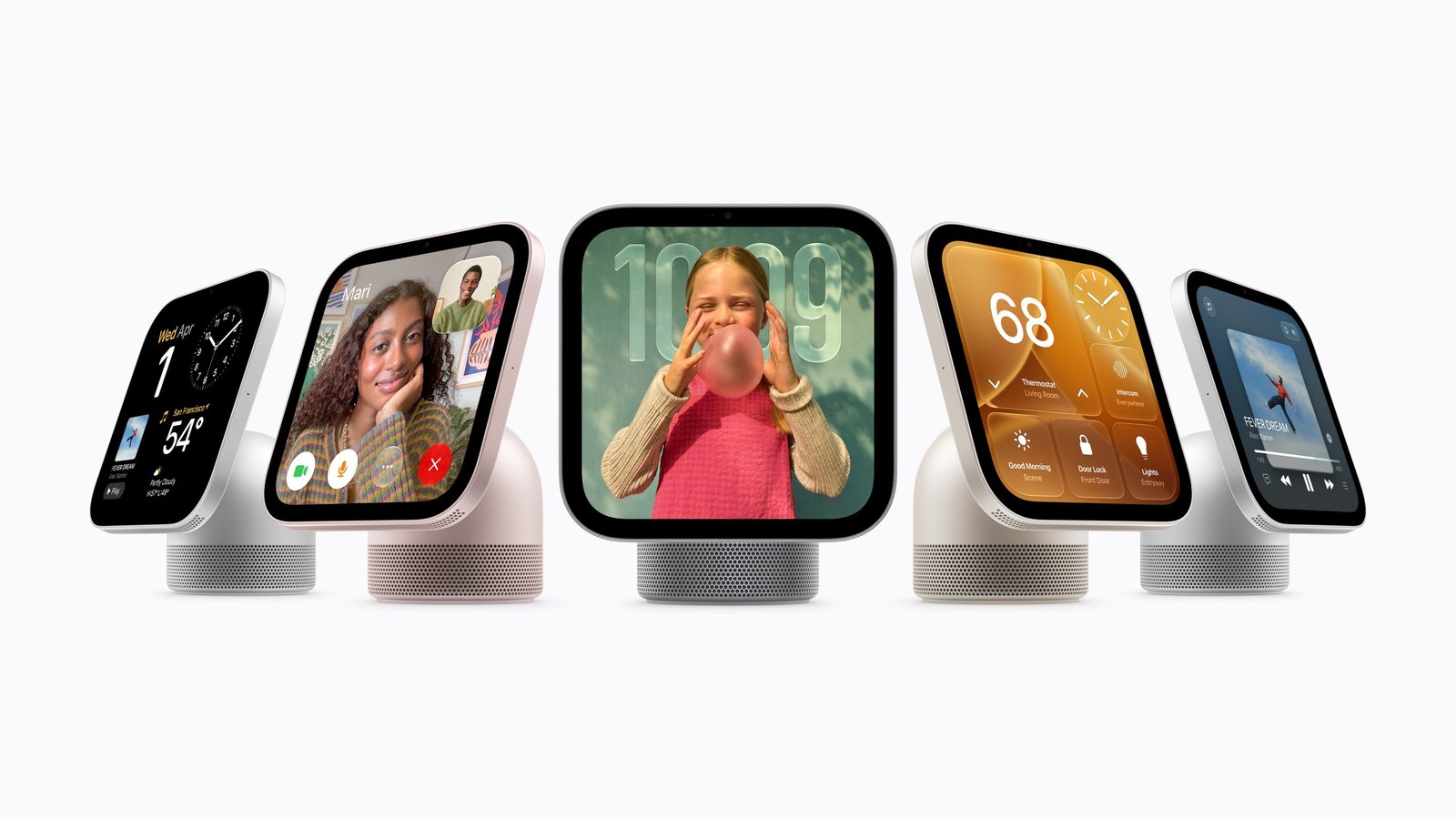
Apple introduced a screen for the household on October 13, its first device built to sit on a kitchen counter rather than in a pocket, and priced it at $299 with a November 13 ship date.
The product is called HomeView, a 7-inch device,. It runs a Liquid Retina touchscreen driven by the new Siri, the version of the assistant built on Apple Intelligence and the company’s own silicon. Apple will sell two versions at the same price, one that sits on a surface and one that mounts on a wall, and neither will run apps from the App Store.
The hub arrives with companions. Apple refreshed the Apple TV 4K at the same event in New York and brought out a second-generation HomePod mini at $149, which is $50 more than the model it replaces. Locks, thermostats and video doorbells now sell under the Apple Home Collection label, made by partners and sold by Apple. It is the first time the company has treated the home as a product category rather than a set of accessories attached to the iPhone.
“Apple HomeView is designed to be shared by everyone in the home yet feel completely personal to each user,” Greg Joswiak, Apple’s senior vice president of worldwide marketing, said in the announcement.
The personal part is where the engineering went. HomeView recognizes as many as six members of a household by face and gives each one a separate home screen with their own widgets and apps. Messages, FaceTime, Calendar, Reminders and Find My stay hidden from everyone else. To surface that content for a signed-in user, the device requires both a recognized face and a paired iPhone or iPad that is nearby and was recently unlocked. Siri requests run either on the device or on Private Cloud Compute, Apple’s system for handling queries on its own servers without retaining them.
Analysts said the pairing requirement is a direct response to the most obvious objection to a camera-equipped screen in a shared room: a household device that greets one person by name while another walks past is a device that has to prove it knows who it is talking to. Amazon and Google have taken a looser approach with their own displays, and both companies sell advertising, a business Apple does not have to protect here.
That contrast is the pitch. Apple does not need HomeView to show ads, because it earns from hardware, services and the subscriptions people attach to an account. A hub that collects household routines is more valuable to Apple as a reason to keep the household inside its ecosystem than as an inventory for advertisers, which is also why the device does not need an app store to be worth owning.
The category history is not encouraging. Amazon’s Echo Show and Google’s Nest Hub have been on sale for years, competing largely on price, and neither has produced demand at the scale of the phone or the television. Households that bought one often used it as a clock, a photo frame and a music speaker, which is a set of jobs an iPhone and a HomePod can already cover. Apple is asking $299 for a device whose rivals start near $100, and the difference has to be visible every day to be worth paying.
There is a second question about the HomePod mini, which now costs $149 after four years at $99. Apple rarely raises prices on shipping products, and the move lands while component costs are climbing. Memory prices have risen through the year as AI data centers absorb supply from the same fabs that make consumer chips, and analysts said that pressure shows up first in devices with small margins and small price tags. If a speaker went up by half, the company’s pricing decisions in the next product cycle are worth watching.
Apple’s hold on the home has been uneven. HomeKit shipped in 2014 and never became the default automation layer, partly because accessory makers found Amazon’s and Google’s systems easier to support. The install base of iPhones is the asset the company has not used well, and HomeView is an attempt to convert it: the hub runs the automations, the phone signs in the user, and the accessories come from the same store.
Rivals will not stand still. Amazon’s displays are cheap and its assistant works on far more devices; Google’s hub connects to a larger set of cameras and doorbells. Apple’s argument rests on privacy, integration and the new Siri, and the last of those carries the most risk. The assistant has been the weakest part of Apple’s software for years, and the company has now put it in charge of the room.
What to watch is measurable. First, whether HomeView ships on November 13 in volume or slips, which would say something about the screen supply. Second, how accessory makers respond to the Apple Home Collection, since a hub without devices to control is a photo frame with a better assistant. Third, whether the new Siri arrives in markets beyond the four countries where the feature set launches, because a household device that speaks one language and works in one region cannot carry a category.
Apple has spent a decade selling hardware that fits in a hand or a bag. HomeView is the company’s attempt to sell one that stays put, is used by everyone in a house and is replaced less often. At $299 and a fifty-dollar increase on the speaker beside it, the bet is that the price of privacy and integration is one that households will pay to stop thinking about which button turns the lights on.



