
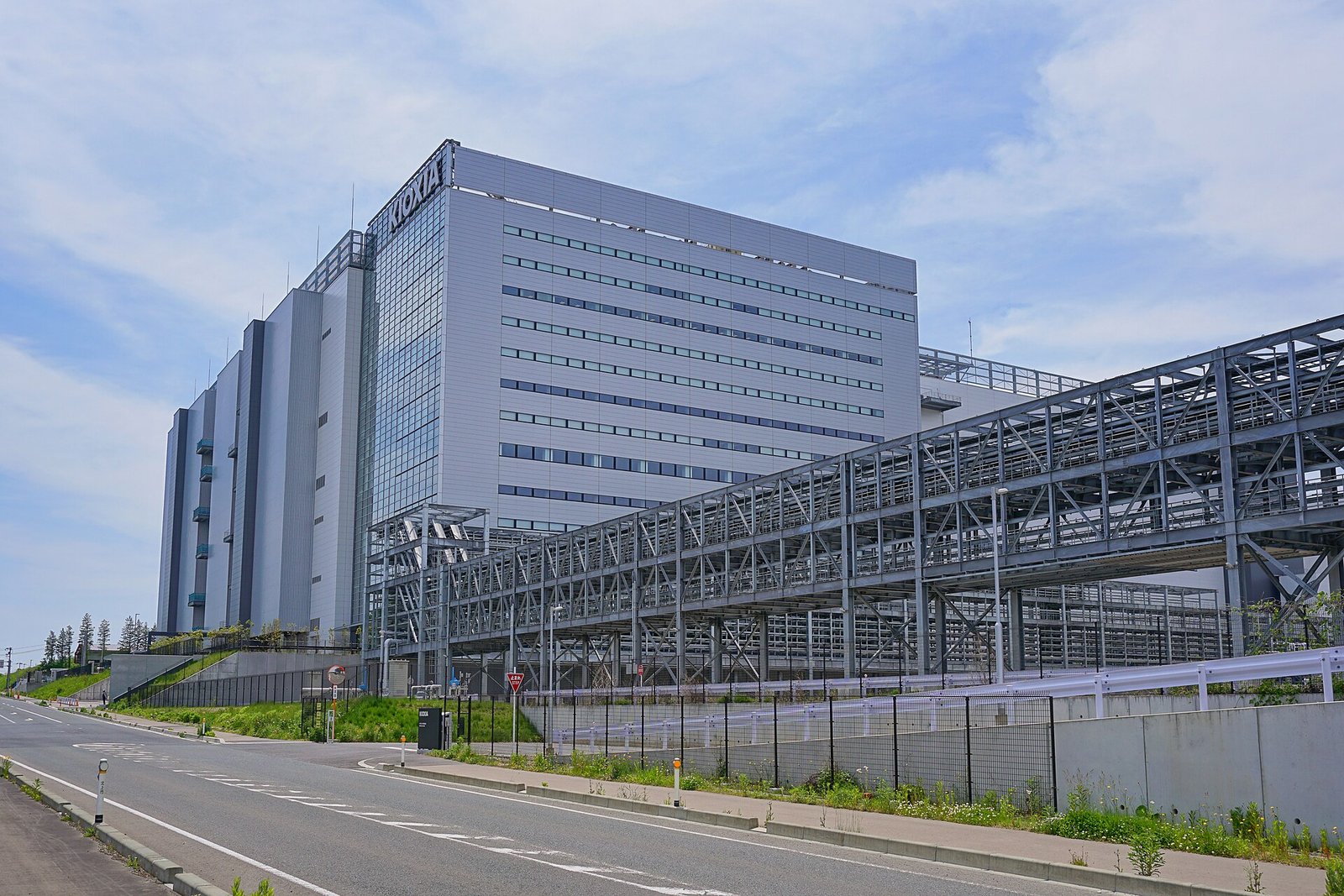
For most of its short life as a separate company, Kioxia Holdings was the debt-heavy remnant of Toshiba’s memory business, carrying debt from a buyout and the memory industry’s habit of destroying capital. On October 13 it moved into the investment-grade column.
S&P Global Ratings raised its long-term issuer credit rating on Kioxia to BBB from BBB-, with a positive outlook. Kioxia, a maker of NAND flash memory and the solid-state drives built from it, listed in Tokyo in December 2024. The earlier rating action in May 2026 had taken the company to BBB- from BB+.
The rating now rests on earnings rather than on the balance sheet alone. S&P expects Kioxia’s earnings before interest, taxes, depreciation and amortization to reach 7 trillion to 8 trillion yen in the fiscal year ending March 31, 2027, and about 9 trillion yen the following year. For comparison, the same measure was 1.1 trillion to 1.2 trillion yen in the year that ended in March 2026, and S&P’s previous forecast for the current year was about 6 trillion yen.
Prices explain most of the revision. Enterprise solid-state drive prices rose about 35% in the second half of 2025, according to TrendForce, and the research firm projects a cumulative increase of roughly 235% across 2026. Kioxia’s own investor presentation cited estimates that the NAND market’s revenue would be about four times larger in 2026 than in 2025, with the trend continuing into the following year.
Demand is coming from a specific place. Data center demand for storage is expected to grow at a rate near 46% a year through 2028, and demand tied to AI inference, the work of running a trained model rather than building one, is growing faster still. Kioxia has said it aims to lift the share of revenue it draws from data center products above 60% by the fiscal year ending March 2028.
The balance sheet has changed with the earnings. The company reached a net cash position in mid-2026, meaning its cash and deposits exceed its debt, and it has been buying back shares. Capital spending is climbing in step: 450 billion yen planned for the current fiscal year, against 280 billion yen the year before, with average annual spending of about 470 billion yen over three years. A new production facility is targeted for the fiscal year ending in 2029.
Contracts are the part of the story that S&P cares about most. Kioxia wants long-term agreements to cover roughly half its projected shipment volume for 2028, up from the one-year contracts that have governed most sales in the industry. Chief executive Hiroo Ota has said some of the largest technology companies in the world are seeking supply agreements that stretch as far as 2030. He has also told his sales teams not to press data center customers for much higher prices, on the view that pushing costs too far could cool the investment that is funding the demand.
That restraint is unusual for a memory maker in a tight market, and it says something about how the industry now reads its own history. Memory has punished the companies that chased peak prices with new capacity, and the participants know it. Long-term agreements with volume commitments and guaranteed floors could reduce the amplitude of the cycle that has wiped out repeated generations of memory earnings.
The positive outlook names the conditions for a further upgrade, and they are demanding. S&P wants the memory market to avoid a significant downturn in the fiscal years ending 2028 and 2029 even as producers add capacity, continued growth in the market serving artificial intelligence, and confidence that long-term agreements genuinely reduce earnings volatility. The same research note flags two risks that sit outside Kioxia’s control: capital spending cuts by the large cloud operators that buy its drives, and new supply from state-backed Chinese competitors.
History argues for caution on the contract defense. Long-term agreements existed before the downturns of 2019 and 2023, and they did not prevent prices from collapsing when too much capacity came online at once. What makes this cycle different, according to the analysts who have raised their estimates, is that the buyers are the same companies building data centers, and their procurement is tied to multiyear construction plans rather than to consumer demand for televisions and phones.
Kioxia’s share price will move on memory prices whatever the rating says. The upgrade gives it cheaper access to debt for the capacity it is adding, and the positive outlook tells lenders that the rating agency expects the improvement to persist. Whether it does depends on two things the company cannot control: how much capacity the industry brings on, and how long the buyers keep spending. The rating is a bet that both stay favorable, made by an agency that has watched this market turn before.



