Josh Weissman, the Amazon Web Services executive who runs data center capacity delivery, began with where he lives. He has children in Loudoun County schools, he said, and his company employs 3,400 people there. “We’re not blind or deaf to the concerns and the feedback that has been shared with us about the development on that campus.”
Then he said Amazon would not build on it. Under an agreement with the county announced October 20, AWS will withdraw its application for four data centers and three parking garages, about 800,000 square feet, on the former George Washington University Virginia Science and Technology Campus north of Ashburn. The settlement is dubbed Project Potomac Promise.
The terms go beyond a withdrawal. Amazon will not sue the county over its opposition to the project, a concession that matters because the county had signaled for months that it believed it held a strong legal case. Amazon will give 25 acres to the county, land with a fair market value of about 65 million dollars, for a community arts center and an indoor sports facility. It will put 5 million dollars into the county’s housing fund. The application comes out by the end of the month, and the county will fast-track a rezoning for housing and mixed-use development on the property. George Washington University can stay on the site for up to five years.
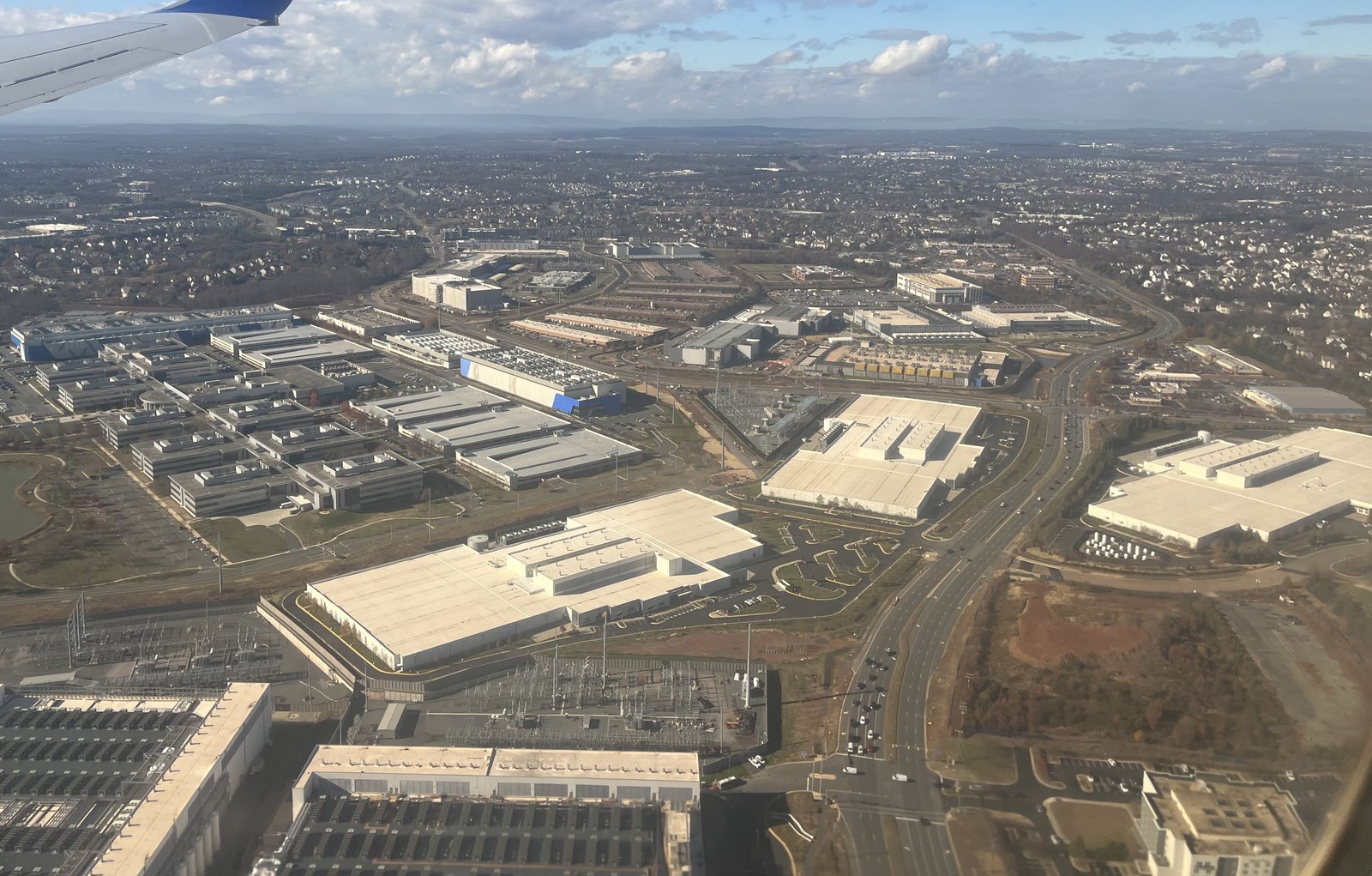
The land has been in play since March, when Amazon Data Services bought the 122-acre campus for 427 million dollars. The university had been shrinking its footprint in Ashburn for years, and the parcel sat within a few miles of the densest cluster of data centers on earth.
Loudoun County holds roughly 250 data centers that are operating or under construction. Industry groups estimate that about 70 percent of the world’s internet traffic passes through the stretch around Ashburn known as Data Center Alley, where transatlantic fiber lands and where wholesale power is cheap enough to run buildings full of servers. Land along that fiber has traded at prices that would be unusual for farmland anywhere else in Virginia.
The proposal ran into months of opposition. Students and faculty objected, as did nearby residents and several members of the Board of Supervisors. The complaints were specific: a high-pitched whine from cooling equipment that carries across subdivisions, transmission lines and substations, water consumption for evaporative cooling, and the effect of data center payrolls on local housing costs.
That opposition is no longer isolated to one parcel. This fall the board tabled a proposal that would have stripped existing approvals from 15 data center projects in the county, lacking the votes to pass it. Similar fights have played out in Prince William, Fauquier and Henrico. In Richmond, legislators have filed bills on siting, water use and disclosure. The politics have moved faster than the industry’s permitting calendar.
Power prices gave the argument a number. PJM Interconnection’s capacity auction for the 2025-26 planning year cleared at nearly nine times the prior year’s price, and Virginia regulators have since fielded complaints about the share of that increase attributable to data center load. A county that hosts the servers does not always capture the revenue that covers the grid upgrades they require.
For Amazon, the arithmetic of walking away is less expensive than it looks. Eight hundred thousand square feet is a mid-sized campus by current standards, where individual AI buildings run past a million square feet. What the site offered was proximity: fiber routes, substations, and a labor pool that already knows how to run a data hall. Those advantages can be replicated on other parcels in the same corridor, and Amazon has been buying them across Northern Virginia for years.
What the company avoids is precedent. A zoning fight it lost, or won narrowly on appeal, would have shaped how every other Virginia locality treats its applications. A negotiated exit with a land donation and a housing check costs a fraction of a delayed campus and leaves the company’s relationships with the board intact. Weissman said his team approached Board of Supervisors Chair Phyllis Randall with the idea, rather than the other way around.
For the county, the deal converts a lawsuit into a park and a housing subsidy, and it establishes a template: opposition, then negotiation, then a payment in land and cash. That template will now be applied to the next applicant. Supervisors in other counties have already begun asking what a developer is prepared to contribute before a vote, which raises the cost of entry for smaller operators who cannot absorb a 65 million dollar donation.
The capacity will still get built. Amazon has not said where, and it rarely does before a site is assembled, but the demand behind those four buildings has not changed. It will land on parcels where the planning commission is more agreeable and the neighbors are fewer, which is the outcome the county’s opponents of the project did not fully intend. The tract north of Ashburn will hold a gymnasium and an arts center. The servers will be somewhere else, and someone else’s board will vote on them.