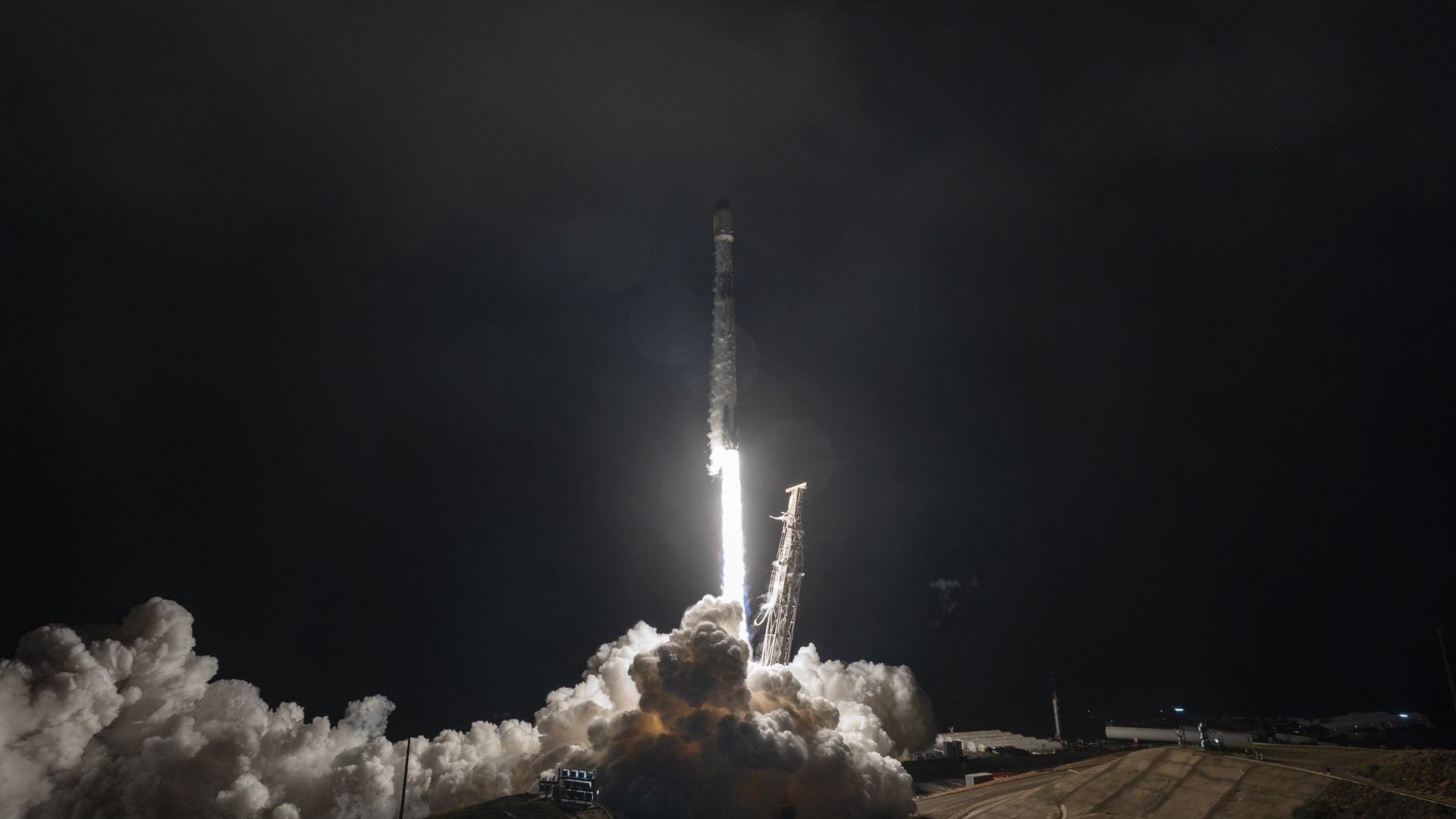
On Friday night a Falcon 9 lifted off from Space Launch Complex 4 East at Vandenberg Space Force Base in California carrying 27 Starlink satellites. The first stage, a booster designated B1093, was making its 18th flight. It came back down on a droneship in the Pacific called Of Course I Still Love You, and SpaceX later confirmed that all 27 satellites had deployed.
It was the 700th flight of a Falcon 9, according to a count maintained by Spaceflight Now. The most frequently flown orbital rocket in history reached that number on a routine Starlink mission, at night, with no customers aboard, which is more or less how it has spent the past few years.
The contrast arrived two days earlier. Fortune reported on October 30 that SpaceX has begun turning away some commercial customers who want Falcon 9, and that a handful have paid more to hold the remaining slots. The company is moving staff toward Starship, the vehicle it intends to fly instead. The rocket that made SpaceX the world’s dominant launch provider is now the one being wound down, and its replacement is not yet flying paying missions at anything like the same rate.
Falcon 9’s record was built on a simple proposition: fly often, land the booster, fly it again. The first test flight came in 2010, after NASA, facing the retirement of the space shuttle, awarded contracts to private companies to resupply the International Space Station. A Dragon capsule reached the station in 2012. In December 2015 a booster came back and landed upright for the first time, which turned the first stage from scrap into an asset. Boosters now fly 18, 20, sometimes more than 20 missions each.
By 2025 the arithmetic had become lopsided. SpaceX flew 165 Falcon missions that year, and more than half of the roughly 330 flights to low Earth orbit worldwide were Falcon 9. Sixteen years of operations produced a catalog of payloads that would once have been uninsurable: Earth-imaging satellites feeding map applications, environmental sensors tracking wildfires, and the capsules that carry NASA’s astronauts.
That last category is the one that complicates the transition. Crew-13 lifted off on a Falcon 9 from Cape Canaveral on October 1. NASA has no second American vehicle certified for crew apart from the one Boeing has struggled to bring into service, and none of the rockets that might eventually compete with Falcon 9 carries people today.
Starship is the plan. The vehicle has moved through successive versions and, on its fourteenth flight, deployed Starlink satellites from the upper stage for the first time, a step that matters more than the spectacle of the landings. SpaceX has said it will retire Falcon 9 once Starship is operating regularly, and Gwynne Shotwell, the company’s president, has pointed to early 2028 for direct-to-cell service carried on SpaceX’s own spectrum. Nothing in that timetable obliges Starship to match 165 flights a year.
The commercial cost of the gap falls on customers with small budgets and fixed schedules. A rideshare slot on a Falcon 9 has been the cheapest route to orbit for a decade, and the price depended on cadence: the more flights, the more chances to hitch a ride, the lower the cost per kilogram. A startup that planned a demonstration mission for 2027 on the assumption that a slot would be available now has to price a delay, or find another rocket.
The alternatives are thin. Blue Origin’s New Glenn has flown, but not often. Rocket Lab’s Neutron, United Launch Alliance’s Vulcan and Europe’s Ariane 6 are new, partly booked, or both, and none of them is positioned to absorb the smallsat traffic Falcon 9 has been carrying almost by itself. Launch capacity is not a commodity that appears when demand does; it takes years of production, integration and range scheduling to grow.
Geography is part of the problem. Falcon 9 flies from two coasts, with pads at Cape Canaveral in Florida and here at Vandenberg, which is what lets SpaceX serve both the equatorial and polar markets on short notice. Starship flies from Starbase in Texas, where the company stacked a vehicle at a second pad in September, and its Florida site is still under construction. One working site limits the trajectories a rocket can fly and the number of launches that weather and range scheduling will allow in a given month.
SpaceX has been here before, in a sense. Falcon 9 was once the unproven newcomer that incumbents dismissed, and its middle years included two failures fourteen months apart, one in flight and one on the pad during a test, each of which grounded the fleet for months. The difference now is that the company is asking the market to move to a vehicle that has not yet demonstrated the cadence, not merely the capability.
For the moment the manifest is still full. Starlink flights continue at a rate of several a week, NASA’s cargo and crew missions are contracted, and the company has not published a date for the last Falcon launch. The 700th flight, in that light, is less a farewell than a marker of how much work the transition has to replace: 27 satellites at a time, 18 flights on a single booster, and a customer list that is being told, politely, to wait.