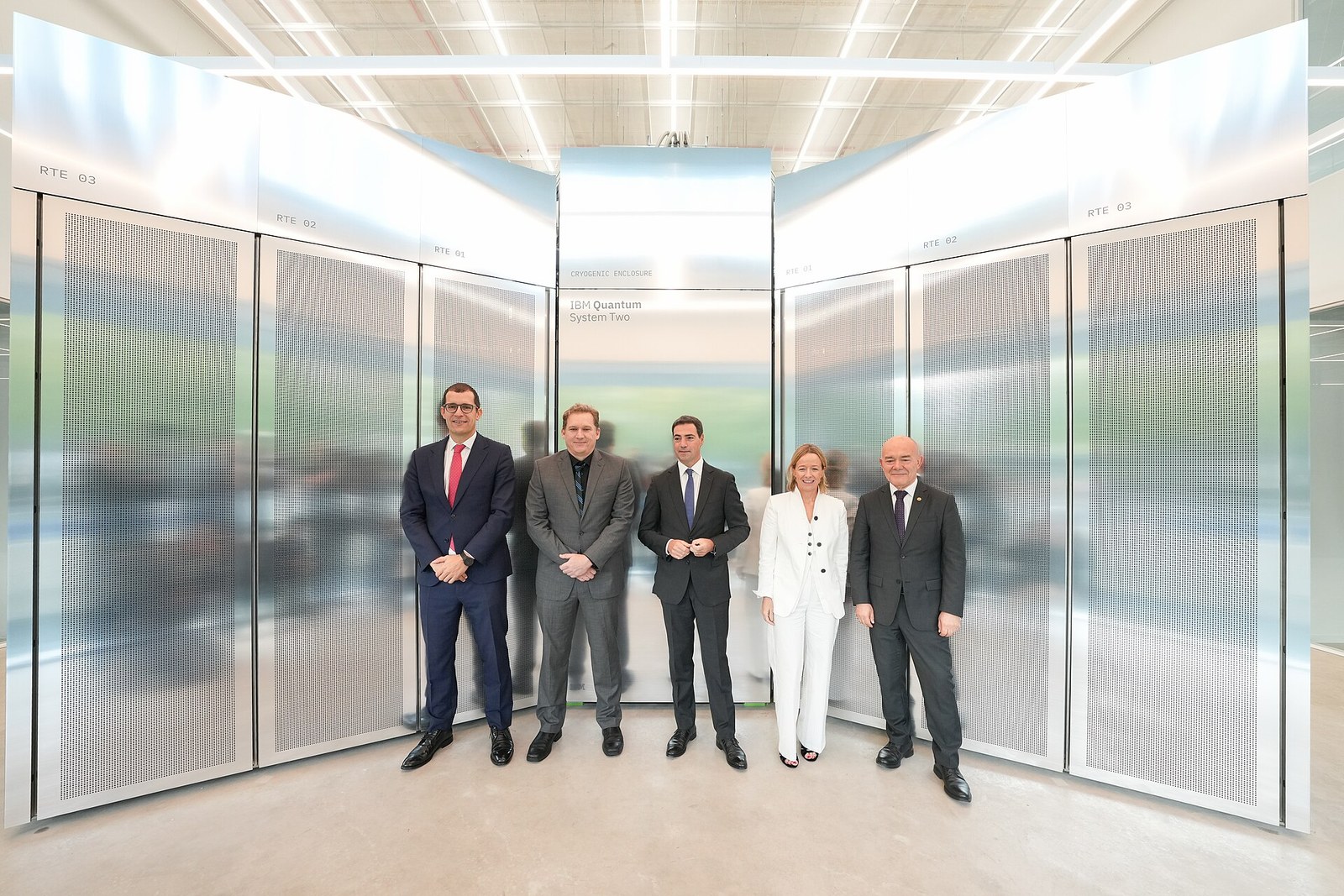
The machine arrives in pieces. A dilution refrigerator the height of a small room, racks of microwave control electronics, a cooling plant, and a stack of shielding that has to be assembled on site because it will not fit through a door. Commissioning takes months before the first experiment runs, and the building has to be prepared for floor loading, vibration and a power draw that no ordinary lab was designed around.
That is why IBM’s announcement on Nov 6 was a real-estate story as much as a computing one. The company inaugurated a Quantum System Two at Hyde Park Labs, on the University of Chicago’s campus, the first quantum computer it has installed in Illinois and the most advanced model it currently makes. It will serve quantum researchers and industry customers in the Chicago area, tied to state and university programs already built around the technology.
The physicality is the part that cloud computing has trained people to forget. A developer who reaches a quantum processor through an API is leasing time on a cryostat somebody else paid for, in a building somebody else reinforced. The service hides the machine. It does not remove the need for one, and the number of these machines in the world is small enough that where they sit determines who gets to run experiments first.
The physics explains the concentration. Superconducting circuits operate at temperatures colder than interstellar space, which means the entire processor sits inside a refrigerator that consumes more power than the chip it cools. Electromagnetic interference has to be filtered at every stage. Mechanical vibration from a passing truck can show up as noise. None of that survives a rack in a shared server room, so quantum hardware clusters in purpose-built facilities, usually on campuses where the electrical and mechanical engineers who keep them running already work.
A university is the natural host for a second reason. The instrument is a shared one, closer to a synchrotron or a telescope than to a server. Access is allocated, not purchased in unlimited quantity, and the allocation process shapes what gets studied. A lab that can iterate on a calibration problem within a day will produce different work than a lab that books time in two-week blocks, and the difference shows up in the literature two years later.
The state programs matter for the same reason they matter at semiconductor fabs. Illinois has been assembling a quantum cluster around the university, and a machine from the largest vendor gives that cluster an anchor tenant. Politicians like the ribbon because it is visible and because the alternative uses of the money are diffuse. Companies like it because proximity to hardware is how a region builds a workforce that can operate hardware, and the workforce is the actual scarce input. There is no meaningful oversupply of people who can tune a superconducting qubit.
For industry customers, the value proposition is less settled. A company that wants to test whether a quantum algorithm will eventually beat its classical pipeline needs access to a machine good enough to run the algorithm at a scale where the answer means something. That is a research budget line, not a production one, and the number of firms with a credible near-term use case remains small. Most of the installed base runs experiments whose results are published rather than shipped.
The label on the machine has a shelf life, too. Most advanced is a claim about a moment, and IBM refreshes its systems on a cadence that has been running for years. The machine inaugurated this week will be the flagship for a while and then will be the workhorse, and then will be the machine that a postdoc uses for calibration studies because the queue for the new one is too long. That is not a criticism. It is how instruments age, and institutions that host them plan for the second and third generation, not the first.
There is a harder limitation, and it is the one the announcement does not address. The usefulness of a quantum processor is bounded by its error rate, and the algorithms with the largest theoretical advantage require error-corrected logical qubits that consume many physical ones. A machine can be the most advanced of its generation and still be a long way from the threshold where the advantage becomes practical. The experiments that matter in the near term are the ones that measure how close that threshold is, not the ones that claim to have crossed it.
That is why the research customers come first in the company’s description of who the machine is for. Industrial users with a specific optimization problem will be disappointed by the size of the problems current hardware can hold. Academic groups studying error correction, materials and control will not be, because their subject is the machine itself, and a better machine is the point of the work.
Whether this installs a durable advantage for Chicago depends on things a press release cannot show: how many groups get time, what they publish, and whether the students who learn on the system stay in the region. The machine is a fixed asset with a depreciation schedule. The cluster around it is the part that compounds, and it compounds only if the access policy is generous enough to make the facility a habit rather than a photo opportunity.
IBM has installed machines like this before, in other states and other countries, and the pattern is consistent. The first year produces a wave of demonstrations and a queue of proposals. The third year produces the papers that decide whether the investment was worth it. Chicago’s clock starts now, and the first thing it will be measured on is not how many qubits the system holds but how many researchers can say they used it.