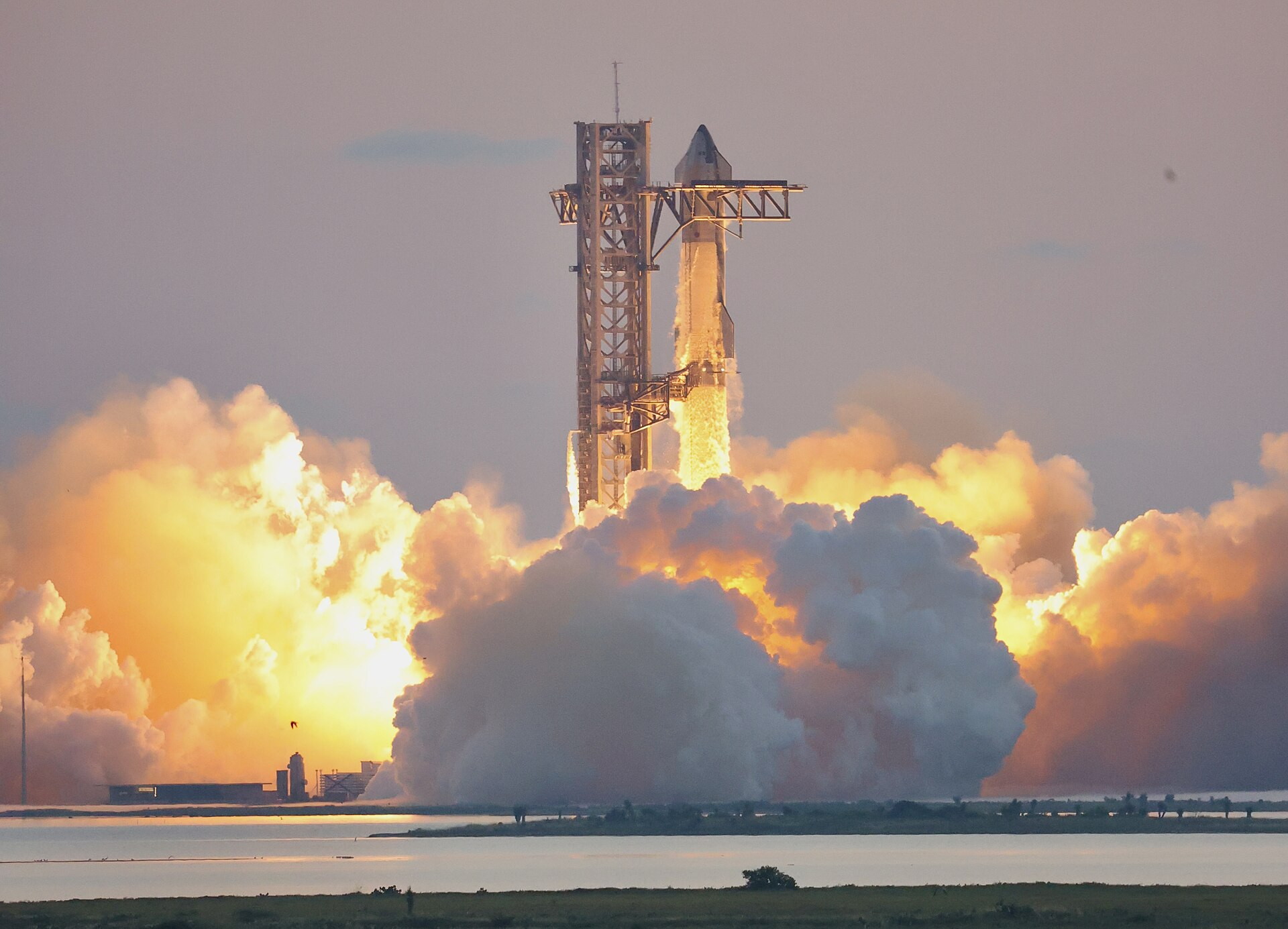
The catch arms on the tower at Starbase, in south Texas, have closed around a returning Super Heavy booster before. They have never closed around the ship that goes to orbit. On Nov. 13, SpaceX intends to bring both back to the same pair of arms on a single flight, the maneuver the company treats as the final step before Starship becomes a reusable vehicle rather than an expendable one.
The flight, the 15th of the program, will use Booster 22 and Ship 42, both Block 3 vehicles that have completed ground static fire tests, according to the company. Liftoff is set for Orbital Launch Pad 2. SpaceX has not published a window length or a backup date, and the attempt still needs a license modification from the Federal Aviation Administration, which has cleared each previous flight after safety and environmental review.
Catching the booster has become close to routine. The first tower catch came in October 2024, and the company has repeated it on later flights. The ship is a harder object to bring home. It returns from orbital velocity, entering the atmosphere at roughly 25 times the speed of sound with a heat shield absorbing temperatures that would soften steel, then has to fly a guided descent to a point above the tower where two arms can close on it. Miss the box and the vehicle arrives on land at speed rather than in open water. Landing on water is the alternative, and it costs the company the entire vehicle. A ship that splashes down is scrap: its engines, tanks, avionics and flight computers go to the bottom or come back corroded by salt. Recovery crews cannot lift it, and seawater destroys what the impact does not. A caught ship can be inspected, its tiles replaced, its engines checked and its next flight scheduled. The economics of the program rest on that difference, because a vehicle that flies once carries its entire manufacturing cost on a single mission.
The commercial case depends on cadence rather than size. Starlink’s next generation of satellites is heavier than the current ones, and each launch carries more of them only if the rocket flies often. The lunar lander SpaceX is building for NASA needs propellant transferred in orbit, and that means flying tanker after tanker to meet a single ship. A program that flies a dozen times a year cannot do that work. A program that flies weekly can, and reuse is the only route to weekly.
The record so far is mixed. The previous flight, on Sept. 28, put the ship into orbit for the first time, then ended early. Ending early is not the same as failing, in a program that has treated each explosion as a data point, but two flights in a row that stop short of their objectives would give regulators a reason to slow the schedule. The FAA has grounded the vehicle after past anomalies while a mishap investigation ran, and each of those pauses cost weeks. Catching the ship also tests the heat shield more severely than a splashdown profile does. A return to the launch site requires the vehicle to fly a tighter, steeper path than a downrange reentry, which raises the thermal load on the tiles and the stress on the flaps that steer it. SpaceX has been iterating on both. The Block 3 ship carries a revised tile layout, and the company has said the flaps on earlier vehicles burned through in places the models did not predict.
Competitors are watching the schedule for their own reasons. Blue Origin’s New Glenn has begun flying, and the European and Japanese launch industries are counting on a market where access to orbit is priced competitively rather than allocated by a single provider. A Starship that reflies quickly would reset those assumptions; one that keeps expending ships would leave the market roughly where it is, with Falcon 9 as the workhorse and Starship as a heavy-lift option that flies a few times a year.
For NASA the stakes are narrower and more immediate. The agency’s return-to-the-moon plan depends on a lander derived from Starship, and that lander depends on orbital refueling, which depends on a ship that can be reused and relaunched on a short cycle. Every slip in the reuse timeline moves the landing date. NASA has already restructured the program once around delays in that vehicle.
What to watch on the day is not the launch. It is the descent, roughly an hour later, when two vehicles approach the same tower from different directions and the arms have to choose. A booster catch has been done; a ship catch has not. Combining them in one attempt saves a launch, and launches are the resource this program has least of. Doing both on one flight would be the first time a rocket of this class returned every piece of itself to the ground intact. The company has said nothing about how quickly a successful flight would be followed by another. In this program the answer has usually depended on how much of the vehicle survived, which is the whole point of trying to catch it.