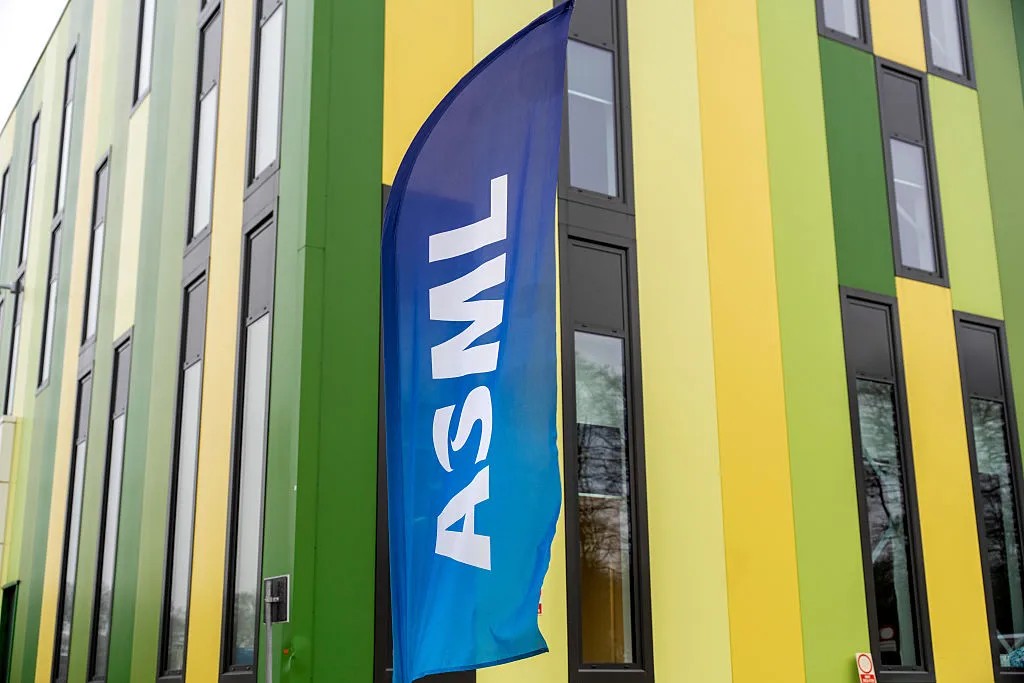
Samsung Electronics and SK Hynix are each preparing to spend 10 trillion to 20 trillion won on extreme ultraviolet lithography, and money is not the constraint. ASML has told the market that supply will fall short of demand in 2027 and 2028. In that gap the two Korean makers are not buying tools, they are buying position, and the position is set years before the steel goes up.
Both plan to take delivery of scanners in batches starting next year, and neither has disclosed how many machines it expects. SK Hynix put a number on its commitment in March: about 11.95 trillion won of EUV equipment, delivered by Dec. 31, 2027. That filing is the clearest public marker of what a place in the queue is worth to a memory maker planning a decade of capacity.
Lead times have stretched to twice the previous longest, according to industry accounts. A scanner ordered today arrives after the current memory cycle has turned, and depreciation does not wait for the market to agree with the decision.
EUV stopped being optional for DRAM a generation ago. At the tightest pitches the capacitor and the peripheral circuits need the shorter wavelength to hold yields, and the number of layers exposed with it has risen every node since. Advanced capacity is now measured in machines rather than in cleanroom floor space.
The two buyers arrive from opposite directions. SK Hynix leads in high-bandwidth memory, the stacked product sold beside AI accelerators, and needs EUV to defend the yield advantage that won it that business. Samsung is spending to close a gap it opened by arriving late to the same product, and its checkbook is larger than its current share.
Samsung’s foundry division competes for the same tools, which puts internal pressure on an allocation the group does not control. Two businesses inside one company, both arguing for the same scarce input, is a scheduling problem before it becomes a capital problem, and the foundry usually wins because its contracts are longer.
For ASML the shortage is a pricing and allocation problem. It sells to a handful of strategic accounts, and every slot given to one is a slot denied to another. Backlog visibility improves. The diplomacy does not, and neither does the queue, which is why customers now negotiate years ahead of the machine they need.
The first risk is timing. Tools ordered into a shortage arrive into whatever demand looks like at delivery, not at order. Memory prices have broken faster than capacity plans before, and a fab full of depreciating scanners is a fixed cost with no floor under it.
The second risk is concentration. ASML is the only supplier of these machines, so a slip in its own supply chain, a lens, a light source, a subsystem, delays every customer at once. There is no second source to call at the leading edge, and no way to stockpile a tool that takes months to install and calibrate.
The third risk sits in product mix. EUV hours inside a fab are finite, and every hour assigned to one DRAM type is an hour taken from another. If high-bandwidth memory keeps earning a premium, the commodity lines keep the older tools and the older yields, and the gap between the two product families widens.
The demand case rests on AI servers, which absorb far more DRAM per system than the machines they replace. That is why both companies treat advanced capacity as a strategic asset rather than a cyclical one, and why they are ordering years ahead of need rather than quarters, in a market where the supplier’s calendar is the binding document.
Korean capex arrives in clusters. Both companies have said they may order earlier than planned and add capacity later, which is the language of a race rather than a plan. Two buyers bidding for one constrained input move price before demand moves, and both would rather overpay now than explain a shortage later.
What a slot buys is time. A fab built without a confirmed scanner schedule sits empty, and an empty cleanroom costs nearly as much as a full one. The deposit is small next to the shell and the staff it will hold, which is why the equipment queue, not the construction schedule, sets the opening date.
Watch ASML’s quarterly bookings and its shipment guidance for 2027. Watch the capex lines in the next calls from both Korean companies. If both raise at once, the shortage is being capitalized into the supply chain rather than resolved by it.
The memory cycle has not been repealed. It has been given more fixed cost to carry into the next downturn, and the machines that make the shortage visible are the same ones that will make the hangover expensive.