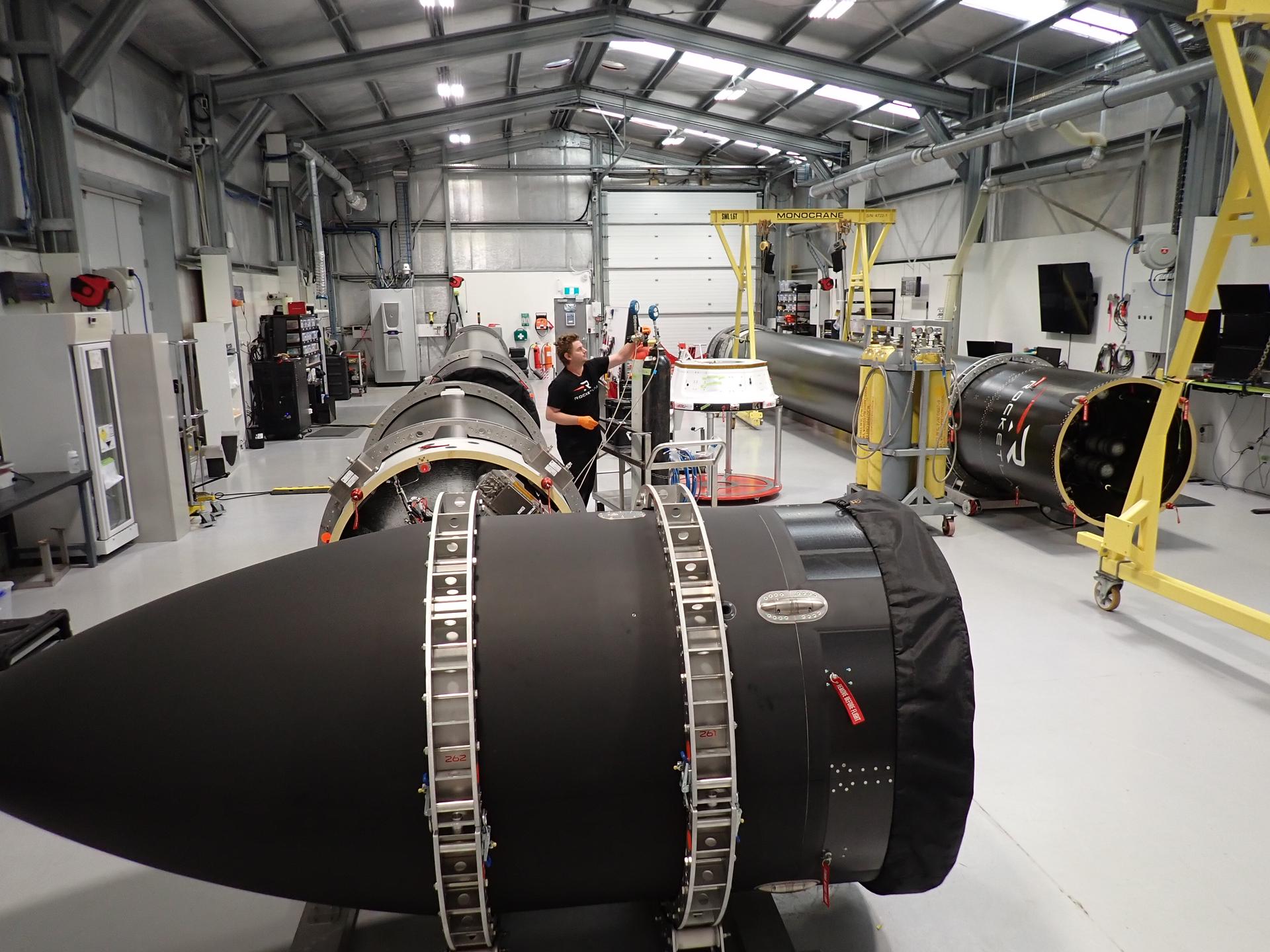
On the Mahia Peninsula, where Rocket Lab’s launch pad sits on a sheep station at the edge of the Pacific, a slender black rocket can wait hours for the wind to drop. The company has built its business on turning those waits into a schedule satellite operators can plan around. On Monday it gave investors its latest accounting of how well that schedule is holding.
Rocket Lab reported third-quarter revenue of $268 million, ahead of the $257.9 million analysts had expected. Its adjusted loss before interest, taxes, depreciation and amortization came to $18 million, narrower than the $20.3 million loss Wall Street had modeled.
For the holiday quarter, the Long Beach, Calif., company guided to revenue of $270 million to $290 million. The midpoint of that range sits above the $265.5 million consensus estimate, and the forecast assumes a busier launch calendar in the final weeks of the year alongside steady demand for spacecraft hardware.
The quarter’s real story is in the mix. Rocket Lab began as a seller of rides for small satellites on Electron, a rocket roughly the height of a two-story building that can lift a few hundred kilograms to low Earth orbit. Launch remains the public face of the company and the part of the business that decides whether customers trust it with expensive payloads. A growing share of revenue now comes from Space Systems, the division that builds satellite components, flight software and complete spacecraft for government and commercial buyers.
That shift changes how the numbers should be read. Launch revenue arrives in lumps, hostage to weather, range availability and the readiness of a customer’s satellite. Components revenue arrives through purchase orders spread across a year, which makes it easier to forecast and harder to price at a premium when demand surges. The result is a revenue base steadier than a pure launch provider’s and less profitable than investors once hoped. Adjusted losses have persisted even as sales climbed.
The variable that decides the next two years is Neutron, a medium-lift rocket meant to carry far heavier payloads and, eventually, to be flown again. Rocket Lab has been assembling it at Wallops Island, Va., where the company added a launch complex to complement its New Zealand site. Neutron is late by the standards set when the program was announced, and each delay costs more than the engineering hours: it holds back the national-security work and constellation contracts that pay the best rates in the industry.
SpaceX sets the terms of that competition. Falcon 9 rideshare prices have fallen far enough that dedicated small-launch missions struggle to compete on cost alone, and customers with flexible schedules routinely choose a seat on a bigger rocket over a bespoke flight. Several small-launch rivals have folded or been absorbed since 2021, leaving Rocket Lab among the few still flying regularly and the only one of that group with a credible path to medium-lift.
Rocket Lab has hedged by selling the parts other companies need. Its spacecraft components fly on satellites built by others, and its solar-panel business, acquired with SolAero, supplies power systems to prime contractors. The company also agreed to buy Geost, an Arizona maker of optical sensors, to deepen its position in payloads for government customers. Those deals give it revenue that does not depend on its own rockets leaving the ground, a hedge that has become more valuable as launch schedules slipped.
The government book is the other support beam. Rocket Lab was selected for the Pentagon’s National Security Space Launch program under its Lane 1 category, which lets it compete for task orders against a short list of providers rather than winning one large award. The arrangement suits a company of its size: recurring opportunities, no single point of failure, and a customer that values a second source.
Analysts said the quarter’s beat was modest but the guidance was the part worth watching. A range of $270 million to $290 million implies growth that depends on launches booked for December actually flying, and December is a month when weather at both of the company’s pads has a history of interfering. If one mission slips into the new year, the top line moves with it.
Costs are the other question. Rocket Lab has spent heavily on Neutron’s engines, structures and ground systems, and the returns arrive only after the rocket reaches orbit and then proves it can repeat the feat. Until then, each quarter’s adjusted loss shows how much capital a launch company consumes before it earns the right to be judged on margin.
Peter Beck, the founder who runs the company, has described the goal as an end-to-end space company: one that builds the satellite, launches it and operates it. The strategy is coherent. The execution is now a scheduling problem, and schedules in this industry slip.
That leaves investors with a specific thing to watch over the next two quarters: whether Neutron’s first flight happens inside the window the company has described, and whether the launch cadence underlying the holiday guidance materializes before the quarter closes. Neither answer will come from the income statement. Both will come from a count of rockets that left the pad.