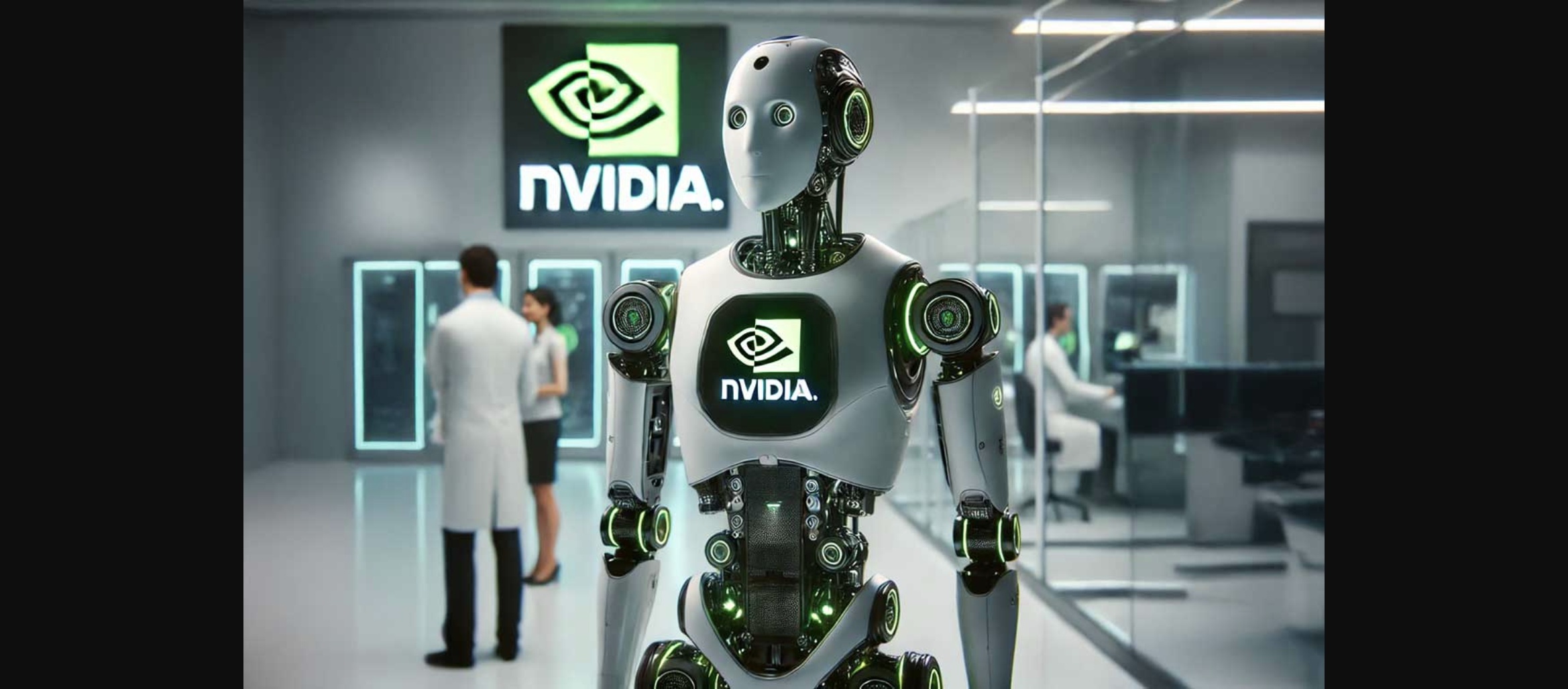
Jensen Huang has a habit of measuring new hardware against himself. On June 1, at Computex in Taipei, the NVIDIA chief executive unveiled a humanoid robot built with Unitree Robotics, a Chinese company, and told the crowd that its build was, as he put it, “pretty much like mine.” The robot stands about 1.8 meters tall, roughly six feet, and weighs about 68 kilograms. It has 31 degrees of freedom across its body and 25 in each five-fingered hand. Huang’s joke landed, but the product underneath it is serious.
The machine is called the H2 Plus, and NVIDIA is positioning it as the first reference design built on its Isaac GR00T platform for humanoid development. Unitree supplies the body. Sharpa, a Singapore-based company, makes the tactile five-finger hands. NVIDIA contributes the compute, in the form of its Jetson AGX Thor T5000 module, along with the Isaac GR00T foundation models that act as the robot’s reasoning layer, simulation tools and middleware. The whole system is offered as one validated configuration, rather than a collection of parts a researcher has to integrate alone.
The target customer is revealing. NVIDIA said the reference design will be made available to academic institutions, naming Stanford, ETH Zurich, the Allen Institute for AI and the University of California, San Diego among the early recipients. Building a complete humanoid test platform from scratch, Huang said, is simply too hard for most research groups. The H2 Plus is designed to remove that barrier: a researcher gets a working, human-scale robot with dexterous hands and modern on-board compute, and can focus on algorithms instead of assembly.
The design decisions say a lot about how NVIDIA views the robotics market. The company did not build its own robot, and it did not crown a Western favorite such as Figure or 1X. It took hardware from a Chinese company that has spent years pushing humanoid prices down, wrapped it in its own compute and software stack, and declared the result the official starting point for academic humanoid research worldwide. That is a platform play rather than a product launch, and it signals where NVIDIA believes the physical-AI race is heading.
The H2 Plus is also a study in the state of the art. The Jetson AGX Thor T5000, built on NVIDIA’s Blackwell architecture, delivers on-board AI compute of roughly 2,070 trillion FP4 operations per second with 128 gigabytes of memory, enough to run sophisticated whole-body control and manipulation policies without a tether to a data center. The dexterous hands, with their 25 degrees of freedom each, are the kind of hardware that separates useful manipulation research from the wheeled robots of an earlier generation.
The timing coincides with a broader surge in humanoid interest. Morgan Stanley analysts projected in a May 14 report that China’s humanoid robot sales would more than double this year to about 28,000 units, the highest level of any country, according to a report carried by Chinese media. Tesla continues to develop its Optimus program, and a wave of startups on both sides of the Pacific has raised billions to chase the same vision of general-purpose machines that work in human environments.
For research institutions, the appeal of a reference design is that it compresses years of integration work into a purchase order. A lab that wants to study whole-body manipulation currently has to source a body, wire up compute, write control software and pray the pieces work together; with the H2 Plus, the integration has already been done and validated by the people who make the chips. That frees scarce research dollars for the actual science, and it steers that science toward NVIDIA’s software stack, which is precisely the point.
For NVIDIA, robots are a natural extension of its core business. Every humanoid needs on-board compute, simulation before it can be trusted in the real world, and foundation models to interpret what its sensors see. Those are all products NVIDIA sells. The Isaac GR00T stack spans data capture, simulation, deployment and the models themselves, and the H2 Plus gives the company a canonical hardware reference around which that software can be tested and improved.
The choice of a Chinese partner carries its own significance. Unitree has become one of the most visible humanoid companies in the world, known for aggressive pricing and rapid iteration. NVIDIA has insisted its partnership is about research enablement, but the arrangement also gives it a foothold in China’s humanoid supply chain at a moment when the country’s robotics industry is scaling quickly. Whether that relationship survives the geopolitical strains of the moment is a question the market will keep asking.
The H2 Plus will be judged by what researchers do with it. Reference designs have a mixed history in computing: some become foundations for entire industries, others gather dust in university labs. NVIDIA is betting that the combination of a capable body, powerful on-board compute and a complete software stack changes the calculus for academic robotics. The cost of entry to serious humanoid research has just come down, and the companies and universities that move first will set the research agenda for the next several years.