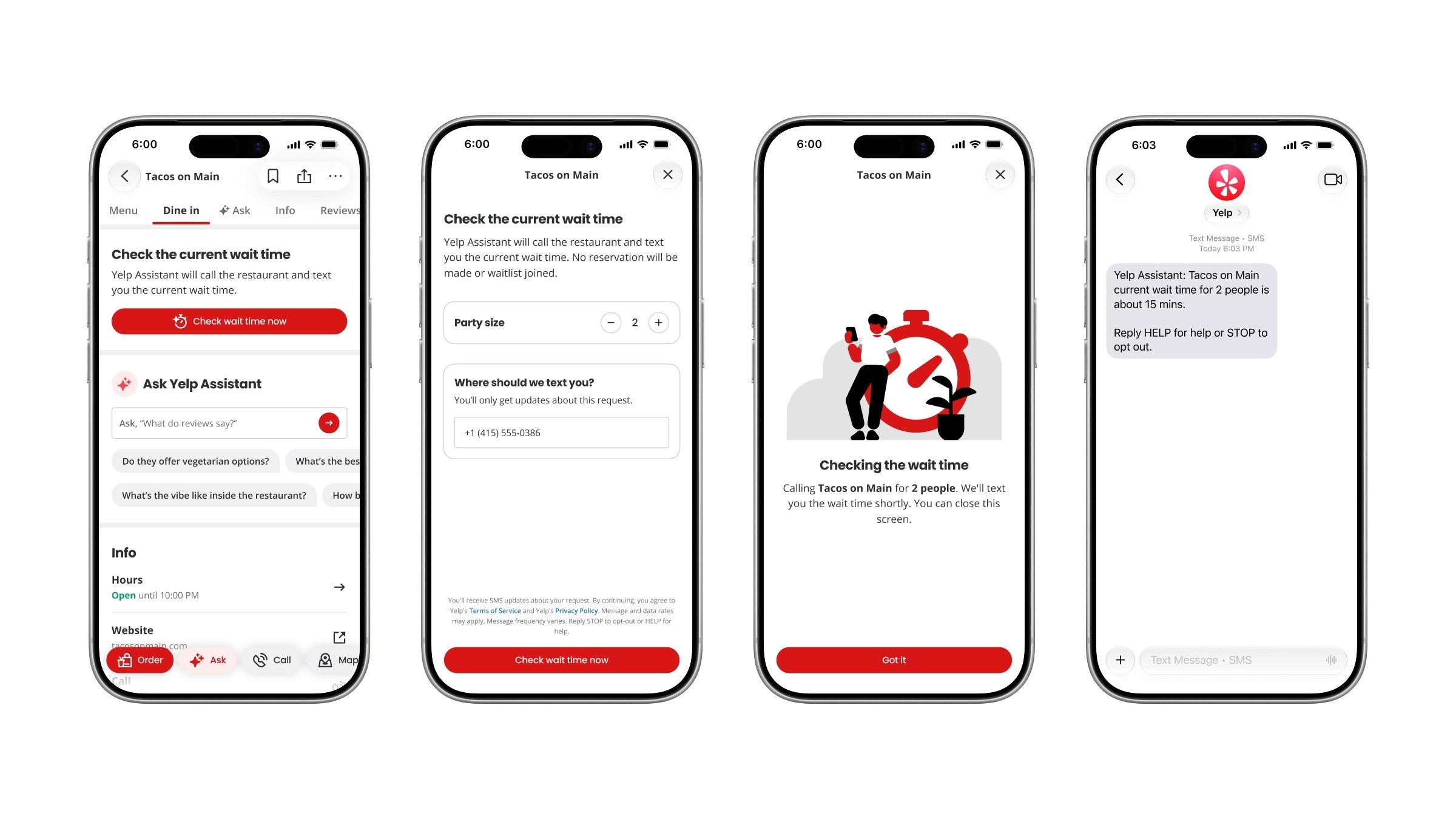
The button sits on a restaurant’s page inside the Yelp app and is labeled “Check for Me.” A user enters a party size and a phone number, closes the app, and a synthetic voice dials the restaurant, asks how long the wait is, and sends the answer back as a text message. The whole exchange takes minutes and involves no typing on either end of the line.
Yelp announced the feature on October 20 as part of its fall product release, along with a set of additions to its AI assistant. The assistant now books tables through OpenTable without leaving the app, remembers preferences from earlier conversations, keeps 30 days of chat history, and will produce personalized weekly recommendations starting next month. Users can build lists, filter them by cuisine and neighborhood, add notes and share them.
For businesses, the company introduced a paid product called Smart Lead Reply, at $30 a month, which answers inbound customer messages and asks the qualifying questions an owner would ask. Yelp said owners can specify how the agent should handle a conversation, including when to hand it to a person.
The interesting part is not the voice. Speech synthesis has been adequate for years, and several startups have shipped assistants that place calls on a user’s behalf over the past few weeks. What is new is the placement: a mainstream consumer app with a large audience for restaurant discovery is now putting an agent between the diner and the host stand.
That position has been Yelp’s business for two decades. The company sells advertising to local businesses on the strength of intent, meaning a person who searches for a restaurant on a Friday evening is closer to spending money than a person served the same ad on a social feed. The phone call was the last mile of that intent, and it has now been automated by the company that was intermediating it.
There is an obvious operational case. Restaurant phone calls are a nuisance for the caller and a cost for the restaurant, which frequently cannot answer during service. A bot that asks a single question and reports back removes a small friction from both sides. Yelp said last year it had built voice agents for restaurants and service providers to handle inbound calls, which means the two systems may eventually speak to each other.
That prospect is what makes the release worth watching. If a diner’s agent calls a restaurant’s agent, the conversation is between two programs negotiating over a table neither of them will sit at, and both parties have an interest in the outcome. The failure modes are easy to imagine: an agent quoting a wait time that was accurate four minutes ago, or two systems looping through hold menus while a customer waits for a text that never arrives.
The economics of the call are also unsettled. Yelp is not charging consumers for Check for Me, so the feature is a retention tool rather than a revenue line. The revenue is in Smart Lead Reply and in advertising that becomes more valuable if the app can demonstrate that it produces seated customers rather than clicks. At $30 a month, the business product is priced for the smallest operators, the ones least able to answer the phone.
Yelp needs the help. Net revenue was $1.46 billion in 2025, up 4 percent, and advertising from services businesses, the category that includes home repair and professional services, grew 8 percent to $948 million. Restaurants, the category most associated with the brand, have been the weaker part of the business, which the company has attributed to pressure on local operators.
The strategic risk is disintermediation, and it is not new. Yelp has argued for years that Google uses its dominance in search to answer local queries without sending users to the source. An AI assistant that answers questions directly is the same problem in a different form: if the model can tell you which restaurant to book and then book it, the review site becomes a data supplier rather than a destination.
Yelp’s defense is the corpus. Two decades of reviews, photographs and hours of operation, plus a steady stream of new ones, is the kind of grounded material that improves an assistant’s answers about specific places. That asset is more valuable inside an agent than as a web page with ads around it, which is the logic behind building the assistant rather than licensing the data.
There is a version of this in which the agent strengthens the position. A diner who asks Yelp’s assistant to check three restaurants and book one has delegated the whole decision, and the app that receives that delegation owns the transaction in a way that a search result never did. Booking through OpenTable costs Yelp a share of the reservation, but it also keeps the user inside its own interface.
The unanswered question is what the restaurant agrees to. A host who picks up the phone and answers a machine is providing information to a company that is not its customer, and the business may eventually want to be paid for the data or to route the call to its own agent. Yelp said it has not set a date for making Check for Me available to all users, which leaves room to negotiate the terms.
What the release shows is where the consumer internet is heading: the unit of interaction is becoming a task performed on someone’s behalf rather than a page viewed. Yelp has decided that the agent should be its own, and that the call it has spent twenty years generating is worth making itself. Whether the restaurant on the other end sees a customer or a machine is the part nobody has priced yet.