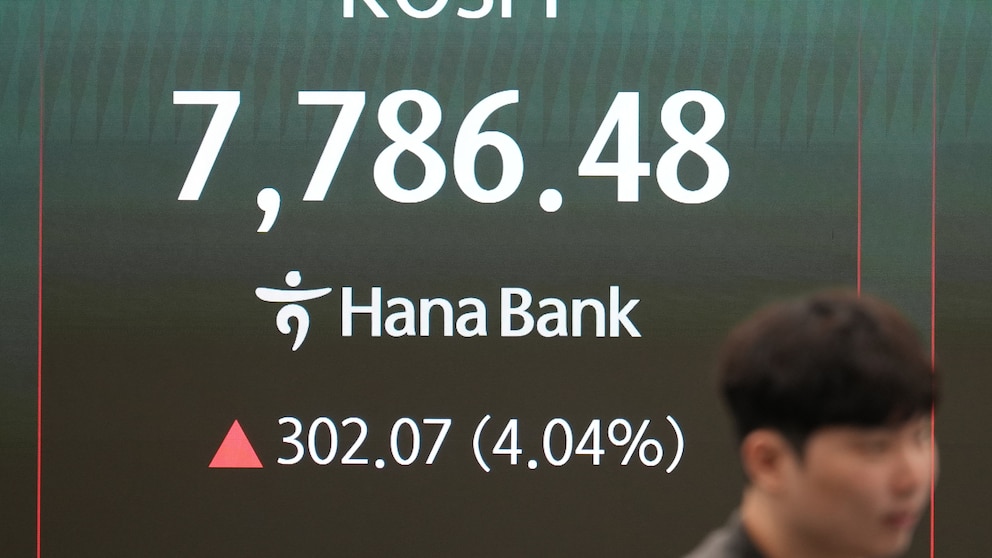
SEOUL — The circuit breaker that halted trading on the KOSPI on Monday was the kind of event markets do not forget quickly, and the rebound on Tuesday was the kind they do not trust. Seoul’s benchmark index surged 8.18% to close at 8,096.93, reclaiming the 8,000-point threshold it had lost in the previous session’s rout, led by the semiconductor stocks that had suffered the worst of the damage.
SK Hynix, the world’s largest maker of high-bandwidth memory for AI accelerators, climbed 6.44%. Samsung Electronics rose 3.38% in early trading and finished higher, and in Tokyo, Tokyo Electron jumped 8.91%, its best session in months. Advantest added 1.51% and Renesas Electronics gained 2.54%. Seoul Semiconductor, a smaller supplier, surged more than 12%. The Nikkei 225 closed up 2.17% at 65,416.41.
The trigger for the buying was the session that preceded it across the Pacific. The Philadelphia Semiconductor Index rose 5.61% overnight, with Micron Technology up 9.87%, Intel up 11.19% and AMD up 5.14%. Nvidia, the stock that started the selloff, gained 1.73%. In New York, the Nasdaq Composite rose 0.86% and the S&P 500 added 0.3%, recovering part of Monday’s losses. The overnight strength gave Asian investors a reason to buy the stocks they had just dumped.
Monday had been brutal. Samsung fell 10.18%, closing below the psychological 300,000-won level, and SK Hynix dropped 7.68%, slipping under 2 million won. The KOSPI fell more than 8%, triggering the exchange’s circuit breaker for the first time in years. The selloff began in the United States, where fears that AI valuations had run ahead of earnings swept through the biggest chip names, and spread across Asia in a single trading day.
The rebound, analysts said, is best understood as a technical correction within a larger trend. “This correction is not fundamentally driven by a peak in semiconductor profits or a loss of policy momentum, but by excessive market concentration,” said Han Ji-young, a researcher at Kiwoom Securities. He noted that the KOSPI has historically delivered positive returns on average in the sessions after circuit-breaker halts. Lee Jongwook, an analyst at Samsung Securities, made a similar point: “Volatility has become significant, but this is due to changes in market structure rather than a shift in cyclical direction.”
Two external factors supported the recovery. Tensions in the Middle East, which had pushed energy prices higher and fed inflation fears, showed signs of easing, and crude prices retreated from their peaks. Investors also had a calendar reason to act: U.S. inflation data is due later this week, and the pricing of SpaceX’s initial public offering on Thursday promises to test the market’s appetite for risk. ORTUS Advisors said Asian markets were likely to remain volatile through the week as investors brace for those events.
The memory makers have more riding on the week than most. SK Hynix and Samsung supply the HBM that Nvidia’s accelerators require, making them direct beneficiaries of every data-center buildout announcement and direct casualties of every valuation scare. Their shares have become the most liquid proxy for the AI trade in Asia, which is why Monday’s decline hit them hardest and Tuesday’s recovery lifted them first.
The selloff that preceded the rebound had a specific trigger: a stretch of earnings and commentary that made investors question whether AI-related capital spending could keep justifying chip valuations. The selling concentrated in the names with the longest run-ups, and by Monday afternoon the KOSPI had fallen more than 8%, tripping the exchange’s circuit breaker for the first time in years. The pattern was identical in Tokyo, where equipment makers fell alongside their Korean peers, and in New York, where the Philadelphia Semiconductor Index suffered its worst session in months. What changed overnight was not the fundamentals but the mood: Middle East tensions that had pushed crude higher showed signs of easing, and U.S. chip stocks rebounded hard enough to pull Asian buyers back in. The memory sector carries extra sensitivity because of its position in the AI supply chain — HBM pricing and allocation are set in a market where a handful of suppliers face a handful of buyers, so any shift in sentiment moves the stocks violently in both directions.
The question hanging over the rebound is whether it marks the end of the correction or a pause within it. Bargain hunters said Tuesday’s flows were dominated by domestic institutions and retail investors buying the dip, while foreign funds stayed cautious. Analysts pointed to the concentration of the rally — semiconductors led, while broader market participation was thinner — as a sign that conviction has not fully returned.
For now, the technicals look repaired. The KOSPI reclaimed 8,000, Tokyo Electron recovered its losses and then some, and the Philadelphia index has closed higher in two of its last three sessions. The real test comes in the days ahead, when inflation data and the SpaceX pricing will tell investors whether the AI trade is being repriced or merely interrupted.
A trader at a Seoul brokerage put the mood in one line: everyone is watching the same two things now — the CPI print and the rocket company’s final share price. Until both land, the bounce stays a bounce.