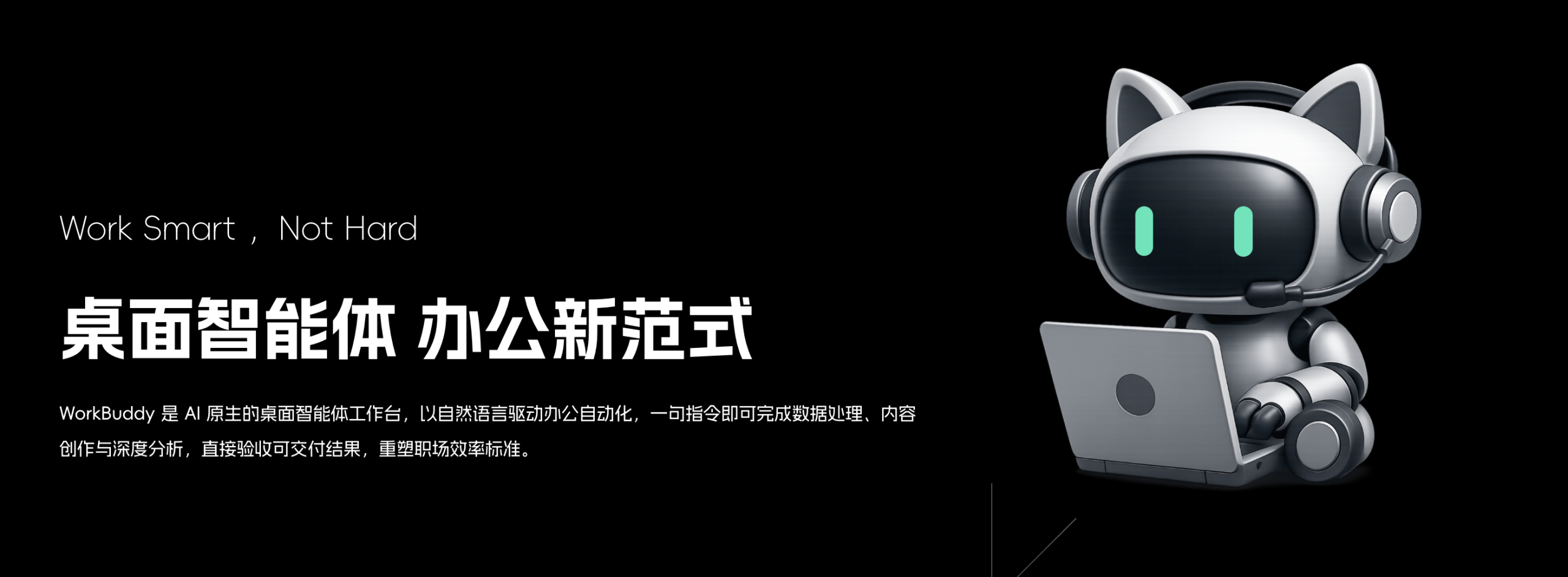
SHENZHEN — Liu Yi, the Tencent Cloud vice president who runs both CodeBuddy and WorkBuddy, has a blunt way of describing the problem his company is trying to solve. AI agents can make an individual worker ten times more productive, creating what he calls “super individuals.” But a company full of super individuals is not automatically a smarter company. On June 5, Tencent rolled out WorkBuddy Enterprise Edition and an Agent Suite designed to close that gap.
The product lineup spans the full range of corporate AI work. CodeBuddy, the developer workbench, covers coding assistants, AI-native development environments and end-to-end agent execution. WorkBuddy, the office product, handles daily work tasks and integrates with the Tencent ecosystem. Managed Agents provides a cloud-hosted runtime so enterprises can run their own custom agents on production-grade infrastructure. Together, the three are Tencent’s answer to a question every Chinese technology giant is now chasing: where do businesses plug AI into their operations?
The suite’s architecture is built around the systems Chinese companies already use. The first integration phase covers Tencent Docs, Tencent Cloud Drive and Tencent Lexiang, unified by a single OneID account system with credit-based metering. Agents can execute tasks remotely through Slack, Telegram, Discord and WeChat, and connect to GitHub, Jira, Google Drive, Gmail and Notion through the Model Context Protocol, the emerging standard for agent-tool integration. More than 100 built-in expert roles ship out of the box.
Liu Yi framed the launch around four organizational failures he said most companies hit when they try to deploy agents: management processes that resist closed-loop automation, difficulty enabling AI-native team collaboration, enterprise knowledge that stays fragmented across departments, and governance questions around what he calls digital employees. The suite’s integrations with Tencent’s office software are aimed at the second and third problems, letting agents read and write directly in the systems where the work already happens rather than forcing data through separate pipelines.
The commercial pitch is calibrated to reassure buyers worried about layoffs. Zhang Xiang, commercial lead for CodeBuddy and WorkBuddy, said AI can execute any process, but human employees remain responsible for reviewing the output and serving as the final quality gate. The message: agents take on the drudgery, humans keep the accountability.
The strategic logic is larger than the product. As AI lowers the barrier to building front-end applications, the entry point for enterprise software is becoming the agent itself — the layer that decides which tools get invoked, which data gets read and which workflows get automated. Tencent is positioning WorkBuddy as that entry point, and it has distribution advantages most rivals cannot match: WeChat for consumer reach, WeCom for workplace messaging and a cloud business that already hosts a substantial share of Chinese corporate workloads. WorkBuddy has already become one of China’s most-used productivity agent tools by daily active users, according to Tencent.
The company is also building the marketplace around the platform. SkillHub, Tencent’s skills community, hosts more than 70,000 skills and has accumulated more than 30 million downloads, giving enterprises a library of pre-built capabilities to install into their agents. The same storefront gives third-party developers a distribution channel, turning the agent platform into a two-sided market.
The timing reflects a broader shift in China’s enterprise software market. AI agents are the fastest-growing product category in the country’s cloud business, and the entry point — the place where a company decides which agent platform to standardize on — has become the battleground. Tencent’s advantage is the WeChat and WeCom ecosystem, which gives WorkBuddy a distribution channel that reaches virtually every Chinese office worker. The company also addresses the governance question head-on, with enterprise-grade security features including unified identity management, permission controls and prompt-injection protection that keeps system prompts managed centrally rather than on local machines. Readhub, which first reported the launch, noted the strategic significance of the moment: as AI lowers the barrier to building software, the agent interface becomes the new front door for enterprise technology, and the company that owns it controls the relationship with the customer.
Competition is intense. Microsoft bundles Copilot with Windows and Office; Google sells Agentspace to the same corporate customers; Alibaba, Baidu and ByteDance are all pushing enterprise agent products in China. Tencent’s edge, executives argue, is the depth of integration: an agent that can read and write directly inside WeCom, Tencent Meeting and Tencent Docs, the systems its customers already use daily, requires less re-engineering than a product bolted onto the stack.
Liu Yi predicted the sector is about to accelerate. AI agent productivity products, already widely adopted, will enter a phase of rapid scaling in the second half of 2026, he said. The company that owns the entry point, in his view, will own the enterprise AI market. Tencent’s bet is that the entry point is not the model, not the chip and not the cloud — it is the agent that sits between them and the employee.