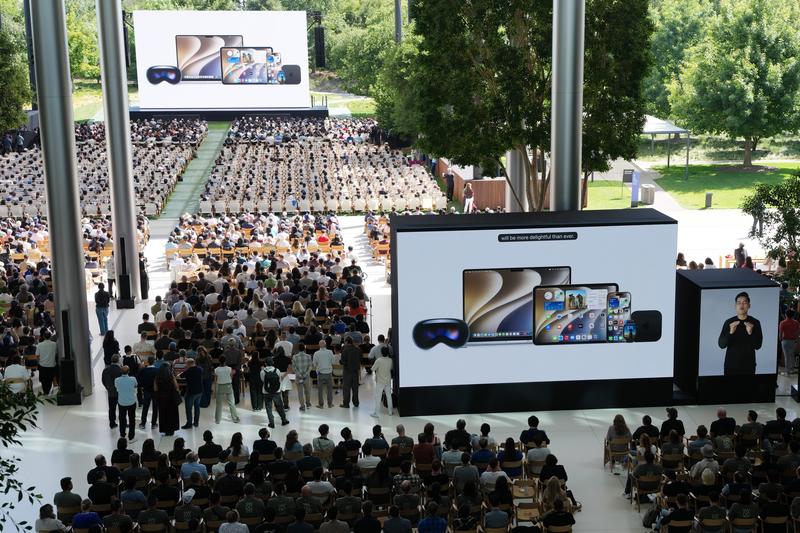
CUPERTINO, Calif. — Tim Cook walked onto the stage at Apple Park on Monday for the last keynote of his tenure as chief executive, and for more than an hour the audience heard about chips, watch faces and a rebuilt Siri. The farewell itself lasted seconds. Mr. Cook closed with a short, unadorned thank-you, according to people who attended, with no retrospective reel and no mention of his successor. Then the lights came up on a company beginning its post-Cook era.
The centerpiece of the event was a Siri rebuilt from the ground up. Apple showed a new voice, a dedicated application and a conversational assistant that can hold multi-turn exchanges and act inside other apps. The company said the overhaul draws on Nvidia chips working with Google to power its AI features, a notable concession for a hardware maker that has long preferred to keep its most sensitive systems in-house. Apple shares fell nearly 2% after the announcement, a muted reaction that analysts read as investors weighing a promising roadmap against a delayed one.
JPMorgan analysts said in a note after the event that the Siri overhaul positions Apple for the long term, calling the new assistant a potential game changer for the company’s services business. The note was a minority view in the immediate aftermath, when much of the developer audience was still parsing how much of the new assistant would actually ship this year.
The answer, at least in Europe, is less. Apple said the new Siri AI will not be included in the European version of iOS 27 at launch, citing an unresolved disagreement over how the assistant handles personal data under the bloc’s privacy rules. The European Commission responded bluntly: the law is not negotiable, a person familiar with the exchange said. The split means Apple’s flagship AI feature will debut in one version for the United States and most of the world, and another, more limited version for its second-largest market — an increasingly familiar pattern as the company navigates regulators in Brussels.
The regulatory friction is a reminder of how much the AI push depends on partners. Nvidia supplies the silicon, Google supplies infrastructure, and both companies compete with Apple in areas the company once dominated. For a firm that spent a decade building its own chips and its own maps, the reliance on outside AI partners is a visible shift in strategy. Apple executives framed it as pragmatism: the AI race rewards speed, and the fastest path ran through existing partners rather than another multi-year silicon project.
The event also gave developers their first full picture of Apple’s AI architecture. Beyond Siri, Apple showed new versions of its operating systems and hardware, with AI features woven through Mail, Notes and Photos, according to people who attended. The company framed the Siri rebuild as a platform change rather than a feature update: the assistant will act on behalf of the user inside apps, subject to permission prompts, a capability that requires the kind of system-level access Apple has historically guarded. The absence of the new assistant from the European release underscores how much of that architecture is shaped by regulation rather than engineering. Apple has already adjusted its App Store, browser and messaging policies to satisfy the bloc’s digital markets rules, and the Siri dispute follows the same pattern: a global product, split into versions by legal geography.
The broader question is succession. Mr. Cook took over from Steve Jobs in August 2011 and has run Apple through the largest run of value creation in corporate history, taking the company from roughly $350 billion in market value to more than $3 trillion. The board has not named a successor, and Mr. Cook did not address the transition beyond the brief farewell. People close to the company said the handover plan has been in place for years, with the operations team and the software and hardware chiefs each groomed as candidates, but no decision has been publicly signaled.
The Siri bet is the strategic hinge of the next era. Apple’s assistant has trailed OpenAI’s ChatGPT, Google’s Gemini and Amazon’s Alexa for years, and the company’s late start has cost it time in a market where consumer habits are forming now. The rebuilt assistant, with its own app and a conversational interface, is Apple’s attempt to close that gap using the one asset rivals cannot copy: the installed base of more than two billion devices and the services revenue attached to them.
Developers who attended the keynote said the demo was the most convincing Siri has ever been, though several noted the assistant was shown working in controlled conditions. The real test comes this fall, when iOS 27 ships and the assistant faces the messy reality of third-party apps, misheard commands and the privacy settings users actually configure.
For Mr. Cook, the timing is tidy in one respect: he leaves the stage at a moment when the company’s next act is defined but not yet proven. The new Siri, the Nvidia partnership and the EU split will all be the problems of his successor. The final keynote ended, people who were there said, with the audience on its feet and Mr. Cook walking off without looking back. The applause was for fifteen years of delivery; the questions were about the fifteen years to come.