
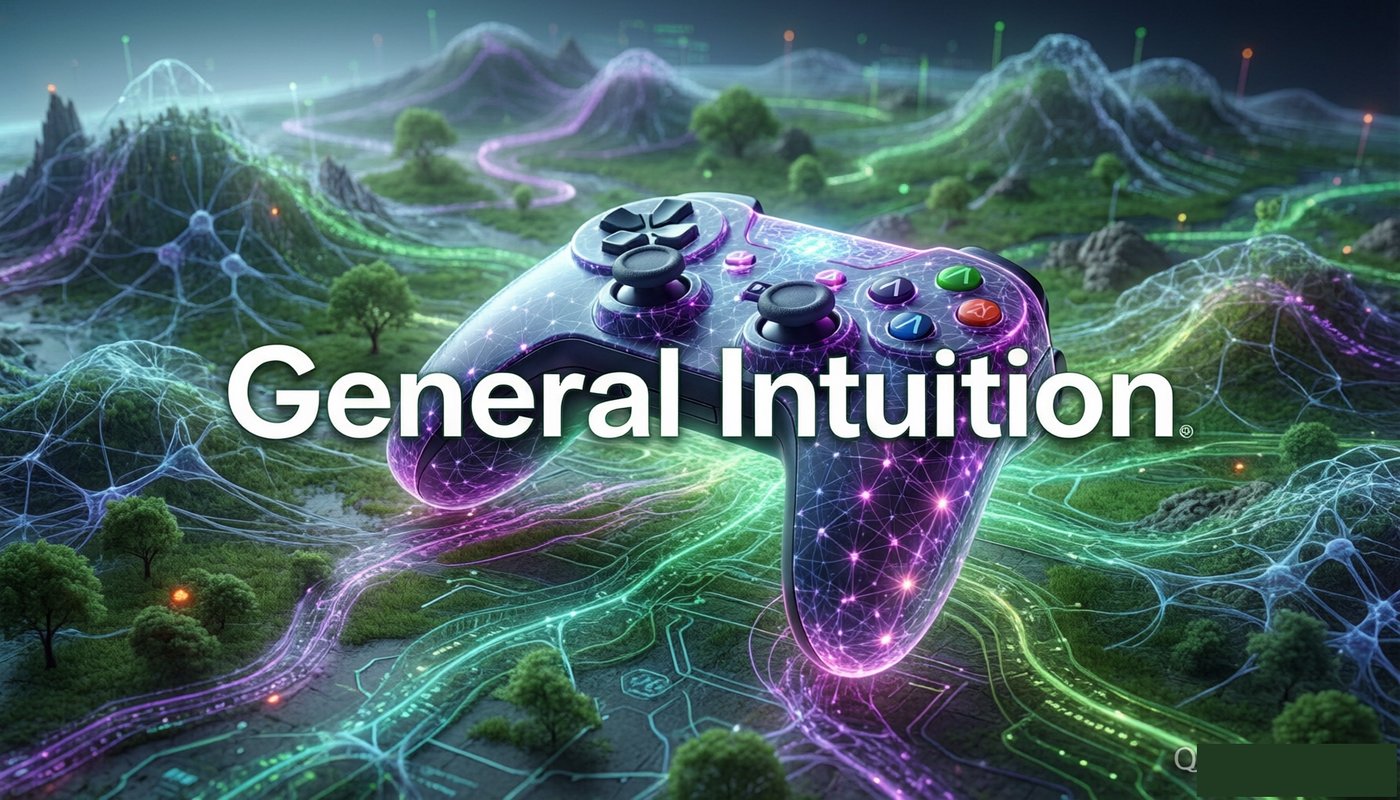
General Intuition said Thursday it has raised $320 million at a valuation of $2.3 billion, a vote of confidence in its unusual thesis: that video games, not real-world data, are the best training ground for AI agents that must make decisions in complex situations. The company, which emerged from stealth earlier this year, builds AI systems that learn inside game engines, where they can practice millions of scenarios in the time it takes a human to play one level.
The approach inverts the logic of the current AI boom. The largest model companies have built their businesses on scale — more data, more compute, bigger models — and their agents learn from text, images, and code scraped from the internet. General Intuition argues that this approach produces systems that can recite knowledge but cannot act in the world. Its counter-proposal is that decision-making is a skill, and skills are learned by doing; game engines provide an endless supply of doing.
The technical case is straightforward. A game engine can generate an infinite variety of situations — a city to navigate, a warehouse to manage, a battle to fight — and an AI agent can play through them millions of times, learning which actions lead to success and which lead to failure. The company says this beats real-world training on two counts: volume, since simulated scenarios cost almost nothing to generate, and safety, since agents can make catastrophic mistakes in a simulation without harming anyone. The same logic has driven autonomous-vehicle companies to test in simulation for years; General Intuition is extending it to general-purpose agents.
The company’s technology draws on the tradition of game-playing AI, a field that produced some of AI’s greatest achievements — DeepMind’s AlphaGo defeating the world champion Go player, OpenAI’s Dota-playing bots, and the agents that mastered chess, poker, and Starcraft. Those systems proved that machines could learn strategy from self-play in games. General Intuition’s founders, who include researchers with backgrounds in robotics and reinforcement learning, argue that the same methods can train agents for the messy, open-ended tasks of the real economy, from operating machinery to coordinating supply chains.
The funding round, according to a person familiar with the terms, was oversubscribed, and the valuation of $2.3 billion reflects investor appetite for bets on the next phase of AI — systems that act rather than just generate. The company’s backers include funds that have also invested in robotics and autonomous systems, and they have told the company they see simulation as the bridge between today’s AI and the embodied systems of tomorrow.
The company’s founders have described their ambition in terms borrowed from biology: intuition, the ability to act correctly in situations never seen before, is what separates experts from novices, and they believe it can be trained the same way humans train it — through practice, variation, and feedback. In a game engine, an agent can practice a thousand variations of a task that a human would face once, and each attempt teaches the model something about the structure of the problem. The founders argue this yields agents that do not merely mimic examples but develop the judgment to handle novel situations, which is precisely where today’s models are weakest.
Skeptics point to the gap between games and reality. A game engine’s physics, its characters, and its objectives are designed by humans, and an agent that masters a simulation can fail the moment it meets the real world, which is messier, noisier, and governed by consequences no developer wrote. The company acknowledges the challenge and says its research agenda includes closing the “sim-to-real” gap — the engineering problem of making skills learned in simulation transfer to physical settings. It has been hiring roboticists to work on exactly that problem.
The round also signals a shift in where AI money is flowing. After two years in which the overwhelming share of funding went to large language models and the infrastructure that serves them, investors have begun to place smaller, more targeted bets on alternatives: robotics, world models, and simulation-based training. General Intuition’s thesis sits at the intersection of all three, and its valuation suggests at least some investors believe the game-based route can produce general decision-making without the trillion-dollar compute bills of the big-model labs.
The company has not disclosed which games or engines it uses, saying only that it has built its own simulation platforms alongside commercial engines, nor has it named customers. Its stated goal is to build agents that can be dropped into real organizations — factories, logistics networks, trading desks — and make sound decisions under uncertainty. Whether video-game training produces that outcome is an open question that the $320 million will help answer. The company’s founders argue that the world is, in the end, a game with higher stakes: rules to learn, opponents to outwit, and consequences for every move. They are betting that the agents which learn to play will also learn to work.



