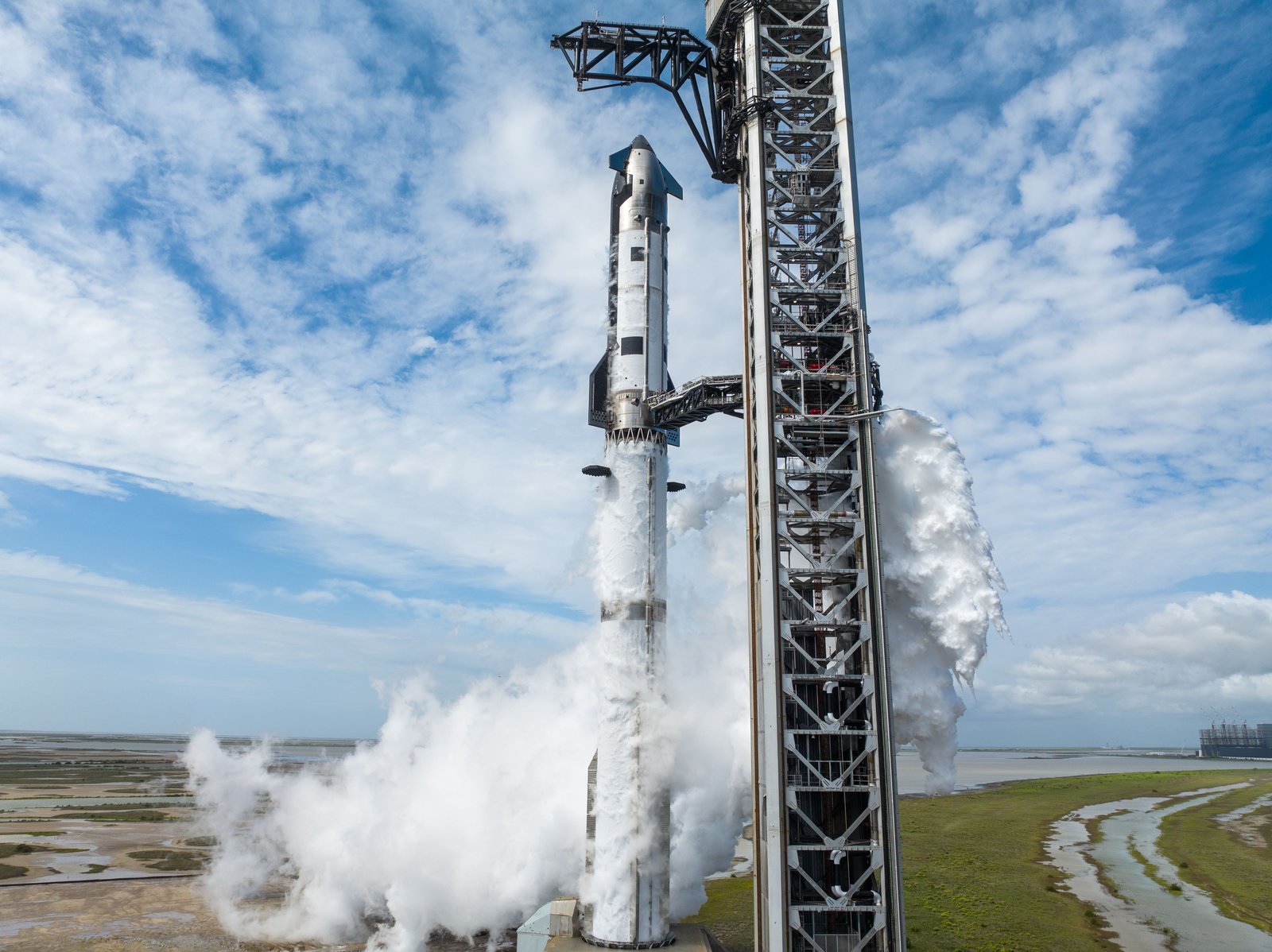
The countdown is set for 5:45 p.m. Central time. Starship Flight 13, the first orbital test of the giant rocket since SpaceX went public in June, is scheduled to lift off Thursday from the company’s Boca Chica, Texas, facility, according to people familiar with the launch plan. The flight carries engineering stakes for the rocket program and market stakes for a stock that has already fallen below its offering price.
The timing is not comfortable. SpaceX shares were trading around $132 to $134 this week, below the $135 initial public offering price, and Reuters reported that the prospect of expiring lock-up agreements is weighing on the stock. A wave of IPO investors becomes eligible to sell in August, and the market has been bracing for that supply. The flight gives investors a fresh reason to reassess the company while the stock is under pressure.
The launch itself is the first Starship test since the listing. Starship is the vehicle SpaceX intends to use for everything from satellite deployment to lunar landings, and each flight test generates data that feeds the next iteration. A success would demonstrate progress at a moment when the company is selling a story of technical momentum; a failure, while common in the program’s history, would arrive at an awkward time for the narrative.
SpaceX’s public debut was one of the largest in history. The company listed in June at a valuation around $1.8 trillion, backed by a shareholder base that included some of the largest funds in the world, and its offering documents revealed the scale of its operations, including a computing contract under which it supplies Anthropic with about 325,000 Nvidia chips at roughly $1.25 billion a month. The stock has traded below its IPO price for much of the period since.
The selloff has several causes, according to analysts. Lock-up expirations are a mechanical overhang, but the company’s valuation, built on projections of Starship’s commercial potential, has also been repriced as investors weigh how much of that potential is already in the share price. The stock’s decline has become a cautionary tale in the IPO market, and bankers preparing other large listings, including Anthropic’s, have cited it in conversations with investors.
Thursday’s flight is also a test of the company’s dual-track strategy. SpaceX operates what are effectively two businesses: a commercial satellite and launch business, and a government-oriented one that includes classified work. The same day as the Starship attempt, the company launched 21 military data-relay satellites from Vandenberg Space Force Base in California as part of the Space Development Agency’s Tranche 1 constellation, according to officials.
The military work has become a growing part of SpaceX’s revenue. The company’s government contracts span launch services, satellite communications and now the proliferated low-Earth-orbit networks the Pentagon wants for resilient communications. Analysts said the defense side of the business provides a revenue floor that pure commercial launches cannot, which is part of why the company could command such a high valuation.
The Starship program is the swing factor. Each flight test costs hundreds of millions of dollars, and the vehicle must fly successfully many times before it can carry the payloads that justify its existence. The company’s plans for Starship include launching its next-generation Starlink satellites, delivering cargo and eventually people to the moon for NASA, and supporting missions that no other vehicle can fly. Every failure extends the timeline.
The market has been through this before. SpaceX’s previous Starship tests have produced a mix of spectacular successes and explosive failures, and the stock market’s reaction to the program has historically been muted, because the company was private and the share price was set by venture investors. Public investors are a different audience: they trade on news, and a visible failure on launch day would give them a reason to sell.
The broader question is what the company is worth. Bullish analysts point to SpaceX’s launch cadence, its Starlink subscriber growth and its defense backlog as evidence that the $1.8 trillion valuation was a starting point, not a ceiling. Skeptics note that the company’s most valuable future programs, including Starship’s heavy-lift missions, are years from generating the revenue implied by the price.
For the IPO investors waiting out their lock-ups, the calculus is simpler. Those who bought at the offering price can sell in August, and the question is whether to take the loss or hold for a rebound. A successful Flight 13 would give the bulls a story to tell; a failure would hand the bears one. The flight, in other words, matters more for the stock than for the rocket.
Launch day will not settle the valuation debate. Starship has many flights ahead of it, and the company has shown the ability to iterate quickly even after setbacks. But the first post-IPO test flight has a symbolic weight that engineering metrics do not capture: it is the first chance for public shareholders to see, in real time, whether the company they bought into can deliver the spectacle and the substance its pitch promised.