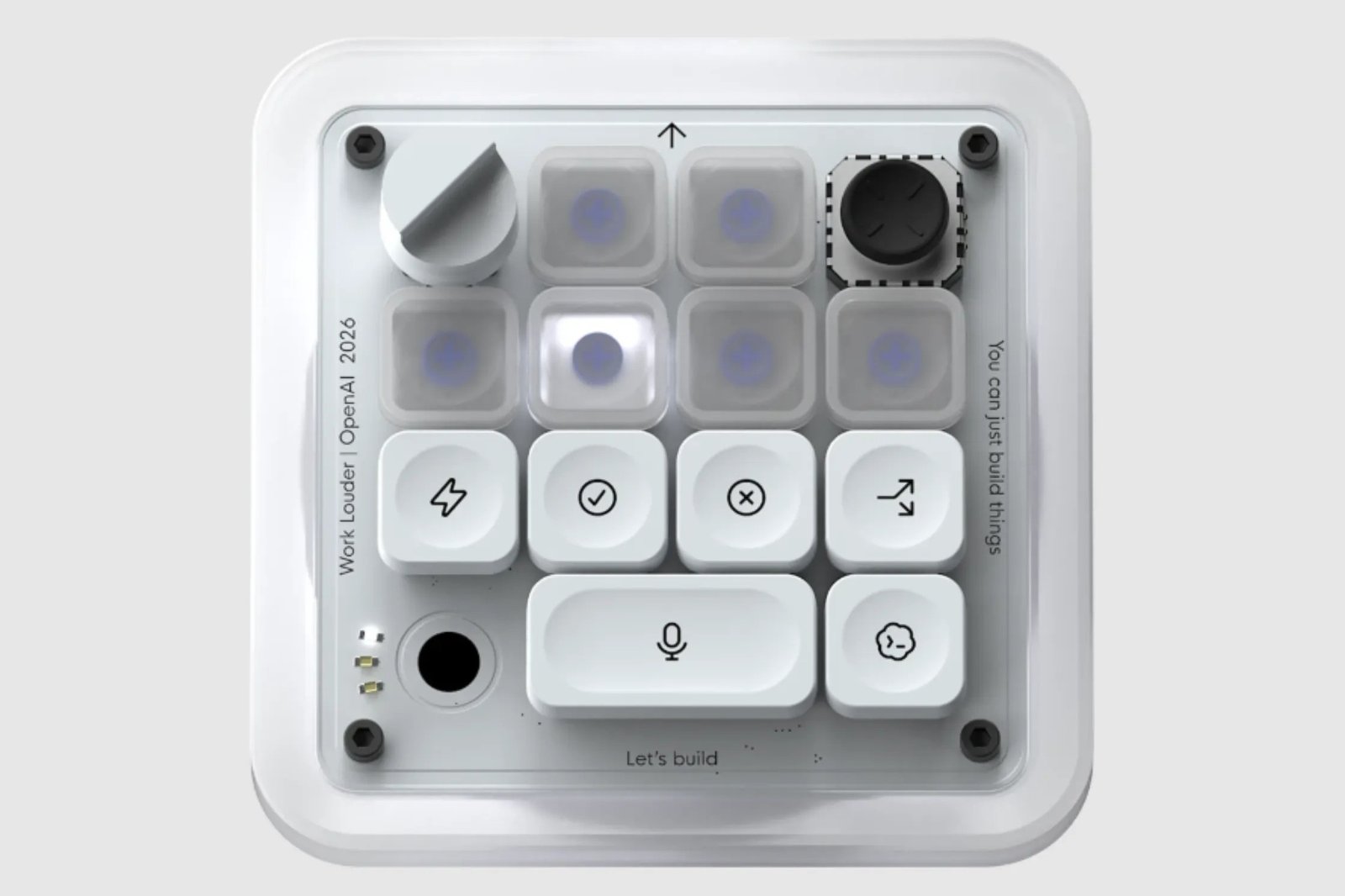
The device looks like a prop from a science fiction film set. Codex Micro, OpenAI’s first consumer hardware product, is a compact desktop keyboard with a row of programmable keys, a joystick, a dial and a touch sensor, priced at $230. The keys glow in colors that reflect the state of the coding agents running on the user’s machine: white for idle, blue for thinking, green for complete, amber for needing input, red for error.
The keyboard is built with Work Louder, a keyboard maker known for modular devices, and is being sold as a limited run through OpenAI’s supply store. It is designed for developers using Codex, OpenAI’s programming agent, letting them start, pause and switch between multiple agents running in the Codex command-line environment without hunting through terminal windows. The company announced the device on July 15.
Codex Micro is a small product with a large purpose. OpenAI has been pushing Codex hard, and the tool’s user base has grown quickly: roughly 5 million weekly active users in early June, accelerating to about 8 million by mid-July after the release of the GPT-5.6 model family, which powers the agents. The device is a way to make the agent workflow physical, an interface for people who manage several AI programmers at once.
The same day, OpenAI announced GPT-Red, an automated security testing system built to find and fix vulnerabilities before they reach customers. The system is designed to run prompt-injection attacks, attempts to manipulate AI models into ignoring their instructions, against OpenAI’s own models and patch the weaknesses automatically. The company said the system would be used ahead of the launch of GPT-5.6, its next flagship, to catch security holes that human testers might miss.
The two announcements fit a pattern. OpenAI is moving beyond pure software, building products and tools that lock developers into its ecosystem, while also burnishing its safety credentials at a moment when regulators and customers are asking hard questions about AI security. The keyboard addresses adoption, the security system addresses trust, and both are aimed at the same audience of developers and enterprises.
The hardware push carries legal baggage. Apple’s trade-secret lawsuit against OpenAI, which the company escalated this week, alleges that OpenAI’s hardware ambitions were built on stolen Apple information, including claims that OpenAI’s chief hardware officer, a former Apple executive, used Apple code names during recruiting and encouraged candidates to bring Apple devices to interviews. Apple has described OpenAI’s hardware business as relying on misappropriated secrets; OpenAI has denied the allegations.
The lawsuit hangs over every hardware move OpenAI makes. The company has been reported to be working on a smart speaker with Jony Ive, the former Apple design chief, whose company io Products was valued at around $4 billion last year. The Codex Micro, built with Work Louder’s chassis, is a smaller bet, but Apple’s lawyers have argued in court filings that all of OpenAI’s hardware work is tainted by the same conduct.
For now, the keyboard is a niche product. It is expensive for a peripheral, useful mainly to developers who already run Codex agents, and limited in quantity, and OpenAI has not said how many it made or whether it will be a permanent product line. The company has framed it as a developer tool rather than a consumer device, a distinction that matters for how the market values the hardware effort.
The strategic logic is clearer. OpenAI’s business depends on developers building applications on its models, and Codex has become its most visible developer product. Physical hardware, even a $230 keyboard, deepens the relationship: a developer who buys a Codex Micro has made a purchase decision that is hard to reverse, and the device’s status lights make the agent workflow feel essential rather than optional.
The security announcement addresses the other side of the business. Enterprises considering OpenAI’s models have been asking pointed questions about prompt injection, data leakage and model safety, and competitors including Anthropic have made security a selling point. GPT-Red, by automating the process of finding and fixing vulnerabilities, gives OpenAI a concrete answer to those questions and a story to tell in enterprise sales.
The two products also illustrate OpenAI’s ambition to control the full stack. Software, hardware, security tooling and the models themselves: the company wants to be the platform on which AI applications are built, and the company that sets the standards for how they run safely. Each product announcement moves that ambition forward, and each one also adds to the list of things Apple’s lawyers will argue OpenAI cannot do without them.
Analysts said the keyboard is best understood as a test. If developers buy it in meaningful numbers, OpenAI learns something cheap about demand for physical Codex accessories; if it fades, the exposure is small. The device sits at the edge of a much larger and more contested hardware effort, one that will be shaped as much in courtrooms as in design studios.