The number that has circulated through Silicon Valley for weeks is finally attached to a negotiation. Anduril Industries is in discussions with investors for a funding round that would value the defense technology company at roughly $100 billion, more than three times the mark it carried a year ago, according to two people familiar with the matter.
The valuation, first reported by Reuters on July 24, would place Anduril on par with Lockheed Martin, the Pentagon’s largest contractor and maker of the F-35 fighter jet, which trades at about $130 billion. It would also make the California startup one of the most valuable private companies in the world, a club currently dominated by AI labs and rocket companies.
The talks come at a moment of extraordinary momentum for the company. Anduril reported $2.2 billion in revenue for 2025 and doubled its workforce, according to a company statement in January. Military sales have boomed during the U.S. conflict with Iran, and investors have piled into its portfolio of drones, software and missiles.
The fundraising structure is drawing as much attention as the number. TechCrunch reported the round is being structured as a two-stage process, with a second tranche at a higher valuation that could close within the year, contingent on Anduril hitting financial targets. Industry lawyers said such arrangements, common in boom markets, give founders the upside of a rising valuation without committing to it in writing.
The pace of Anduril’s ascent is without precedent in defense. In June 2025, the company raised $2.5 billion at a $30.5 billion valuation led by Founders Fund. Two months ago, it doubled that, raising $5 billion at a $61 billion valuation in a round led by Thrive Capital and Andreessen Horowitz. A $100 billion mark would nearly double the May figure.
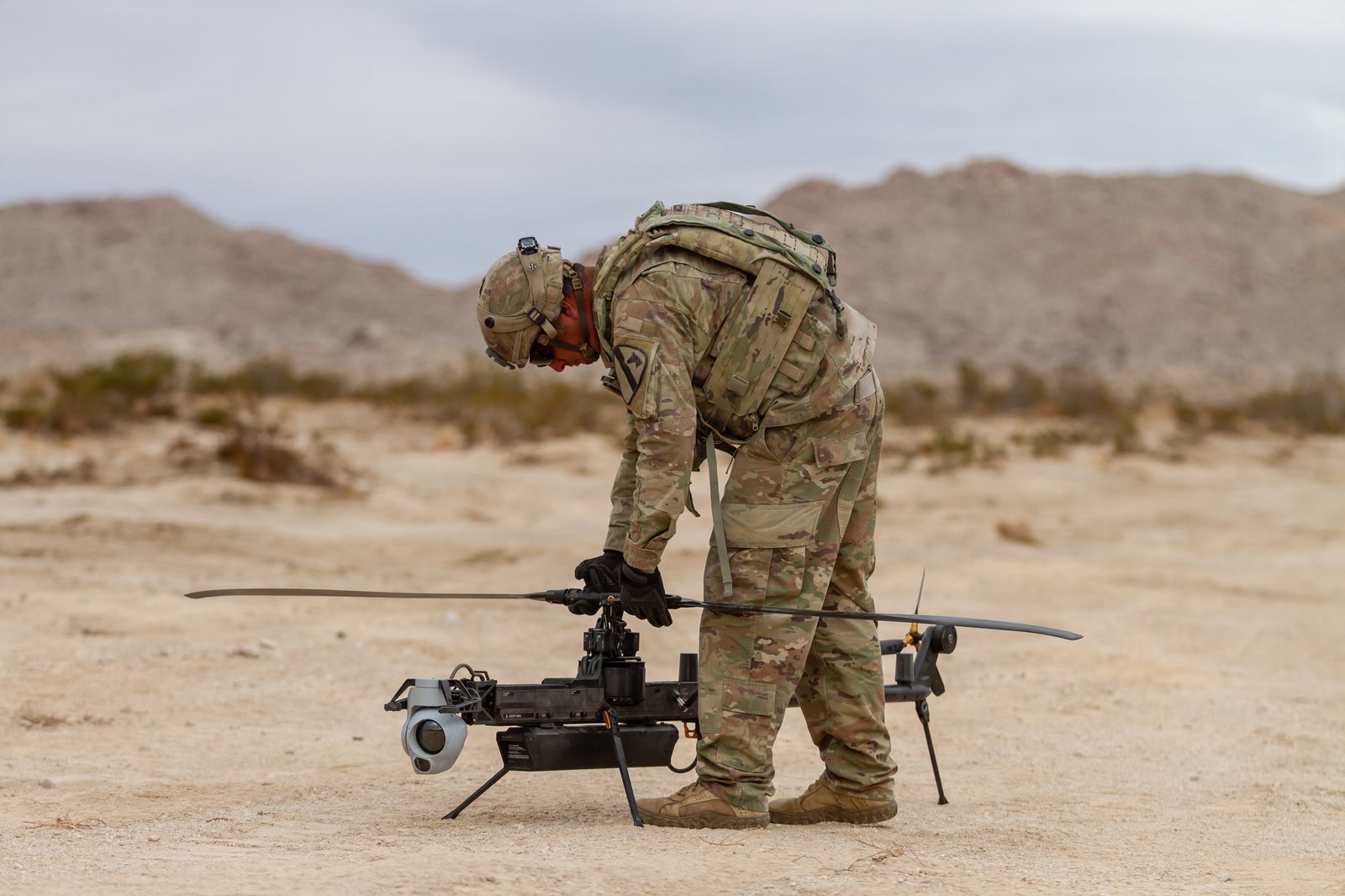
Founder Palmer Luckey has leaned into the moment. This week at the Farnborough Air Show in England, Anduril unveiled Thunder, a vertical-takeoff-and-landing drone designed to operate alongside military helicopter units. The company has spent the year announcing weapons, drones and software contracts at a pace that has kept its rivals — and the Pentagon — scrambling to keep up.
The valuation discussion says as much about the market as about Anduril. Defense technology has become the hottest corner of venture capital, as governments redirect spending toward cheaper, expendable systems that can be produced at scale. Anduril’s Lattice software platform, which fuses sensor data into a single operating picture, has become a staple of U.S. military operations.
Rivals are raising at record paces too. Helsing, the European defense startup, raised $1.8 billion this month at an $18 billion valuation. Shield AI reached a $12.7 billion valuation after a U.S. Air Force deal in March. Mach Industries quadrupled its valuation to $1.8 billion in June. The common thread is a shift toward attritable hardware — systems cheap enough to lose — over the expensive equipment that defined Cold War procurement.
The terms being demanded are unusual, people familiar with the discussions said. Fast-growing startups are increasingly wielding their market power to extract concessions from investors, from limited financial disclosures to extensive vetting. SpaceX, before its June public offering, imposed similar conditions on private investors, a template that defense and space startups have adopted.
A $100 billion valuation raises the bar for the company’s eventual exit. At that price, Anduril would need to justify multiples that assume years of defense spending growth and continued dominance of the autonomous systems market. Analysts said the company’s revenue trajectory — roughly tripling annually — supports aggressive assumptions, but the gap between revenue and valuation remains wide.
The structure of the round matters for another reason. By staging the raise in two parts, Anduril can lock in capital now and repriced later, depending on how its financial targets shake out. Investors who commit to the second tranche are effectively underwriting the company’s projections a year in advance, a bet most funds are unaccustomed to making.
The U.S. conflict with Iran has accelerated procurement across the board, and Anduril has been a direct beneficiary. Its drones and counter-drone systems have been deployed in active operations, giving the company real-world feedback that it has used to iterate products at software speed — an advantage traditional contractors cannot match. The Pentagon has also signaled it will buy more autonomous systems under multiyear contracts, a shift that favors suppliers who can manufacture at scale.
People familiar with the company said Anduril has no immediate plans to go public, preferring to stay private while the defense budget cycle favors its products. The two-stage round gives it the option to delay an IPO until the valuation environment suits it.
For the defense industry, the message is unambiguous: the old order is being repriced. A startup founded in 2017 by Palmer Luckey, then a 24-year-old known for making virtual reality headsets, is now worth nearly as much as the company that built the F-35. Whether the Pentagon’s procurement system can absorb the change — and whether Anduril can deliver on its promises at this scale — will define the next phase of the defense economy.