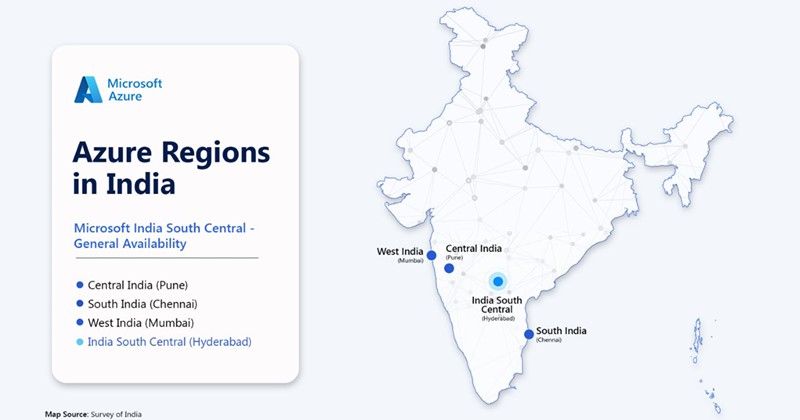
HYDERABAD—The cranes have come down and the servers are running. Microsoft said on Aug. 6 that its cloud region in Hyderabad, the capital of Telangana state, has officially opened, making it the company’s fourth cloud region in India and its largest data center campus in the country. The facility is part of the roughly $20 billion Microsoft has committed to invest in India, a bet that the world’s most populous nation is about to become one of the biggest markets for cloud computing and artificial intelligence. Early customers include some of India’s largest companies: the Adani Group, Bajaj Finserv, HDFC Bank and PB Pay, the fintech backed by PhonePe’s founders.
The timing is no accident. India’s data center market has been growing at a furious pace, driven by a government push for data localization, the explosion of mobile payments and the arrival of AI workloads that demand domestic compute. Foreign companies operating in regulated sectors—banking, insurance, payments—face pressure to keep data inside the country, and every global cloud provider is racing to build the local capacity to serve them. Microsoft now has regions in Pune, Mumbai, Chennai and Hyderabad, a footprint that covers the country’s business centers and its southern tech corridor.
The Hyderabad campus is the centerpiece. Microsoft has described it as its largest data center investment in India, spanning multiple buildings designed for the high-density racks that AI workloads require. The region will offer the full range of the company’s cloud services, including its Azure AI stack, and Microsoft has said it expects demand to come from financial services, manufacturing and the public sector. The company’s early customer list reads like a map of India’s digital economy: Adani, the conglomerate building out its own data center ambitions; HDFC Bank, the country’s largest private lender; and Bajaj Finserv, the financial services giant that runs one of India’s biggest consumer lending platforms.
The competitive stakes are high because India is the rare market where all three global cloud giants are going all-in at once. Amazon’s AWS has operated in the country for over a decade and remains the market leader, with the largest installed base among Indian enterprises. Google has invested heavily in India, including a data center in the country’s south and a tie-up with the telecom giant Jio. Microsoft’s pitch is its enterprise heritage: decades of relationships with Indian companies, a deep bench of local partners and the increasingly popular Azure AI platform. The battle for India’s cloud workloads is being fought on price, on compliance and on the speed of local deployment.
The government’s posture is a tailwind. New Delhi has pushed a data protection regime that requires sensitive data to be stored domestically, and it has encouraged the buildout of local data centers as a matter of digital sovereignty. The result is that cloud providers must physically be in India to compete for the largest customers, and the cost of that presence is rising as land, power and cooling become scarcer. Data centers are a heavy-asset business with long payback periods, and the companies that lock in enterprise relationships early will hold an advantage for years.
India’s AI opportunity is the subtext of the entire buildout. The country has one of the world’s largest pools of software engineers, a government that is digitizing public services at scale, and a population of 1.4 billion that is rapidly adopting smartphones. The demand for AI inference—the work of running models once they are trained—is expected to be enormous, driven by Indian languages, local businesses and government applications. Microsoft and its rivals are positioning their Indian regions to capture that inference demand, which is why the new Hyderabad campus is engineered for AI workloads rather than just general-purpose computing.
Power remains the constraint that will shape the market. India’s grid is expanding but data center developers across the country face long waits for reliable power connections, and the southern states where most facilities are concentrated have dealt with recurring shortages. Microsoft has said it is investing in renewable energy to supply its Indian operations, and the company has signed power purchase agreements to back its commitment to run its data centers on clean energy. The economics of the Indian market, where customers are price-sensitive and competition is intense, make power costs a decisive factor.
The opening of the Hyderabad region also carries a signal for Microsoft’s broader Asia strategy. The company has been expanding its cloud footprint across the region, with new regions in Southeast Asia and plans in Japan, and India is the largest single market in that push. Microsoft’s investment of roughly $20 billion in the country is among its biggest commitments anywhere, and the company’s leadership has described India as central to its long-term growth. The Hyderabad launch is the most tangible evidence of that commitment to date.
Analysts said the early customer list shows Microsoft is competing on compliance and relationships rather than price alone. HDFC Bank, Adani and Bajaj Finserv are all companies that prize data security and regulatory alignment, and their presence as launch customers gives Microsoft a reference point for the next wave of Indian enterprises moving to the cloud. The question is whether Microsoft can convert that momentum into market share against Amazon’s entrenched lead. The company has done it in other markets by combining infrastructure with software that customers already use, and its Azure AI portfolio is widely regarded as the strongest of the three. In a country that is only beginning its cloud migration, the race is still early, and Hyderabad is Microsoft’s stake in the ground.