
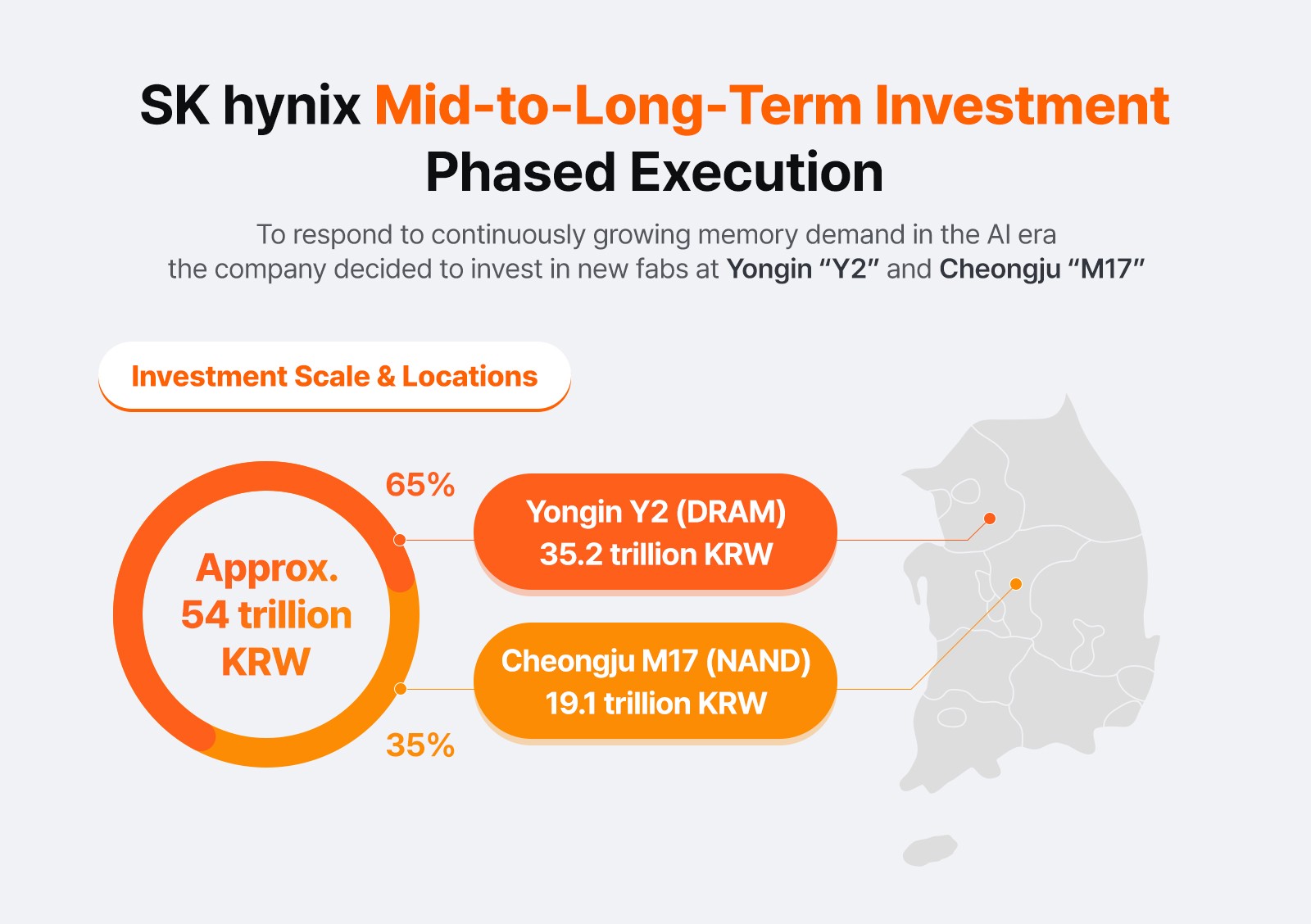
SEOUL—The two-page disclosure landed on South Korea’s stock exchange shortly after the opening bell on Aug. 7, and by lunchtime it had become the most-watched filing in the country’s chip industry. SK Hynix said it will invest 19.1 trillion won through April 2031 at its M17 fab in Cheongju and another 35.2 trillion won through October 2031 on a second-phase wafer plant at the Yongin semiconductor complex. The two projects total roughly 54 trillion won, or about $38 billion, and mark the largest capacity investment in the memory maker’s history. Cleanrooms at the new facilities are scheduled to come online in 2028 and 2029.
The scale of the commitment reflects a bet that demand for memory is no longer a cyclical spike but a structural shift driven by artificial intelligence. High-bandwidth memory, the specialized chips stacked beneath Nvidia’s AI accelerators, has been in shortage for more than a year, and prices for standard DRAM have climbed through consecutive quarters as server makers compete for supply. SK Hynix has been the dominant supplier of the highest-margin HBM grades, and executives in Seoul have said publicly that its production capacity for the current generation is sold out well into next year. The new spending, spread across Cheongju and Yongin, is aimed squarely at that gap between what the company can make today and what its customers have already asked for.
The company paired the disclosure with a promise that it will announce a new shareholder-return program in the third quarter. The gesture appeared aimed at investors who have watched SK Hynix pour cash into fabs for two straight years while its stock moved sideways. Memory makers historically traded at low valuations because capacity always arrives just as prices fall, and the industry’s scars from the 2022 downturn remain fresh. SK Hynix is trying to argue that this cycle is different, that the demand is contracted and the technology harder to replicate, and the return plan is the sweetener for anyone who still doubts it.
Executives have described the decision in unusually personal terms. The company’s management, many of whom survived the 2008 crisis and the 2022 glut, said repeatedly this year that they would rather leave growth on the table than build ahead of demand. The Aug. 7 filing reverses that caution with a single stroke. People familiar with the company’s planning said the decision to expand at the top of the cycle was made after customers signed multiyear supply agreements for HBM, giving SK Hynix enough committed volume to justify the construction. Analysts said the timing also reflects pressure from Samsung Electronics, which has accelerated its own HBM qualification efforts at Nvidia and is rebuilding capacity in Pyeongtaek.
The investment lands at a delicate moment for the broader memory market. DRAM contract prices are near multiyear highs, and every major producer is now expanding at once. Samsung has committed tens of trillions of won to its own fab plans, and Micron Technology is building in Idaho and New York with support from U.S. CHIPS Act grants. When all three expand simultaneously, the industry’s historical playbook says oversupply follows within two to three years. Some analysts have already begun flagging 2027 and 2028 as risk years, when the first wave of new cleanrooms opens just as AI server growth is expected to slow from its current pace.
SK Hynix’s answer is that the demand curve has changed shape. AI data centers consume far more memory per server than the traditional cloud workloads that preceded them, and each generation of accelerator increases the amount of HBM attached to every chip. The company’s executives argue that the industry’s old boom-bust math, built on personal computers and smartphones, no longer applies when a handful of hyperscalers sign contracts for years of supply. The Yongin complex, once conceived as a long-term land bank, is now being built out in earnest, and the Cheongju M17 expansion doubles down on the same wager.
The practical work begins immediately. Construction crews in Cheongju will start on the M17 cleanroom this year, while design teams in Yongin finalize the second-phase layout for a site that the government has designated as a national strategic industrial park, complete with expedited permitting and subsidized power lines. South Korean officials have cheered the plan as a win for the country’s ambition to keep advanced memory manufacturing at home, particularly as Washington pushes allies to build more chip capacity inside the United States. The government’s industrial ministry said the two sites would anchor Korea’s position in the AI supply chain for the next decade.
For investors, the numbers are straightforward: 54 trillion won against a company whose annual capital spending has hovered around 20 trillion won in recent years. The commitment implies several years of elevated spending, funded by record operating profits and a cash pile that management has said it wants to deploy rather than hoard. The shareholder-return announcement in the third quarter will tell investors how much of the upside they get to keep.
The bigger question is what the investment says about the two companies at the top of the memory industry. SK Hynix and Samsung have spent the past two years trading jabs over HBM quality and qualification timelines, and the Aug. 7 filing makes clear that the rivalry now extends to capacity. Samsung’s pressure is visible in its own expansion plans and in its aggressive push to close the HBM gap with its latest parts. SK Hynix, by committing first and at record scale, is trying to set the pace. The risk, as always in memory, is that both build too much. The bet, as SK Hynix’s management frames it, is that AI demand will make this cycle different from every one that came before. The first cleanrooms open in 2028. That is when the industry will find out who was right.



