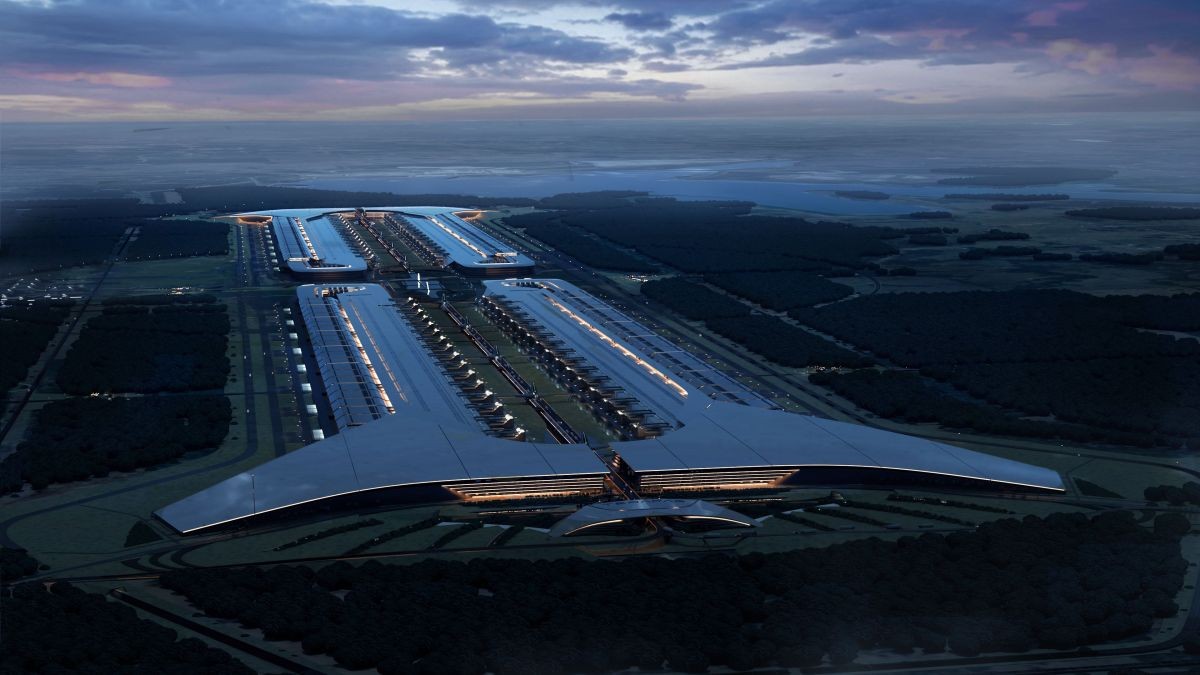
GRIMES COUNTY, Texas—The announcement went out late on Aug. 6 with the kind of numbers that usually accompany national infrastructure projects, not corporate press releases. SpaceX and Tesla, the two companies controlled by Elon Musk, said they will build a chip-making center called Terafab in this rural county northwest of Houston, with a first-phase investment of $16.8 billion. The facility will combine design, manufacturing, packaging and testing under one roof, a structure the companies say is intended to become the largest chip plant on Earth. The target, repeated in the announcement without a specific production timeline, is a terawatt of compute capacity a year—1,000 gigawatts—to be consumed by Tesla’s self-driving systems, the Optimus humanoid robot and orbital data centers.
The project is an unusual bet for two companies whose core businesses have nothing to do with semiconductors. Tesla has designed its own custom chips for years, most notably the FSD computer that powers its driver-assistance software and the Dojo training chip developed in-house, but it has always contracted manufacturing to foundries such as Samsung. SpaceX has relied on commercial suppliers for the electronics that fly on its rockets and Starlink satellites. Terafab, as described in the announcement, would change that equation, bringing advanced chip production under Musk’s direct control and reducing dependence on outside vendors. The companies said the site will span more than 100 million square feet and support at least 3,000 jobs, with Musk describing the finished facility as “the largest and most valuable building on Earth.”
Land and power have been the two commodities that decide where chip plants can go, and Grimes County offers both. The region sits near the Texas grid that has become a magnet for data centers and industrial power users, and the county has courted large industrial projects with expedited approvals. Local officials said in response to the announcement that negotiations over the site had been underway for months, though neither company disclosed whether state or county incentives were part of the deal. Texas has no corporate income tax and has made itself a favored destination for Musk’s ventures; the billionaire moved Tesla’s headquarters to Austin in 2021 and SpaceX operates a launch site in the southern part of the state.
The engineering questions are harder than the political ones. Building a chip plant requires thousands of precision tools, ultrapure water systems and cleanrooms that hold contamination at near-zero levels. The world’s most advanced fabs, run by Taiwan Semiconductor Manufacturing Co. and Samsung, cost more than $20 billion each and take three to four years to reach volume production. SpaceX and Tesla have never operated a facility of this kind. The announcement acknowledged the scale of the ambition by declining to set a capacity target for the initial phase, saying only that Terafab would ultimately produce a terawatt of compute. Musk has said publicly that he expects the first wafer to come off the line after 2028.
The technology question is which chips the plant will actually make. Musk’s companies have multiple internal silicon programs, including the next-generation Tesla AI5 computer and Dojo upgrades, and he has spoken about building custom accelerators for xAI, his artificial-intelligence company. Terafab’s output could feed all of them, a vertically integrated structure that mirrors what Apple achieved with its own chip team and what Amazon is attempting with its Trainium processors. The difference is that Apple and Amazon still rely on foundries; Terafab would own the factory.
Industry veterans greeted the plan with a mixture of respect and skepticism. Building a competitive leading-edge fab takes years of process engineering that cannot be bought outright, and even experienced semiconductor companies have stumbled on new-node ramps. Analysts noted the project’s economics depend on Musk’s compute-efficiency claims, which would require chips that outpace Nvidia’s accelerators on power and cost. People familiar with the industry said the realistic path for Terafab is likely to begin with mature-node chips, the kinds of components used in vehicles and satellites, before attempting anything close to leading-edge logic. Those parts are easier to make and less dependent on the most advanced lithography, which remains dominated by a single supplier in the Netherlands.
The announcement also carries political weight. The United States has poured federal money into domestic chip manufacturing through the CHIPS Act, and the Commerce Department has urged companies to build capacity on American soil. A Musk-backed fab in Texas fits the administration’s narrative of reshoring critical industries, and the project gives Washington another data point for building AI infrastructure at home. At the same time, the scale of the claim invites scrutiny; 100 million square feet would make Terafab one of the largest buildings ever conceived, larger than anything currently under construction in the industry.
For Grimes County, the immediate effects are tangible. The county’s population is about 30,000, spread across small towns and ranchland, and a construction project of this size will reshape the local economy before a single chip is produced. Roads, housing and schools will need to catch up with a workforce that the companies say will number in the thousands, with construction labor peaking even higher. Officials in nearby counties, which lost similar projects to Grimes in the bidding, are watching closely.
The most honest summary of the project came from Musk’s own framing: it is a bet that the future of computing is large enough to justify an entirely new industrial complex, and that his companies can build what the semiconductor industry spent decades perfecting. The first wafer is scheduled for some point after 2028. Until then, Terafab exists as a plan, a patch of Texas land and a very large number on a press release. Whether it becomes the largest building on Earth depends on the same thing every chip project depends on: the people who have to make the machinery work.