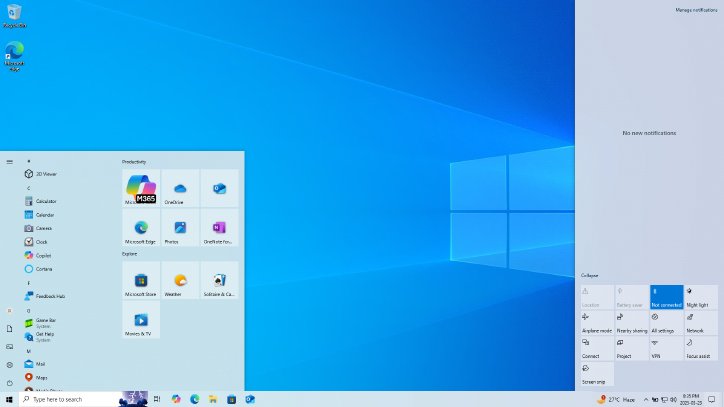
China’s Ministry of State Security has told some state institutions to remove the government-customized edition of Microsoft’s Windows 10 from their computers, earlier than the original timetable, Bloomberg reported on Aug. 18. The directive landed without fanfare, but its meaning is clear: the last enclave of American PC software in the Chinese public sector is being closed.
The order is the latest step in Beijing’s campaign to replace U.S. software with domestic alternatives. Chinese-made operating systems, built largely on open-source Linux kernels and commercialized by vendors such as Kylin and UOS, have already been rolled out across party and government offices over the past several years. The uninstall order extends that substitution to the customized Windows builds that had survived the earlier rounds.
Government-customized Windows editions had been a durable Microsoft business in China since the 2000s, when Beijing licensed tailored versions of the operating system for state use. The relationship was never warm. China barred Windows 8 from government procurement in 2014, and the broader substitution campaign accelerated after tensions between Washington and Beijing deepened. What survived was a customized Windows 10 build maintained specifically for government customers, and that, too, is now being uninstalled.
The timing is notable. The Ministry of State Security is a security agency, not a procurement office, and its involvement signals that the concern is not simply about cost or domestic industry promotion but about control over the software running on government machines. The order came ahead of the planned schedule, which suggests urgency, and it applies to at least some state institutions, with the scope of the rollout still unclear.
The security rationale is straightforward. A customized operating system built by a U.S. company contains code that Chinese security officials cannot fully audit, telemetry that reports usage data back to its maker, and update channels controlled from abroad. For a government that has spent years trying to secure its digital infrastructure, that combination became indefensible. The domestic systems replacing Windows are no more secure by default, but they are auditable, which is the point.
For Microsoft, the loss is strategic rather than financial. China’s public sector was always a small slice of the company’s global revenue, and the consumer and commercial markets in China operate under their own dynamics. But the government business was a beachhead, a reason for Microsoft to maintain a China operation and a source of influence that no longer exists. With the state stack emptied of Windows, the company’s relevance to Chinese officialdom shrinks to its cloud and enterprise offerings, which face their own regulatory headwinds.
The substitution campaign, which Beijing groups under the banner of IT application innovation, covers the full stack: chips, operating systems, databases, and office software. The Windows removal is one column in that ledger, and it follows the pattern set by the hardware push, in which domestic chips replaced foreign ones in government systems before expanding outward. Software is moving through the same sequence.
Analysts said the pace is accelerating because the security rationale has merged with the industrial one. Every government machine that runs a domestic operating system is a demand signal to Chinese software companies, which have struggled for years to reach the scale needed to fund serious research and development. The public sector is their training ground, and the uninstall order expands it.
What is left for Microsoft in China is a question the company has been avoiding. The consumer market remains large, and enterprise cloud services still find customers, but the government segment was the anchor of the relationship, the reason for decades of localized development and regulatory engagement. With it gone, Microsoft’s China operation becomes a commercial outpost rather than a strategic position, and the direction of travel is not in doubt.
The campaign has deep roots. Chinese operating systems have been in development for two decades, with government-backed projects producing Linux-based systems such as Kylin for official use, but they long suffered from poor software compatibility and limited developer support. The push to make them viable began in earnest after the tensions of the late 2010s, when the government concluded that dependence on American software was a strategic vulnerability, and procurement rules began directing state bodies toward domestic options.
The software substitution has followed the hardware playbook. Beijing moved first on chips, then on operating systems, then on databases and office software, and each step created demand that Chinese vendors used to fund product development. The Windows uninstall order is a demand shock for the domestic OS vendors, which have spent years building products for a market that was promised but slow to arrive; now the orders are arriving.
The ripple effects reach beyond Microsoft. Chinese institutions that drop Windows will also reconsider the American productivity software that runs on top of it, and domestic alternatives to office suites and email have been the beneficiaries of similar procurement shifts. For U.S. software companies, China’s public sector has gone from a market to a liability, and the calculation of whether to invest in the country at all has changed.
The pace is the surprise. The order came ahead of the original schedule, which suggests the security establishment wanted the transition completed sooner than the procurement bureaucracy had planned, and other agencies are likely to follow the state security ministry’s lead. What began as a gradual substitution program is becoming a forced migration, and the timeline for removing American software from the Chinese state is now measured in months rather than years.