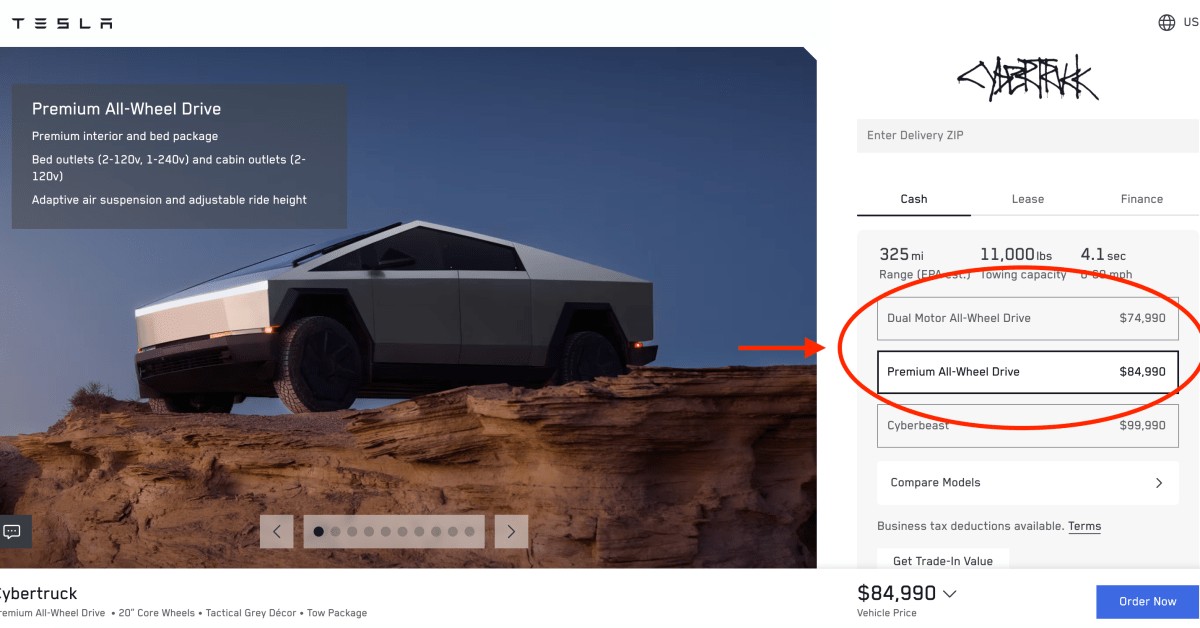
Tesla has increased the price of both versions of the Cybertruck by $5,000, Reuters reported on Aug. 25, a move that pushes the angular pickup deeper into luxury territory even as its sales have slid. The base all-wheel-drive model now starts above $85,000, and the top-tier version approaches six figures. The company did not announce the change; it appeared quietly in the pricing on its website.
The increase is a deliberate choice between two strategies. With Cybertruck sales falling, Tesla could have cut prices to stimulate demand, the playbook it used repeatedly with the Model 3 and Model Y. Instead it raised them, signaling that the company has decided the Cybertruck’s future is as a low-volume, high-margin halo vehicle rather than a mass-market pickup. The pricing decision suggests cost pressure on the vehicle’s unusual stainless-steel body and giant castings has overwhelmed any interest in volume.
The Cybertruck has been a problem child for Tesla since its launch. Unveiled in 2019 with a promised starting price around $40,000, the truck arrived four years later at nearly double that, and early production was plagued by assembly issues. Tesla executives acknowledged the vehicle’s complexity, and the company has gradually positioned it as a niche product for buyers who want something no other manufacturer makes. The price increases continue that repositioning.
Sales data tell the story. Cybertruck deliveries peaked in the quarters after launch and have declined since, according to industry estimates, as the initial wave of reservation holders took delivery and broader pickup buyers chose more conventional trucks. In the U.S. market, where full-size pickups are a fiercely competitive category led by Ford, General Motors, and Stellantis, the Cybertruck has carved out a small but loyal following. Tesla has not published Cybertruck-specific figures in recent quarters, a departure from its earlier enthusiasm about the vehicle.
The economics of the truck explain the pricing. The Cybertruck’s exoskeleton, made from ultra-hard stainless steel, is expensive to form and paint, and the vehicle’s size pushed it into the largest, most costly category of casting and battery. Every unit sold at a lower price would have widened the losses Tesla absorbed during the model’s production ramp. Raising prices, even as demand softens, protects margin on a product that will never achieve the scale of Tesla’s core models.
The decision also reflects Tesla’s broader situation. The company’s vehicle deliveries have been under pressure globally, and its stock price has swung with the fortunes of its AI and robotaxi ambitions rather than its car sales. In that context, a pickup truck with declining volume matters less for the company’s valuation than the progress of its autonomous-driving software. Tesla’s leadership appears to have concluded that the Cybertruck’s job is to generate attention and margin, not volume.
Customers who ordered at the lower price are caught in the change. Tesla’s policy has been to honor prices for reservation holders at the time of order, but new orders and many configured builds now carry the higher price. Forums and owner groups have filled with complaints from buyers who watched the truck’s price climb by thousands of dollars between reservation and delivery, a pattern that has repeated across Tesla’s lineup as costs rose.
The competitive picture gives Tesla room to move up. The pickup market’s luxury end, trucks priced above $80,000, is thin but real, populated by heavily optioned versions of the Ford F-150 Raptor and the Ram TRX. The Cybertruck’s design gives it a category of one, and Tesla is betting that the buyers who want it will pay whatever it costs. Analysts said the strategy is defensible as long as Tesla keeps the truck’s production costs under control and its quality reputation intact.
For the broader industry, the Cybertruck’s trajectory is a case study in the limits of novelty. The truck demonstrated that Tesla can build a vehicle unlike anything else on the market, and that a dedicated audience will pay premium prices for it. It also demonstrated that unconventional design does not automatically translate into mass-market volume, and that the engineering compromises required for a stainless-steel pickup carry persistent costs. Rival automakers, which initially scrambled to respond to the Cybertruck, have largely concluded that conventional trucks with electric drivetrains are the safer bet.
Tesla’s own messaging has shifted accordingly. The company’s launch events emphasized the truck’s toughness and its ability to replace the traditional pickup. Recent communications have emphasized its presence as a statement piece and its role in Tesla’s lineup as the most expensive, most distinctive vehicle it sells. The $5,000 increase is the price of that positioning, and it is unlikely to be the last.
The question now is how much demand the higher price costs Tesla. The truck’s reservation backlog, once enormous, has thinned, and the buyers remaining are those who want the vehicle for its own sake rather than for its value proposition. Tesla appears willing to accept lower volume in exchange for profitability on each unit, a trade that makes sense for a vehicle that was never going to win the sales race against trucks that cost half as much.