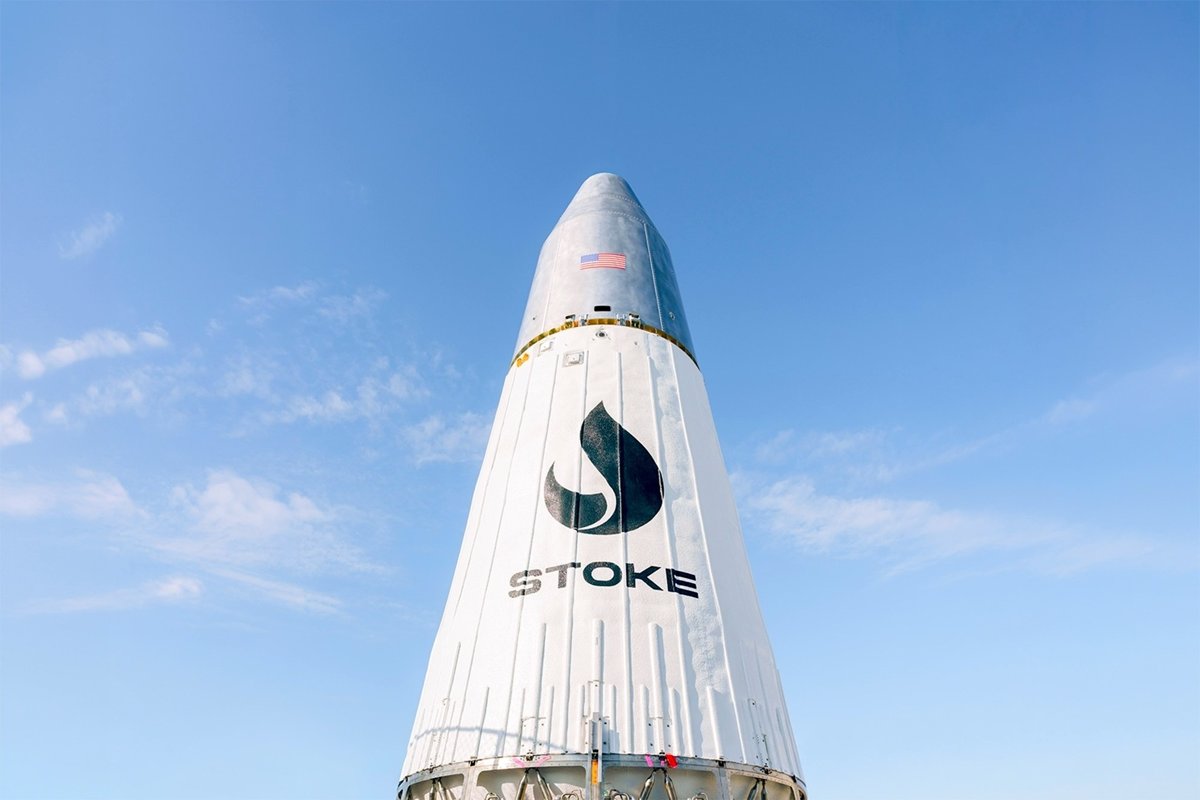
The company’s pitch to investors has been the same since its founding: build a rocket where everything comes back. On Tuesday Stoke Space announced the funding to keep pursuing that goal, closing the first tranche of a $1 billion Series E round led by Point72 Ventures and Spark Capital, with Y Combinator among the participants. The company said its total funding now stands at $2.3 billion.
The ambition behind the money is easy to state and hard to execute. Every orbital rocket in operation today is either expendable or only partially reusable, with the industry’s progress so far concentrated in the first stage, the booster that carries a vehicle through the lower atmosphere and returns to land. Stoke’s goal is full reuse: a first stage that comes back to Earth, and a second stage that returns with its payload delivered, ready to fly again.
No company has done it. The second stage is the harder half of the problem, because it enters orbit and returns through the heat of reentry, which means it needs thermal protection of a kind that first stages never require. SpaceX has spent well over $10 billion developing Starship, its fully reusable system, and has yet to bring the vehicle’s upper stage back intact through a complete mission. Stoke is attempting the same problem with a fraction of that budget.
The company’s answer to the hardest part of the challenge is what attracted the investors in Tuesday’s round. Stoke has designed its second stage with an active cooling system that circulates liquid hydrogen through the vehicle’s structure to absorb heat during reentry, a scheme that could replace the heavy heat shields that other vehicles carry. The company said the approach has passed ground tests at its Moses Lake facility in Washington state, the site where it has been validating the technology.
The vehicle that would carry the design, called Nova Pathfinder, could make its first flight as early as early 2027, according to the company. The timeline is ambitious for a rocket that has not yet flown, and Stoke’s executives have been careful to describe the schedule as a target rather than a promise. The industry’s history is littered with vehicles whose first flights slipped by years, and a company raising this much money on this schedule will be watched closely for every delay.
The engineering bet underneath Nova is that new materials and new manufacturing methods have changed the economics of reuse. Stoke has said its upper stage is designed so that the engines sit inside the vehicle’s structure, protected by the active cooling rather than shielded behind a disposable heat shield. The design trades complexity at the vehicle’s most demanding point for simplicity in operations: if the second stage returns intact, the cost of each launch falls to propellant, maintenance and the overhead of turning the vehicle around.
The investors in the round represent a shift in how the space industry is being funded. Point72, the family office of investor Steve Cohen, and Spark Capital, a technology investor, are not traditional aerospace backers, and their participation signals that the economics of reusable launch have begun to attract generalist capital. Y Combinator’s presence ties Stoke to the startup ecosystem that the company’s founders came from, an unusual lineage for a heavy-industrial venture.
Stoke’s founders built the company on lessons from the industry’s giants. Both came from Blue Origin, Jeff Bezos’s space venture, and they founded Stoke in 2019 with a critique of the industry’s incremental approach: rather than recovering stages one component at a time, they argued, design for recovery from the start. The company’s early years were spent on the second stage’s thermal problem, on the theory that it was the binding constraint on full reuse, and the Moses Lake tests suggest that bet is paying off.
The competitive field has grown crowded around the same insight. SpaceX’s Starship has driven every serious launch company to reconsider reuse, and a new generation of vehicles in the United States and Europe has made recovery a design requirement rather than an afterthought. Stoke’s position in that field rests on the claim that its approach to the second stage, the part everyone else has struggled with, gives it a path to the lowest launch costs in the industry.
The test will come in the air over the Pacific Northwest. A successful Nova Pathfinder flight would make Stoke the first company to demonstrate the technologies of full reuse in flight, and the first flight is scheduled within a window the industry has learned to treat with skepticism. If it works, the $2.3 billion Stoke has raised will look cheap for what it bought; if the schedule slips and the budget grows, the company will join a long line of ventures that discovered the gap between a promising design and a flying rocket.