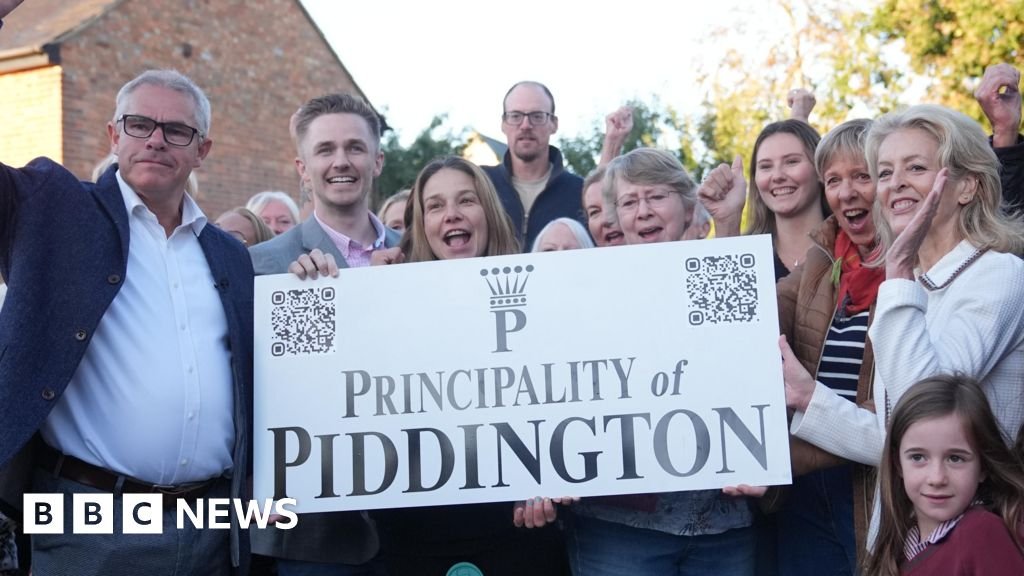
The wooden sign went up at the village entrance this week. It reads “Principality of Piddington,” and it is the product of a vote held on September 16, 2026, in which the residents of one Oxfordshire parish decided, symbolically at least, that they no longer wished to be governed from London. The result was 285 in favor of independence, 26 against, and one spoiled ballot.
Piddington is a village of 358 residents, and the turnout, at roughly 92 percent, was higher than almost any national election in Britain has managed in decades. The vote carries no legal force. It binds no government, transfers no sovereignty, and will not appear on any official map. What it measures is a mood.
The parish council chairman, reported as McNally, told reporters the vote was only the beginning. Hundreds of villages across the United Kingdom, he said, were preparing to follow Piddington’s example. Whether that claim holds will be tested in the coming months; for now it is a statement of intent from a place whose entire grievance fits on a single wooden board.
The proximate cause of the rebellion was not abstract. British press reports said the village had been identified as a site where the government planned to house asylum seekers, and the vote was cast as a protest against that plan. The sign, the ballot, and the talk of independence are the village’s answer to a policy handed down from Whitehall, the latest chapter in a long-running argument about who gets a say in what happens to a small community.
The episode belongs to a tradition with deep roots in England. Villages have been seceding from things for as long as there have been boundaries to cross. The Cornish town of St Ives, the London borough of Frestonia in the 1970s, and a string of Welsh and Scottish hamlets have all, at one time or another, declared themselves free of the authorities that nominally govern them. None of it changed the map.
What is different this time is the audience. In 2014 Scotland held a full referendum on independence and came within a few points of leaving the union. In 2016 Britain voted to leave the European Union, a decision that cracked the country’s politics along new lines. In that context, a village ballot over asylum housing reads less like a joke and more like a symptom of a country still working out what holds it together.
The asylum question has become the sharpest edge of that argument. The government has pressed local authorities across England to accept accommodation for people awaiting decisions on their claims, and rural communities in particular have pushed back, arguing that small villages lack the services to absorb an influx. Piddington’s vote is one village’s way of saying the decision should not have been made without it.
Local government specialists said the practical effect is close to zero. A parish council cannot opt a village out of national law, and a wooden sign confers no constitutional status on the 358 people behind it. The value of the gesture, they said, is political rather than legal, a way of forcing a national policy back into local view.
McNally’s claim about hundreds of villages preparing to follow is difficult to verify, but it points at something real. A network of parish councils shares grievances about planning, housing, and the sense that decisions are made elsewhere. Whether that network can translate local frustration into anything resembling a movement is the open question the Piddington vote has raised.
The village itself remains, for now, a place of ordinary English life. A church, a pub, a school, and a few hundred residents who on a single September day chose to declare themselves a principality. The sign at the entrance is the only visible change, and it may prove to be the most durable thing the vote produced.
England’s parish councils are the smallest tier of local government, and their actual powers are modest: footpaths, allotments, bus shelters, and a voice in planning consultations. It is precisely that smallness that gives the gesture its force. When a body with so little authority votes to leave the country, the vote is not really about the country; it is about the distance between the people and the decisions that shape their lives, a distance many residents feel has widened faster than anyone in Westminster has acknowledged.
The episode will be read two ways. To its supporters it is a small act of defiance against a distant government. To its critics it is a stunt that trivializes a serious question about how Britain houses the people arriving at its borders. Both readings are probably true at once, which is what makes the village’s 285 votes so hard to dismiss as nothing.
For now the Principality of Piddington exists only in the imagination of its founders and in the paint of a sign. That is often how such things begin, and it is also, just as often, where they end.