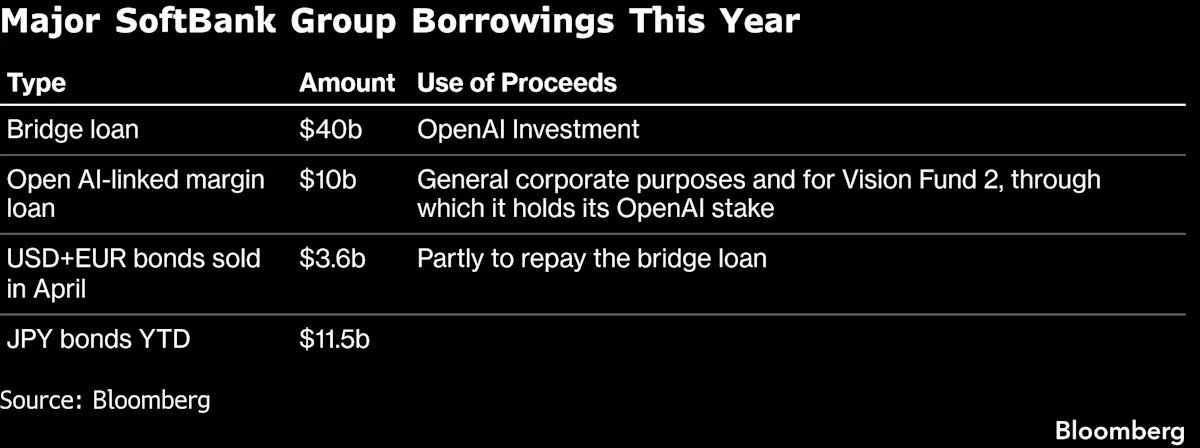
SoftBank Group went back to its most reliable source of capital and asked for more. The Japanese conglomerate has increased the margin loan it holds against its shares in chip designer Arm by $5 billion, bringing the total to $25 billion, and the new terms were renegotiated and signed with lenders this month. The borrowed money is earmarked for the expanding artificial-intelligence bets of founder Masayoshi Son.
The loan is secured by Arm stock, the company’s most valuable asset, and it has become a recurring instrument in Son’s financing playbook. This is the third time SoftBank has enlarged the margin loan against its Arm stake. Each expansion converts paper wealth in the chip designer into cash that can be deployed elsewhere, without selling the shares outright.
The cash is headed toward AI. Son needs tens of billions of dollars for his growing slate of investments, the largest of which is a commitment of close to $65 billion to OpenAI. The margin loan is one piece of a financing apparatus that SoftBank has been steadily widening as the scale of its AI spending has grown.
The same month brought a second piece. SoftBank extended a credit facility of about $6.05 billion that was due to mature, rolling it forward for another year and adding $450 million of new capacity to bring the total to $6.5 billion. The rate on that facility is SOFR plus 210 basis points, and more than twenty banks participated. The terms suggest lenders remain willing to extend credit to SoftBank, but at a price that reflects the debt involved.
Bloomberg reported earlier that Apollo was considering lifting its own loan to SoftBank to $9 billion, with the money pointed toward the OpenAI investment. If that materializes, it would be another tranche of debt stacked against the same wager on the AI developer.
Son’s AI ledger is distinguished by how much of it runs on borrowed money. The strategy has a straightforward logic: Arm’s stock, which has multiplied since its 2023 listing, provides collateral that can be tapped to fund stakes in companies Son believes will define the next era of computing. The risk is equally straightforward. A fall in Arm’s share price would shrink the value of the collateral and could force the lender to demand more.
The margin loan is also a measure of how central Arm has become to SoftBank’s balance sheet. The chip designer, which SoftBank took private in 2016 and re-listed in 2023, now does double duty as a business and as a funding source. Its stock price is the foundation under much of Son’s AI spending, and a scorecard for the semiconductor unit.
SoftBank has said little publicly about the specific use of the new funds, beyond the broad statement that they support its AI investments. The company has not detailed how much of the $65 billion OpenAI commitment has already been drawn or when the remaining portion will be needed.
The margin loan strategy carries a warning label that SoftBank knows well. The group has used borrowed money against public holdings before, and the practice drew scrutiny during the market downturn of 2022, when the value of its tech portfolio fell sharply. The difference now is the size of the numbers and the conviction behind the AI thesis.
Arm’s stock is the engine behind this borrowing. Since its return to the public market in 2023, the shares have multiplied in value as the semiconductor industry has boomed, and that appreciation has given SoftBank a deep pool of collateral to borrow against. The margin loan converts that appreciation into cash without requiring a sale, preserving SoftBank’s voting position in its most strategic asset.
Son has been the loudest voice in the AI capital cycle, arguing that the technology will reshape the economy on a scale that justifies the scale of his spending. The OpenAI commitment, the largest single wager in the portfolio, is the centerpiece of that thesis. SoftBank has structured its balance sheet around the bet, and the margin loan is the most visible instrument in that structure.
The mechanics carry a known hazard. A margin loan is marked against the value of the pledged shares, and a sharp decline in Arm’s price would trigger calls for additional collateral or repayment. SoftBank has lived through that scenario before, when the value of its technology holdings fell sharply in 2022. The difference now is the size of the numbers and the conviction behind the AI bet, neither of which reduces the risk embedded in the structure.
For now, the lenders are cooperating. The renegotiation was completed, the credit facility was extended, and the terms were set. Son has his cash. The question that follows, as with every SoftBank financing, is whether the returns on the AI investments will outrun the cost of the money raised to make them.