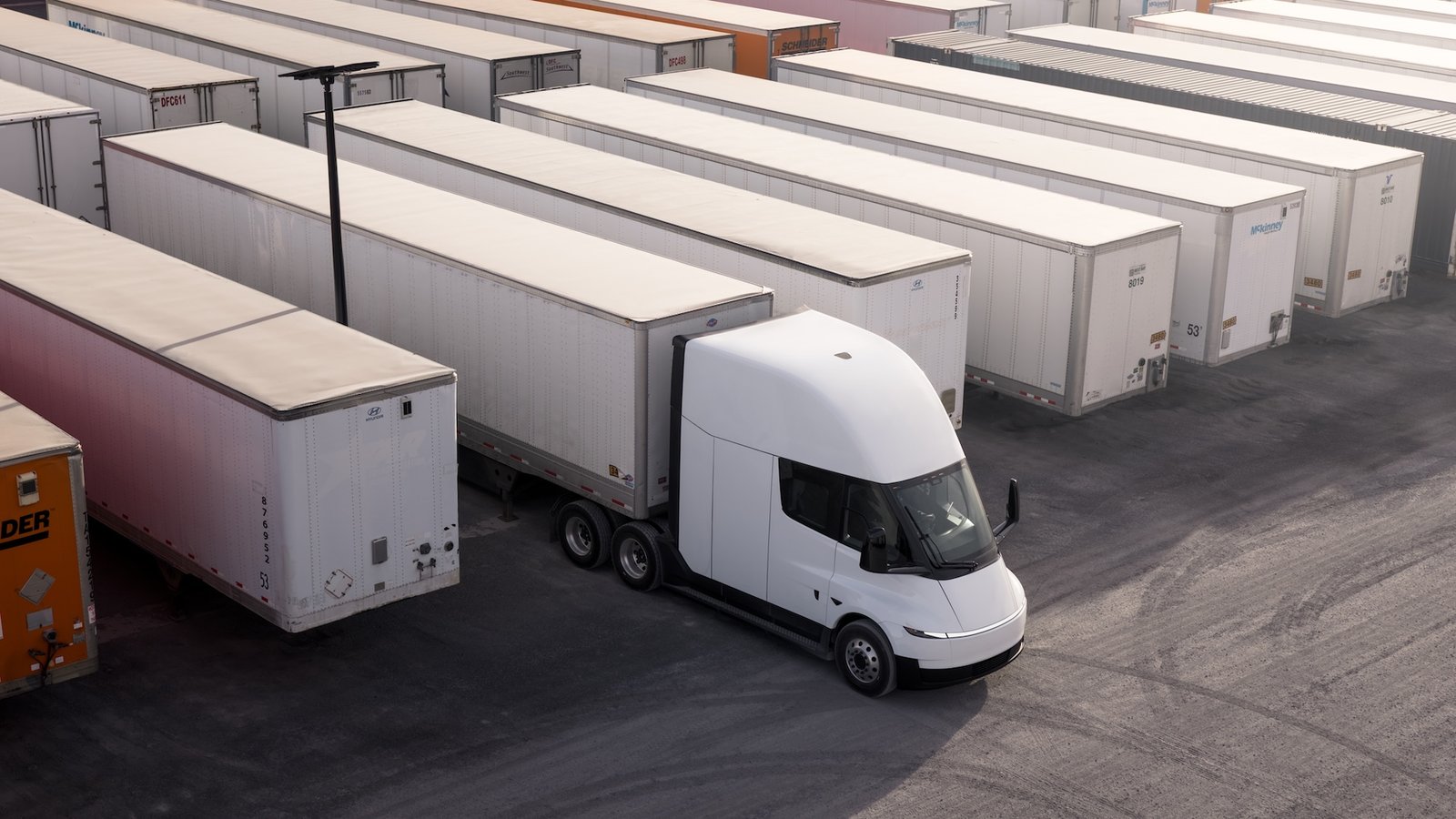
The Tesla Semi was unveiled in 2017 with a promise to remake trucking. For most of the years since, it has been a truck that mostly lived in a slide deck. On Tuesday it got the order that finally matches the promise.
ZET SCALE, a new alliance of shippers and carriers, named Tesla its primary manufacturer for an initial order of 2,500 electric Class 8 trucks, the largest single electric heavy-truck purchase in U.S. history. The order on its own would nearly double the number of electric Class 8 trucks operating in the country, according to the alliance, with Kenworth and Volvo named as secondary manufacturers carriers can also choose.
Tesla delivered the first Semis to PepsiCo at the end of 2022, five years after the reveal and two years later than planned. Production has ramped slowly since, from a trickle at the company’s Nevada factory to a program that has struggled to keep pace with the demand Tesla kept promising. A 2,500-truck order amounts to years of output at the program’s recent pace, which is both the appeal and the problem.
The order has been a long time coming for a vehicle that skeptics wrote off. When Tesla unveiled the Semi, diesel trucks did not compete on energy cost the way they do now, and the company’s own priorities kept shifting toward the Model 3 and the Cybertruck. Fleets watched, ordered cautiously, and waited.
The economics have shifted in the truck’s favor, at least on paper. An Electrek analysis of total cost of ownership puts the Semi at about $486,000 over a seven-year life, or 97 cents a mile, against $633,000, or $1.27 a mile, for a diesel truck, a saving of roughly $147,000, or 23 percent. With diesel near $5.35 a gallon, some fleets could save more than $400,000 over five to ten years. The Semi’s base model lists around $260,000 with a range of more than 300 miles, and the long-range version promises up to 500.
Those figures are the entire argument for the order, and the entire risk in it. Electric trucks make financial sense only where the routes are short enough for the range, the chargers are close enough to reach, and the electricity is cheap enough to beat diesel. The heavy-truck charging network in the United States remains thin, and building it is a separate, slower project than selling the trucks.
The charging problem is the quiet constraint behind every electric-truck promise. A Class 8 truck burns far more energy than a passenger car, and recharging a fleet of them demands megawatt-scale stations built along freight corridors, on grid connections that in many places do not yet exist. Until that infrastructure arrives, fleets can only run the Semi on routes that begin and end within reach of a charger, which is a smaller map than the marketing suggests.
ZET SCALE’s members are large shippers with the volumes and the route data to know where an electric truck actually pays for itself. That they committed to thousands of trucks, rather than dozens, is a statement that the economics have crossed a line for the biggest freight buyers, not just for early adopters.
Policy has pushed the same direction. California and a growing list of states have moved to phase out diesel trucks over the next decade, and federal tailpipe rules have pressed manufacturers toward zero-emission heavy vehicles. Fleets are buying against those deadlines, and against the expectation that diesel costs and regulation will only tighten.
For Tesla, the order is validation of a bet that has looked, for years, like a distraction. The company poured attention into cars and energy while the Semi idled, and rivals including Kenworth and Volvo built their own electric trucks while Tesla’s sat on back order. The alliance named Tesla the sole primary manufacturer, a vote of confidence in a truck that has had to earn it the hard way.
The open question is execution. A record order is a promise to build, and Tesla’s record on the Semi is one of promises delivered late. The company must turn a program that has struggled to reach volume into one that can deliver thousands of trucks, and the buyers must find somewhere to charge them.
Tesla has not said how fast it can build 2,500 Semis, and the Nevada plant has never demonstrated that kind of run-rate. The order will live or die on whether production can scale, a familiar question for a company whose ambitions have repeatedly outrun its assembly lines.
If both happen, the order becomes the point at which the electric truck stopped being a science project and became a fleet decision. If they do not, 2,500 trucks will join a long list of orders that looked better on the day they were signed.