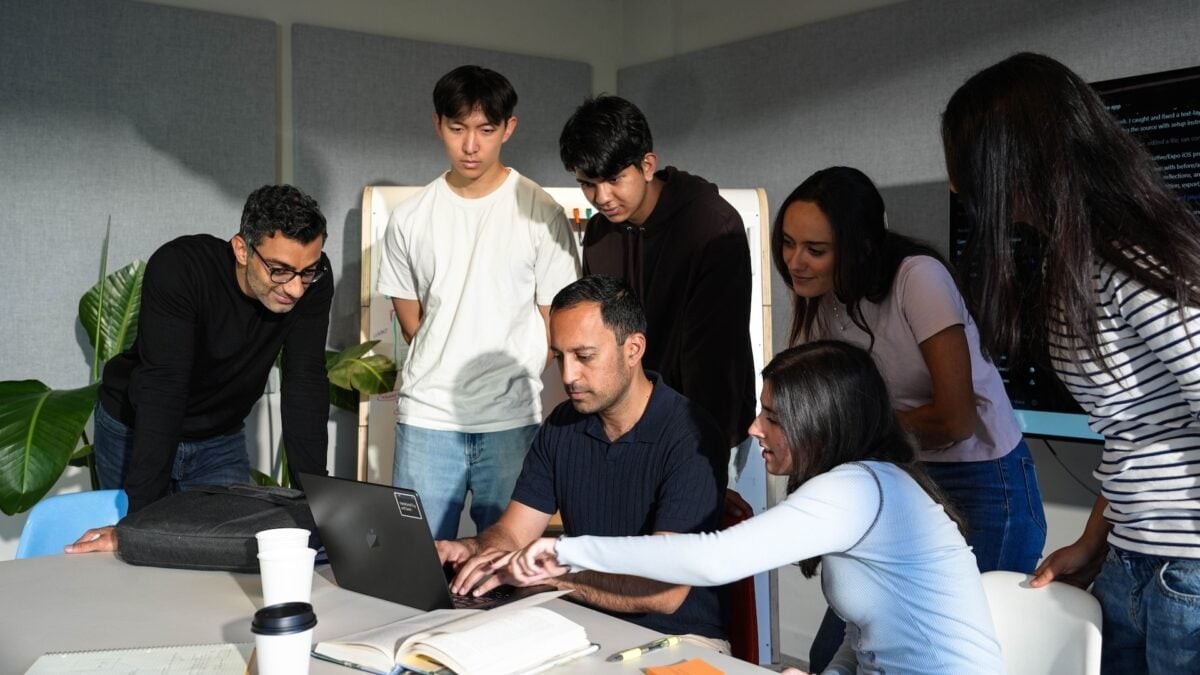
The course catalog reads like a guest list at a technology conference. Jensen Huang, Sam Altman, Satya Nadella, Fei-Fei Li, Mira Murati and Travis Kalanick appear on the same faculty roster.
They are teaching at the Horowitz Andreessen Academy, a school that the venture firm Andreessen Horowitz has founded in San Francisco and positioned as a college alternative for high school graduates. Applications opened this month, according to an account published by the education desk of the Chinese news outlet TMTPost on September 23.
The format is deliberately unlike a university. The first cohort will number about 50 students, beginning in September 2027 and finishing a year later. Tuition is free. There are no homework assignments, no examinations and no diploma of any kind at the end. Admissions decisions rest on what the academy calls proof of work rather than on transcripts or test scores.
Courses run in blocks of two days to four weeks. Students spend September through April in San Francisco, travel abroad in May, and rotate through ten founding partner companies from June to August, among them Anduril, Anthropic, Google, Meta, Nvidia, OpenAI, Palantir and Stripe. Each student receives more than $50,000 in compute credits and a $5,000 travel budget.
A roster that large is a promise about attention as much as a list of names. . That number and the named instructors do most of the work of making the school credible before it has taught anyone.
Starting in 2028, the academy plans to extend the program to two years and to seek state regulatory approval. If that approval comes, tuition would be set against Harvard’s, at $60,000 to $90,000 a year.
Ben Horowitz, the firm’s co-founder, framed the school as an experiment in a statement. Training that worked during the Industrial Revolution, he said, will not transfer unchanged to the AI revolution, and someone has to be first to work out how to educate people for this new world.
The skepticism arrived quickly. The economist Bryan Caplan said the approach would work for 50 handpicked people and would not work for 5,000. Ryan Craig of Achieve Partners called it a bootcamp with a college attached. AltSchool, a venture-funded attempt to rebuild schooling from first principles that shut down after burning through $176 million, is the precedent critics cite most often.
Those objections are not about the quality of the instruction. They concern whether a model built on a small cohort, elite mentors and corporate partners can be repeated at a scale that changes anything about how students are educated. Universities are judged on what happens to the average student. The academy is selecting for students who need the least help.
The academy’s chief executive is Gagan Biyani, who previously co-founded Udemy, an online course marketplace last valued at about $3.2 billion. He has described higher education as a $2 trillion market, a figure that explains the venture firm’s interest. Andreessen Horowitz has committed $42 million in seed funding.
The structure gives the firm something a recruiting pipeline cannot. Its portfolio companies compete for engineers against the largest technology employers, and the academy creates a route from high school graduation to those companies that does not pass through a university’s placement office. Whatever the educational argument, the commercial one is a supply chain for talent.
For-profit education has a difficult history in the United States, and the regulatory treatment of a school whose tuition would eventually approach elite private colleges depends on accreditation bodies that the academy has not yet asked for approval. Job placement figures for the first cohort will not exist until 2029, and by then the program’s structure will have changed.
The school joins a longer line of technology fortunes spent on education. Elon Musk founded Ad Astra, a small school that began inside SpaceX before branching out. Mark Zuckerberg and Priscilla Chan created The Primary School, which pairs schooling with health services for low-income families. Peter Thiel has funded students to leave college since 2011 through the Thiel Fellowship, which pays them to build companies instead of finishing degrees.
The compute credits are the detail that separates this effort from earlier ones. Access to accelerators is the practical constraint on what a young person can build with AI, and more than $50,000 of it is a resource most undergraduates cannot obtain. It also ties the curriculum to the firm’s portfolio, since compute is purchased through the same vendors the academy’s partners supply.
What the academy will not produce in its first year is a measurable outcome. Its students will have worked at ten companies, learned from a roster of chief executives and left without a credential their next employer can verify. Whether the first 50 graduates receive an education or an extended interview is a distinction the first 50 graduates will define.