The sentence was short, and it was the one arms-control advocates cared about most: a requirement that any target generated by artificial intelligence be reviewed by a human being before a weapon could act on it. This month, according to people familiar with the matter, American and Russian diplomats working at the United Nations agreed to take it out.
The deletion was part of a broader rewrite of a draft agreement on AI in weapons, The Washington Post reported on September 26, in which the two countries removed a range of provisions meant to safeguard the use of artificial intelligence in conflict and reworded others to soften their force.
The change reverses what had been a rare point of consensus. For several years, most governments at the U.N. had said, at least in principle, that humans should retain control over decisions to use lethal force. The idea that a machine might identify a target and a weapon might strike it with no person in between has been the line most states refused to cross.
The U.S. and Russia were not always expected to work together here. The two countries are adversaries in nearly every other forum, and their arms-control relationship has been frozen for years. Their agreement on this narrow point, diplomats said, reflects a shared interest in not being the first to bind their own militaries’ use of AI.
The negotiations sit inside a process that has moved slowly for a decade. States have met in Geneva under U.N. auspices to discuss lethal autonomous weapons, the systems that campaigners call killer robots, but talks have produced no binding treaty. The draft language being revised this month was one of the few concrete texts in front of them.
What the two countries removed matters because of what it signals about the direction of travel. Once the human-review requirement is out of a working draft, advocates said, the burden shifts: the baseline becomes machines acting on machine-chosen targets, with any human oversight treated as an optional extra rather than a requirement.
The rewrite also touched other provisions. People familiar with the text said multiple passages had been softened, though the full extent of the changes was not public. The pattern, they said, was consistent: language that constrained the use of AI in weapons was either deleted or qualified.
Human Rights Watch and other groups have spent years arguing for a treaty that bans systems that select and strike targets without meaningful human control. The removal of the human-review clause, they said this week, moves the talks in the opposite direction and makes a ban harder to achieve.
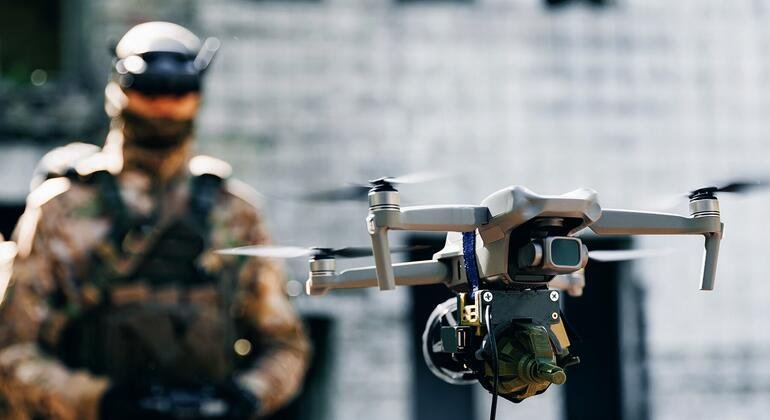
The military argument for removing the clause is not difficult to understand. In a fast-moving fight, a human in the loop can be a bottleneck, and the pace of modern warfare has pushed some commanders to argue that machines must be able to act faster than people can approve. The U.S. and Russia both field increasingly automated systems, and both have reasons to avoid a rule that could read as a constraint on their own arsenals.
The diplomatic argument is harder to square. A treaty stripped of its clearest safeguard is easier to agree to but less worth having, a dynamic familiar from every arms-control negotiation. The question is whether the countries removing the safeguards are genuinely seeking a treaty or merely shaping one so weak it binds no one.
Analysts said the episode shows how far the politics of AI weapons have shifted. What was once a fringe concern, dismissed as science fiction, is now a live negotiation in which two nuclear powers are quietly aligning on the details of how much human control is required, and deciding the answer is less.
The timing is significant. AI systems have begun appearing in real targeting roles, and reports of AI-enabled targeting in recent conflicts have moved the discussion from hypothetical to operational. Each such report makes the treaty language less abstract and raises the cost of writing it loosely.
The United States has not publicly explained its position, and the Russian delegation has said little about the changes. The work was done at the level of diplomats and working groups, where the most consequential revisions to arms-control text are often made far from public view.
Advocates said they would fight to restore the human-review requirement when the draft returns to the full membership. But restoring a deleted clause is always harder than defending an existing one, and the two countries that removed it are among the few with the power to block any treaty that does not suit them.
The draft, whatever its final form, will not be binding without broad agreement, and broad agreement is still distant. What changed this month is the direction of the text: away from a world in which a human must approve a machine’s choice of target, and toward one in which the machine’s choice may simply stand.