
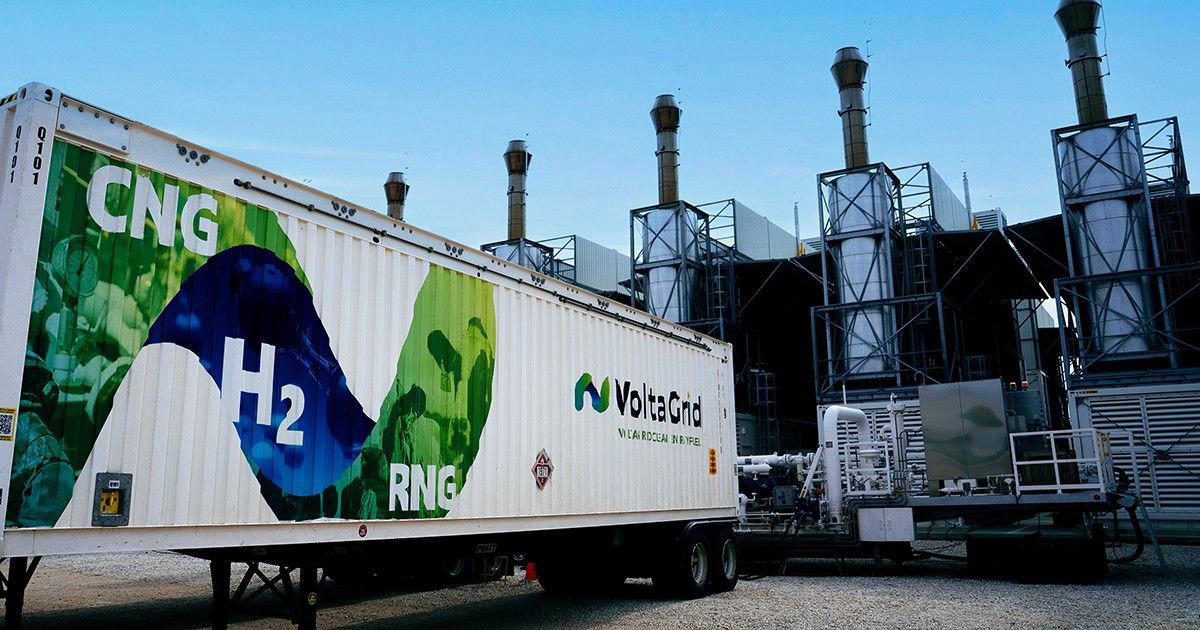
The data center outside Salt Lake City ran for more than a year on natural gas that arrived by truck. Oracle, waiting for a pipeline to be built and connected to its equipment, kept the site moving by hauling in compressed natural gas, trailer by trailer, in what the industry calls a virtual pipeline. Bloomberg reported the arrangement on October 8, citing people familiar with the work.
The company has repeated the trick in Texas, where trucked gas is powering early work at a campus Oracle is building for OpenAI in Shackelford County. And it is weighing the same approach at Project Jupiter, a stalled AI campus in New Mexico also tied to OpenAI, where a gas pipeline has been delayed and the start date has slipped to February of next year.
The mechanics are simple and punishing. Gas is drawn from a real pipeline, compressed into a trailer, driven for hours to the site, and decompressed into generators. It is not cheap. Jack Weixel, senior director of energy analysis at East Daley Analytics, told Bloomberg that once labor, equipment and the trucks’ own fuel are counted, delivered compressed gas costs roughly four times the price of gas at a major pipeline hub.
The physical limits are sharper than the financial ones. Ellie Holbrook, an energy analyst at SemiAnalysis, estimated that at 100 megawatts of demand, about 4% of Project Jupiter’s planned 2.45-gigawatt footprint, a single large trailer would provide electricity for roughly 40 minutes. Scaled to the full campus, that implies close to 900 truck deliveries a day. No trucking network is built for that.
The companies that specialize in compressing and trucking gas have seized on the demand. Certarus, a unit of Superior Plus, supplied the Utah site; VoltaGrid handled the Texas work, according to Bloomberg. Both pitch their virtual-pipeline services as a bridge, a way to switch on computing power months before a pipeline arrives.
The New Mexico project shows why such a bridge can be worth building. The pipeline that was supposed to serve Project Jupiter, run by Energy Transfer, hit a wall with the state. New Mexico Land Commissioner Stephanie Garcia Richard denied the company a right-of-way in March and again in July, citing emissions and water strain. The line was rerouted across federal land, and its in-service date slipped from this summer into next year. Oracle sent a force majeure notice to the project’s developer last month, signaling it would not be held to a schedule the pipeline could not meet.
The episode is a window into the bottleneck that now constrains the AI buildout. Computing power is no longer the thing companies wait for. Electricity is, and electricity waits on gas, and gas waits on pipelines, and pipelines wait on regulators. Each link in that chain can slip by months, and a data center that has already ordered its chips and poured its concrete cannot simply pause.
So the industry has begun working around the chain instead of through it. Trucking gas is the least elegant workaround and, at four times the pipeline price, the most expensive, but it keeps a site alive during the months when the alternative is to sit idle.
The strategy has clear limits. It works for the first building or the early commissioning phase of a campus, when demand is a fraction of the final load. It does not scale to a 2.45-gigawatt facility, which would need a stream of trucks that the roads could not carry. Trucks can energize the first rack of servers; the campus still needs its pipeline.
The scramble has also created a real business out of a niche one. Pipeline builders and gas transporters have watched the data center boom arrive faster than the permitting and construction system could answer, and the companies that compress and move gas by road are now pitching developers across the country. What they are selling is time rather than cheap energy, and Oracle’s willingness to pay four times the hub price shows how much that time is worth.
Oracle is far from alone in running into this wall, and it is among the most aggressive in spending its way around it. The company has committed to building enormous power capacity for its AI customers, and the trucked-gas work is a sign of how much it is willing to spend to keep a schedule that the permitting process keeps rewriting.
The deeper question is what this says about the price of the AI boom. Every workaround, trucked gas at four times the pipeline rate, diesel generators, batteries, raises the cost of a kilowatt-hour at the moment the industry is trying to convince investors that the margins on AI will eventually justify the billions going into it. The Salt Lake City facility is proof the workaround can be made to work. Whether it can be made cheap is another matter, and for now the answer appears to be that it cannot.



