
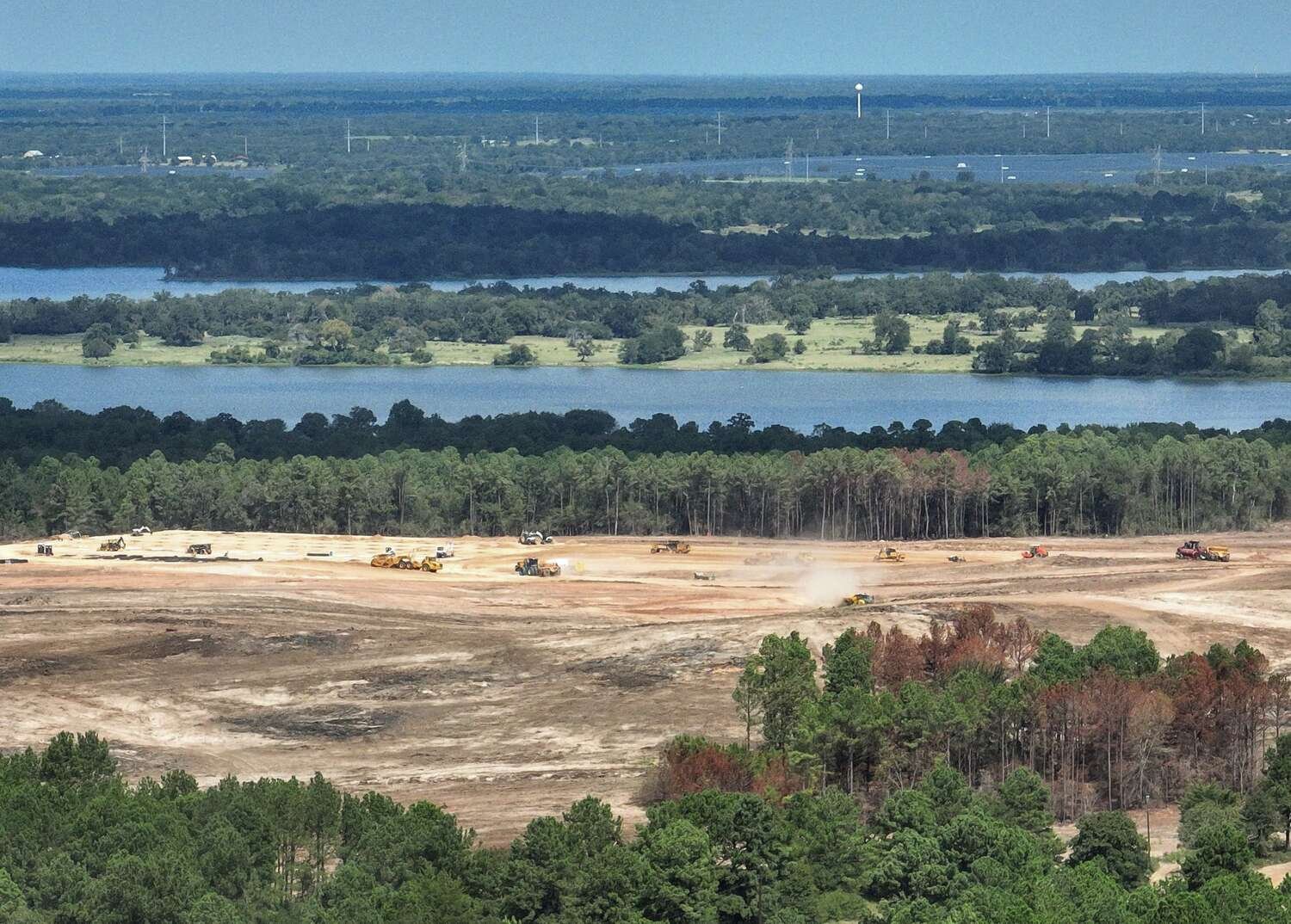
When Elon Musk’s companies first described Terafab, the plan already sounded enormous: a semiconductor and advanced-computing campus in rural Grimes County, Texas, that would dwarf the largest building on Earth by floor area. Public filings reviewed this week suggest the full ambition is larger still, as much as $119 billion across four construction phases stretching to 2036.
The documents, filed with Texas officials and the county, lay out a four-phase project. The first phase, announced by Governor Greg Abbott in August, carries more than $16.8 billion in investment and about 3,000 jobs, spread across two school districts near Gibbons Creek Reservoir, roughly 20 miles east of College Station.
The later phases are where the number balloons. The filings schedule the first phase for 2026 to 2028, followed by a second phase in 2029 to 2031, a third in 2032 to 2034, and a fourth in 2035 to 2036. Each phase would be independently capable of manufacturing semiconductors, according to the applications, and the company would decide whether to proceed with the next phase only after finishing the one before it.
The arithmetic behind the headline figure runs through the state’s Jobs, Energy, Technology and Innovation incentive program. The phase-one investment splits between two school districts: about $10.37 billion on one side and $6.43 billion on the other. Later phases add roughly $38.6 billion each for the second and third, and about $25.3 billion for the fourth.
The plant is described as a vertically integrated complex of more than 100 million square feet, where advanced logic and memory chips would be made, packaged and tested under one roof. That scale would make it more than five times larger by floor area than the New Century Global Center in Chengdu, China, the current record holder. The campus is planned to produce chips for Tesla’s Optimus robots and Cybercabs, and to power SpaceX’s space-based data centers.
Musk has framed the project as a matter of necessity. SpaceX and Tesla expect to need more than one terawatt of computing power in the coming years, and the company has said the gap between global chip supply and that demand is the reason Terafab exists. On October 11, Musk wrote that Terafab would make chips better than anyone, adding that the effort would take time.
The project is not SpaceX’s alone. It is being developed by affiliated entities tied to SpaceX, Tesla and xAI, the artificial-intelligence company Musk also leads, an arrangement that pools the computing ambitions of all three under one roof. That structure also means the investment figures are shared across the Musk companies rather than carried by any single one.
The scale sits at the outer edge of what the semiconductor industry has attempted anywhere. TSMC has spent tens of billions of dollars on individual fabs over years, but a single-site project of $119 billion would rank among the largest industrial investments ever disclosed. The comparison is imperfect, because the Texas figure covers four phases that may never all be built.
That caveat matters. Public notices have cited figures ranging from $55 billion for initial phases to $119 billion if every phase is completed, and the companies have not reconciled the difference between the $16.8 billion first-phase number and the larger estimates in county filings. The later phases hinge on technology and capacity needs.
Much of what the public knows about the project came out through a records dispute. Engineering News-Record reported that the county filings exposing the four-phase buildout surfaced as SpaceX stepped up a construction-management hiring push, suggesting the company is staffing up for a decade of building before the later phases are formally approved.
The chip ambitions behind the site are specific. Musk’s companies want to stop depending on outside suppliers for the processors that run Tesla’s robotaxi fleet and humanoid robots, and for the computing behind SpaceX’s satellite and space ventures. Terafab is the attempt to bring that supply chain in-house, at a scale no single technology company has tried.
The project fits a broader American push to bring chipmaking back to the United States. The federal government has spent billions through the CHIPS Act to lure semiconductor manufacturing from Asia, and Texas has competed with Arizona and other states for those investments. Terafab is different because it is being financed by private companies building for their own needs rather than for a public incentive program.
For Grimes County, a mostly rural area, the project promises transformation on a scale that has divided residents. The tax-abatement agreement describes on-site power plants that would let the campus run largely off the grid, a detail that shows how self-contained the operation is designed to be. The project crosses two school districts, each of which must weigh tax incentives against the growth the plant would bring.
What gets built first is no longer in doubt. The state has announced the first phase and its jobs, and site work is expected to begin in the coming years. What remains uncertain is whether Terafab becomes the $119 billion complex the filings contemplate, or stops at a first phase that is already one of the largest industrial projects Texas has seen.



