
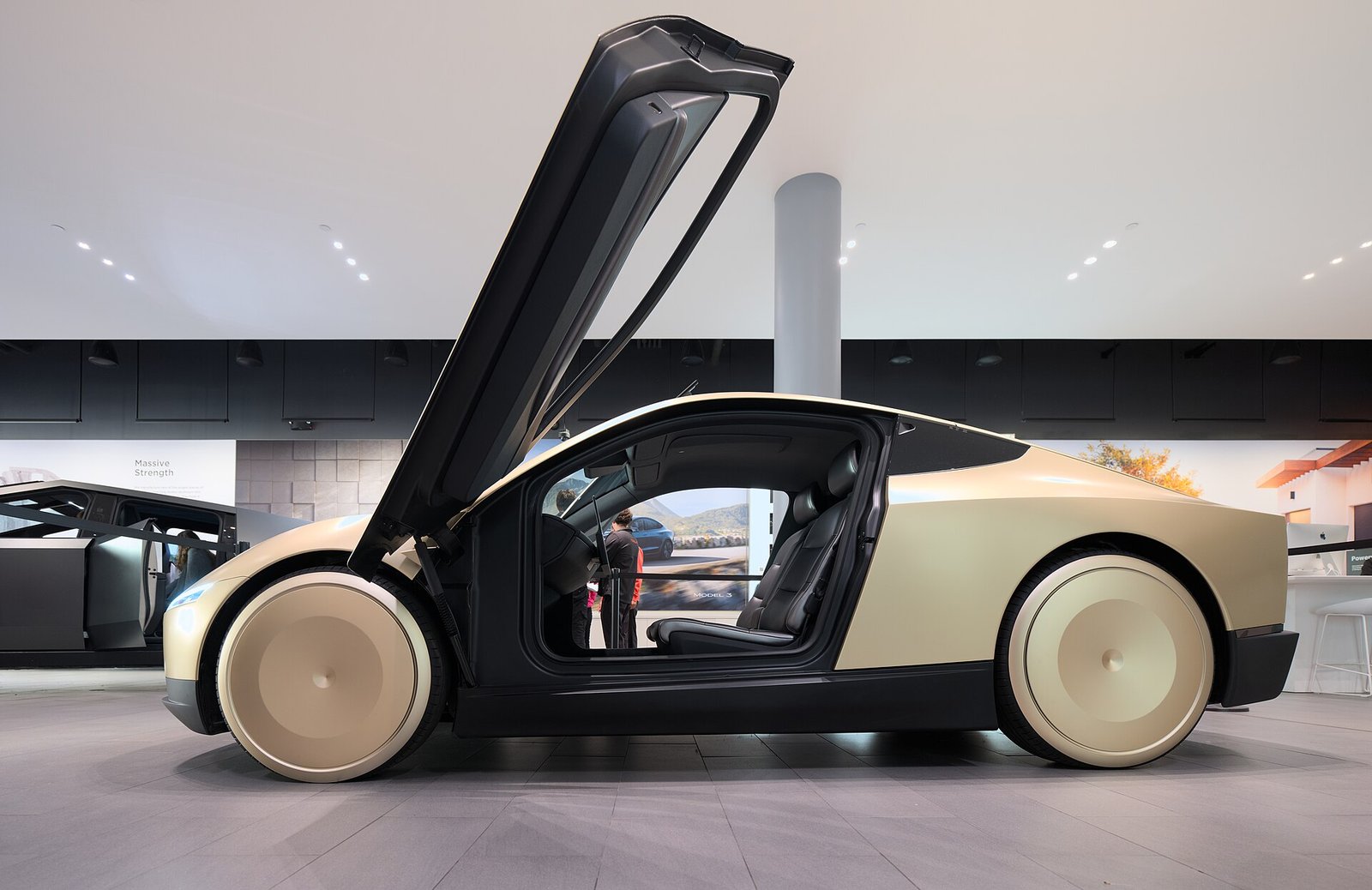
For most of the past year, investors who pressed Tesla about its robotaxi business heard a familiar answer: the Cybercab fleet in Austin was still small, still stuck somewhere between 90 and 100 cars. This week the company finally moved the number, and it moved it sharply. Tesla’s Robotaxi account said the service had scaled to more than 300 Cybercabs serving Austin, an eightfold increase in 30 days.
The underlying records support the claim. Texas motor-vehicle data show Tesla added 150 Cybercabs to its automated-vehicle registry on Thursday, lifting the count to 319 from 169, according to observers who track the state’s filings. The first seven Cybercabs appeared on the registry on August 31, which means the fleet has grown from nearly nothing to 319 in about six weeks.
The service itself is younger than that. Tesla opened Cybercab rides to the paying public in Austin on September 4, a day after an invite-only launch event. The purpose-built two-seater, with no steering wheel and no pedals, has been carrying riders in the Texas capital for barely a month.
Dallas is next. Elon Musk wrote on X that, two years after the original Cybercab unveiling, the cabs were now everywhere in Austin and that Dallas would follow soon. It is the first time Tesla has named the next city for public Cybercab rides, and it caps a stretch in which the company declined to say where the service would go after Austin.
The naming of Dallas matters because it answers, in part, the question investors have been asking for months: whether the robotaxi business can scale beyond a single demonstration city. Tesla’s shareholder materials had sketched a seven-city plan for the first half of 2026, and Cybercab test vehicles had been spotted in the Dallas suburb of Plano as early as September 2025. Until now, the company had not committed publicly to a second market.
The ramp has been steep but recent. More than 100 Cybercabs were added to the registry in a short span earlier this month, taking the count to 169, before Thursday’s batch of 150 more than doubled it. The pace of additions now far exceeds anything Tesla had shown before, when the fleet lingered near 100 cars for months despite repeated investor pressure.
The growth spurt arrives against a mixed backdrop. Tesla reported third-quarter deliveries that beat expectations, yet the stock did not break out afterward, as investors weighed the robotaxi timeline against the rest of the business. The robotaxi program has drawn particular scrutiny because Musk has made it central to Tesla’s long-term valuation argument, telling shareholders the cars would make the company far larger than a carmaker.
The gap between registrations and revenue remains the open question. A registry entry does not mean a car is carrying paying riders on any given day. Community trackers that count vehicles from sightings and state records have reported figures well below Tesla’s. RobotaxiTracker listed 275 Tesla vehicles in unsupervised service in Austin, 105 of them Cybercabs, a number that does not square with the company’s claim of more than 300.
The registry itself offers limited visibility. It lists vehicle identification numbers, models and model years, but not where each car operates or how much it earns. Tesla’s total Texas roster now stands at 739 vehicles, according to the tracker, made up of 420 Model Ys and 319 Cybercabs. That means the Cybercab has gone from under a third of the fleet to nearly half in a matter of weeks.
Tesla’s own number suggests most of the 319 registered Cybercabs are serving Austin, which would leave fewer than 20 available for Dallas if the company is accurate. The company has said it will add Cybercabs in Dallas soon, and gold Cybercabs have been seen massing at Tesla’s robotaxi hub in the city even as Dallas riders are still being picked up in Model Ys.
The anniversary framing matters. The original Cybercab was shown off at a Hollywood studio lot on October 10, 2024, in an event that Musk used to promise a driverless future within a few years. Two years later, the company is finally putting real numbers behind the service, and Musk’s message leaned on that arc: the cabs that were a stage prop in 2024 are now carrying riders in Austin.
The company has also been extending the service’s reach in smaller ways. Tesla recently pushed its robotaxi operating hours an hour later, keeping the ride-hailing service running until 11 p.m., and Ashok Elluswamy, Tesla’s head of AI software, pointed to the Dallas announcement as the next step. The incremental moves suggest a service still finding its footing rather than one operating at full scale.
For now, the eightfold figure gives Tesla a concrete answer to its critics on the question of whether the fleet can grow at all. A month ago the service was measured in dozens of cars. Today it is measured in hundreds. Whether hundreds become thousands, and whether they earn money, is the next question, and Dallas will be its first real test.



