
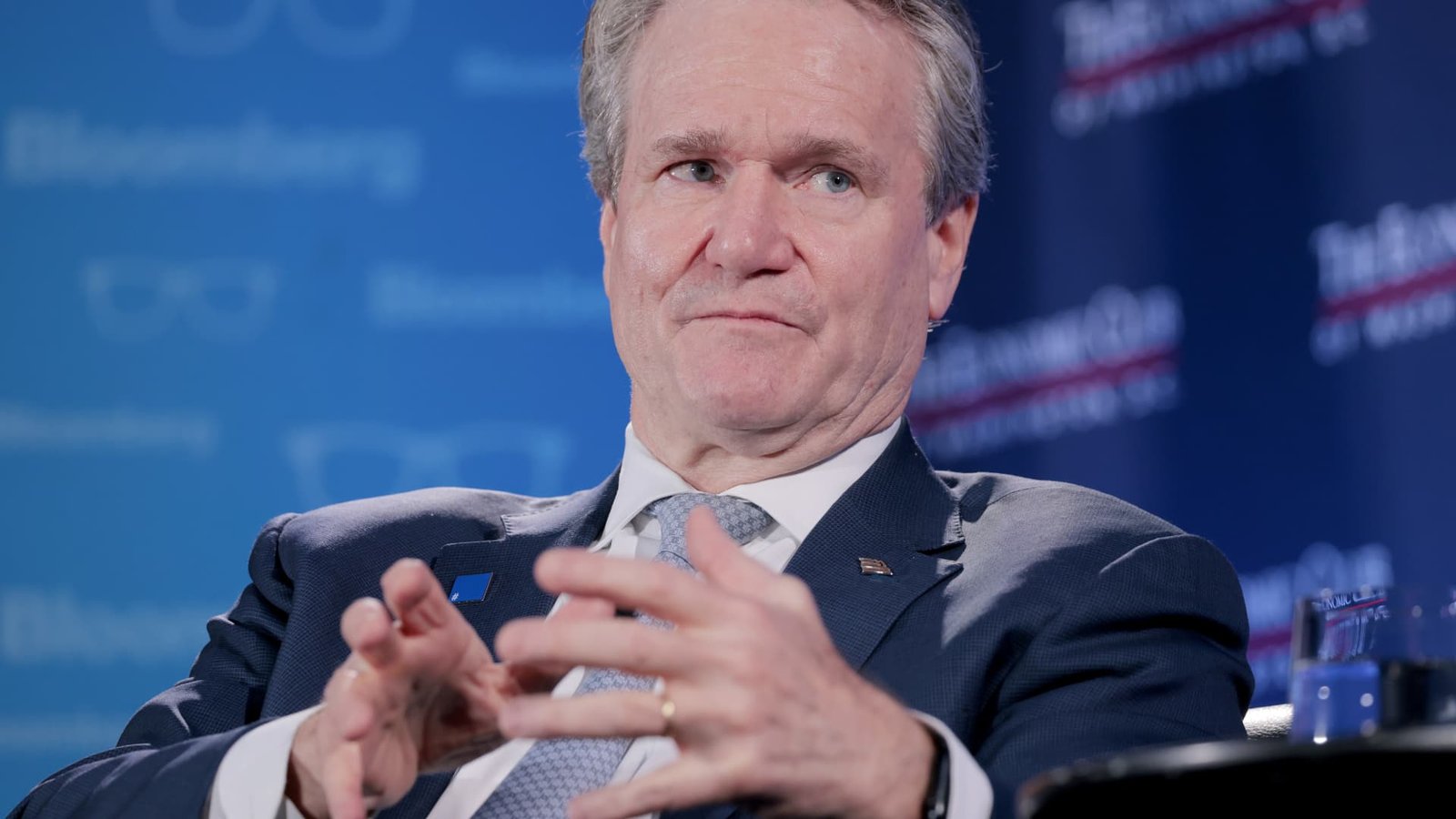
Brian Moynihan told analysts in September that trading revenue would come in roughly flat for the third quarter. On Wednesday morning, the chief executive of Bank of America had to explain a number that was anything but flat.
The Charlotte lender reported companywide revenue of $30.12 billion on a fully taxable-equivalent basis, up 3.2% from a year earlier and about $570 million short of the consensus estimate. Fixed-income trading fell 17% to $2.55 billion on weak mortgage, municipal and credit activity, roughly $450 million under the StreetAccount figure. Equities trading rose 10% to $2.51 billion, still nearly $300 million light. Together, the two desks missed expectations by about $750 million, and combined trading revenue declined 5%.
The penalty landed the same morning. Regulators fined the bank $1.2 billion over what the Treasury Department said was a failure to report billions of dollars in suspicious transactions. The charge is not deductible and stripped 17 cents from earnings per share. Net income fell to $6.9 billion, or 91 cents a share, from $8.3 billion, or $1.04, a year earlier. Excluding the fine, earnings came to $1.08 a share, two cents below the $1.10 analysts expected.
Shares fell as much as 8% in morning trading, among the sharpest declines in the financial sector on the day.
Net interest income, the line Bank of America investors watch most closely, rose 8% to $16.4 billion, and it was the clearest bright spot in the release. Investment banking fees dropped 11% to $1.8 billion, matching the guidance Moynihan gave in September.
The deposit franchise behind that spread is the bank’s largest source of earnings and also its most sensitive. Management has argued through the year that net interest income would keep climbing as loans reprice and as customers shift deposits into interest-bearing accounts more slowly than the industry feared. Wednesday’s figure supports the claim, and it gives the bank one part of the story it can tell without qualification.
The compliance question has become the harder one. Treasury officials said the bank outsourced critical parts of its monitoring to protect revenue. On the earnings call, several analysts returned to earlier assurances that control costs would stay contained and asked how a shortfall of that size had escaped internal forecasts. Wells Fargo analyst Mike Mayo described the quarter’s capital markets results as “easily worst in class.”
What the print exposes is a mismatch between the two halves of the bank. Consumer lending and deposits produce a spread that has been widening while the Federal Reserve holds policy steady, and that spread is now doing the heavy lifting. Trading and advisory swing with client activity, and this quarter clients did not show up in the mortgage and credit markets where Bank of America is a major dealer.
Rivals with heavier equities and derivatives exposure fared better. The contrast matters because the third quarter is usually a season when fixed-income franchises count on rate and credit volatility to generate volume. Volatility was ample: an inflation report published Tuesday pushed yields higher and unsettled equity markets. The flow simply ran to competitors.
The fine adds a second variable that will not disappear with the charge. Banks have spent a decade building anti-money-laundering systems that satisfy examiners, and the cost of that work shows up in the efficiency ratio rather than in any revenue line. A $1.2 billion penalty is large enough to move a quarter’s earnings on its own, and the underlying finding, that a unit scaled back monitoring while protecting a revenue stream, is the kind of claim that draws follow-on questions from other supervisors and from plaintiffs’ lawyers.
Moynihan, who has run the bank since 2010, built his tenure on expense discipline and on the argument that the lender’s regulatory troubles belonged to an earlier chapter. The bank has paid penalties before, including a $250 million fine in 2023 tied to junk fees and a set of mortgage settlements a decade ago, and each time management framed the charge as a discrete item. Investors have grown less willing to accept that framing.
One mechanical question will be settled over the next two quarters. Adjusted earnings per share missed by two cents only because of the fine. Without it, the bank would have been near consensus on profit while missing on revenue, a pattern that points at the revenue mix rather than the expense base.
The bond desk has now missed guidance that management itself gave a month earlier. Management has pointed to a deliberate reduction in risk-weighted assets across rates and credit, which is a defensible strategy and also a cap on how much the desk can earn when clients trade heavily. The bank has not said whether that posture will change.
The share reaction suggests investors are not separating a strategy from a stumble. Bank of America trades toward the lower end of its book-value multiple among the largest U.S. banks, which limits how far the stock can fall before the argument shifts from earnings to capital return.
What management has not offered is an end date for the compliance matter. The Treasury finding describes conduct, not a fee to be paid and set aside, and the bank has not said which businesses are in scope or what remediation will cost in the fourth quarter. Until it does, each quarterly print will read as an update on controls as much as on revenue.



