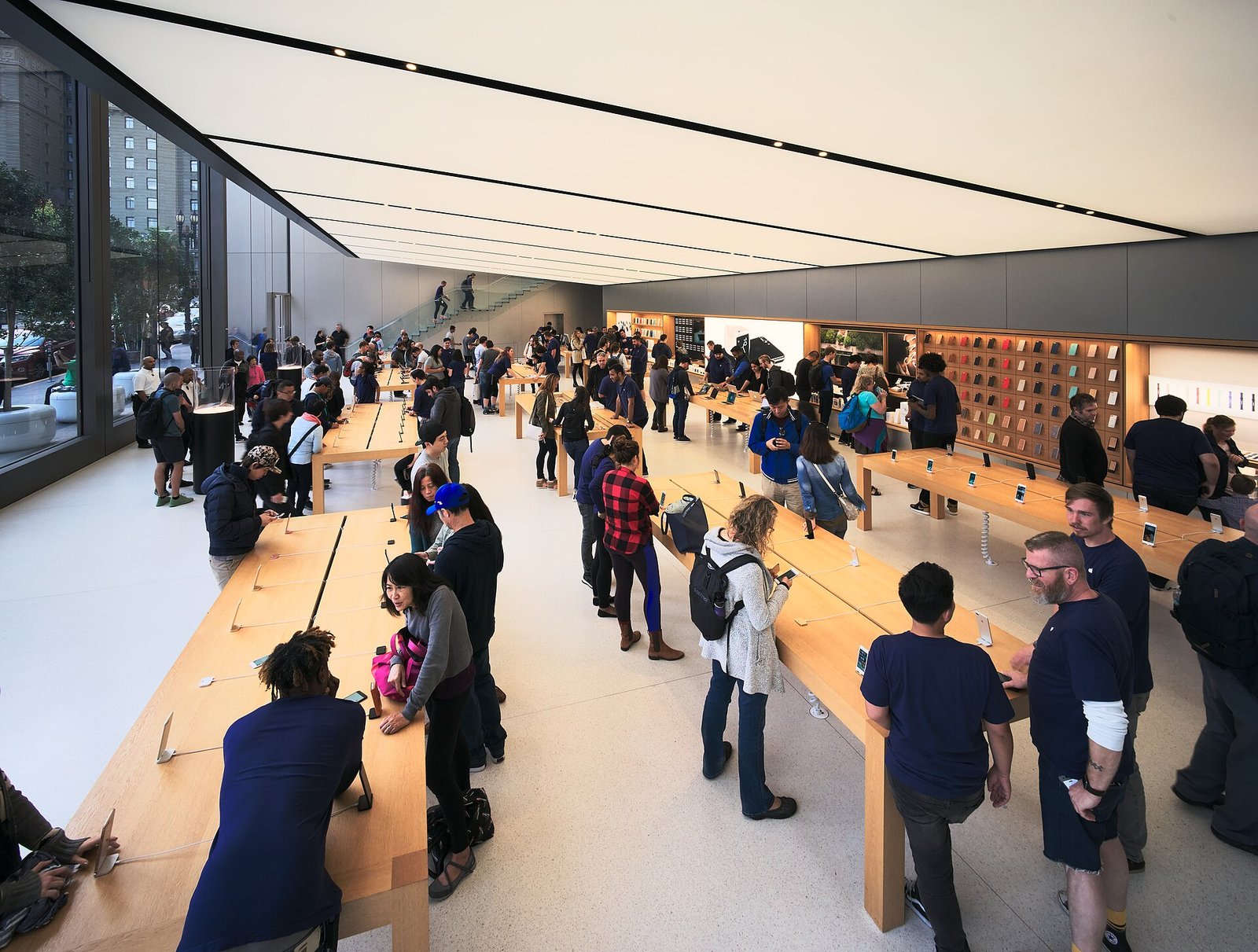
On the morning the iPhone Duo went on sale, the line outside Apple’s stores formed the way it has for a decade: folding chairs, coffee, a few people who had been there since Thursday. Then the doors opened and the staff did something unusual. They told the people at the front to go home and order online.
Retail employees were instructed during the launch window to discourage customers from buying the new phone in stores and to steer them toward online orders, according to MacRumors and 9to5Mac, which reported the guidance on Oct. 17. The instruction applied to walk-ins, the people who show up on day one because they want the device in hand.
Apple has spent fifteen years turning launch day into theater. The queue is the advertisement: local news films it, the first buyer holds the box above his head, and the message is that the product is scarce and wanted. Telling that queue to order online inverts the ritual.
The company has reasons. A phone that ships in limited volume is easier to allocate through a central warehouse than through hundreds of stores that each want stock for their own customers. Online orders also capture a name, an address and a payment method, and they let Apple promise a delivery date instead of a maybe.
Inventory is the likelier explanation than strategy. New industrial designs are hard to build in volume in the first quarter, and a device with an unusual hinge, frame or display stack puts more strain on assembly lines than a refresh of an existing model. Apple has not said how many units it expects to sell.
The accessory detail in the same reports is more revealing. Apple’s official silicone case for the Duo attaches with adhesive, according to the two publications, which makes it awkward to remove and difficult to reinstall. A case that sticks is a case designed around a shape that does not accept the usual snap-on shell.
Accessory makers read those signals early. A case that requires adhesive suggests the phone’s back or edges do not offer the ledges that clips grip, and it means third-party manufacturers will design around the same constraint. Buyers who swap cases often, or who take one off to clean the phone, will not enjoy the experience.
Repairability advocates will have a similar complaint. Adhesive is cheap, thin and reliable in the factory, and it is the enemy of anyone opening a device later. European rules on battery replacement and repairability have pushed handset makers toward screws and pull tabs, and a glued-on case sits awkwardly against that direction even though it is an accessory rather than the phone itself.
For Apple, retail is a strategic asset rather than a channel. The stores exist so that people can touch the product, and a launch where customers are told not to come in weakens the one advantage Apple has over online-only rivals. Executives have described the stores as the company’s most important product.
The online-first approach also changes who buys first. A queue selects for enthusiasts willing to spend a night on a sidewalk. An online order selects for people with a credit card and a delivery address, a broader and less photogenic group. Launch-day coverage shrinks accordingly.
Analysts said the guidance is consistent with a company that expects supply to lag demand for several weeks. When a product is short, moving buyers online lets Apple manage the queue invisibly, without the pictures of empty shelves that follow a sellout. When supply is ample, stores want the traffic.
The tactic carries a cost. Retail staff are measured on sales and on customer satisfaction, and telling a customer to leave is bad for both. Employees who spoke to the publications described the instruction as temporary, tied to the first days of availability rather than to the life of the product.
There is a version of this story Apple has run before. The company has used online reservation systems on launch days since the early 2010s, and it has taken orders online before stock reached stores for several models. What is new is the explicit direction to send walk-ins away rather than sell them whatever sits in the back room.
Competitors will study the results. Samsung, Google and the Chinese manufacturers all run launch campaigns built on retail availability, and all of them face the same arithmetic: a phone that sells out in stores looks successful, and a phone that sits on shelves does not. Moving the queue online keeps the appearance of scarcity without the empty display tables.
That appearance has a limit. A product that nobody can buy in a store for a month reads to some shoppers as a product with a problem, and the guidance to stay home gives the impression that Apple cannot supply its own retail network. The company will want the constraint to end before the holiday quarter.
Customers who wanted the phone on day one got a delivery window instead. That is a smaller disappointment than it sounds, since most of them were going to spend the first week on the setup screen anyway. It is a larger change for the stores, which have spent a decade being the place where launches happen.
Apple has not said when stores will begin selling the Duo to walk-in customers. The company rarely explains retail logistics and is unlikely to start with a product whose launch it has just reorganized. The next test comes in November, when the shelves either fill or stay empty.