The trouble on Eurowings flight EW-9631 announced itself row by row. Passengers flying from Rhodes to Dusseldorf on the evening of Oct. 18 began reporting stomach symptoms while the aircraft was still in the air, and the cabin crew stopped treating the matter as one unwell traveler.
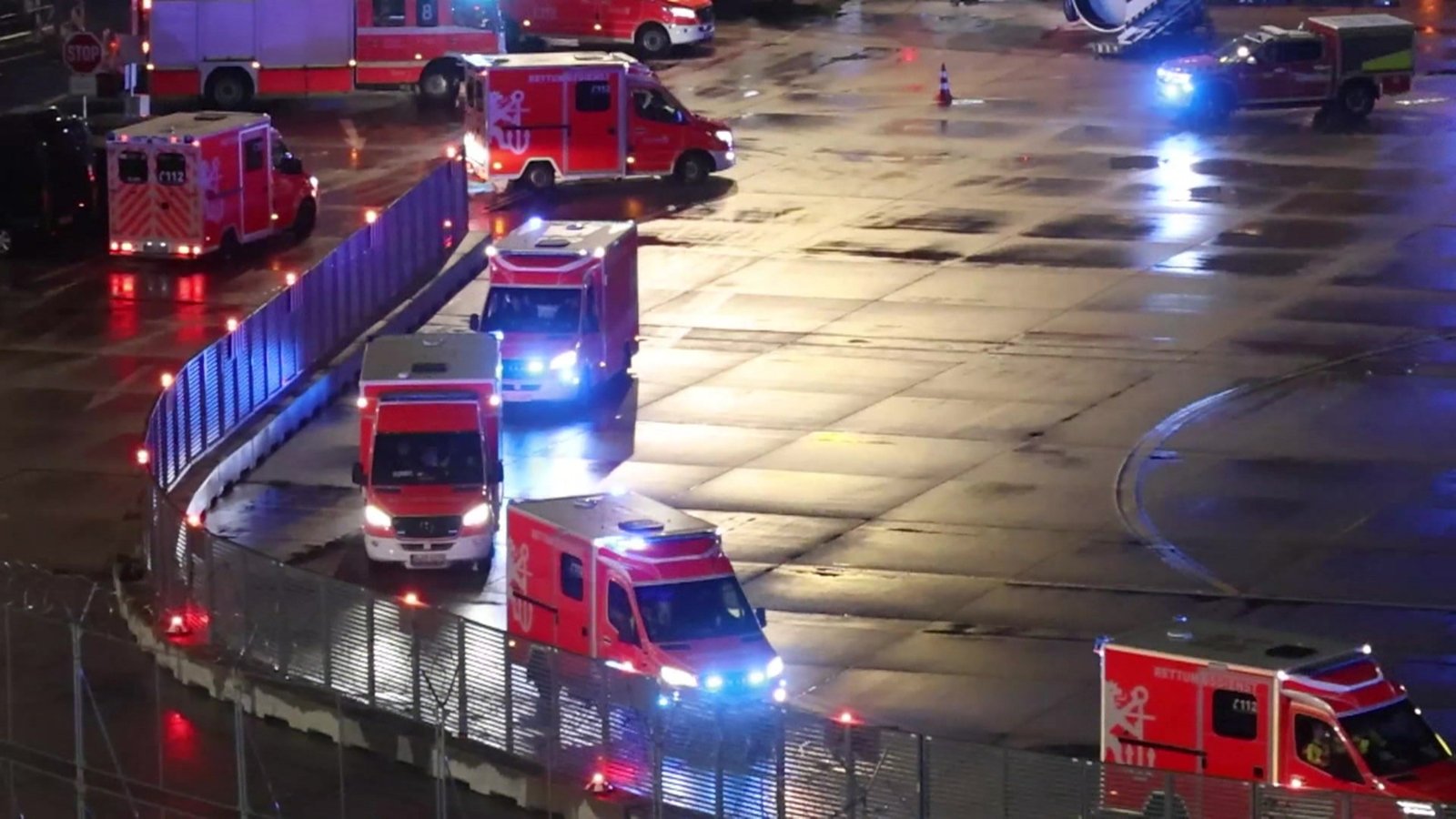
The crew asked for priority handling on arrival, according to the airline. Dusseldorf Airport answered with its mass-casualty protocol: emergency vehicles on the apron, medics in protective suits walking up the aisle, a reception area carved out of the terminal and kept away from ordinary arrivals.
Three passengers went to hospital. The jet had been carrying 212 passengers and seven crew members. The cause of the illnesses was still under investigation this week, and neither the airline nor German health officials confirmed a pathogen.
The designation confuses people, and understandably so. In German emergency planning, a mass-casualty alert describes the size of the response rather than the outcome of the incident. It is triggered when the number of people who might need care outruns what a normal shift can absorb. Two hundred and nineteen people on one aircraft, with an unknown infection among them, clears that bar without anyone dying.
That is why the response looked heavier than three hospital admissions would suggest. Airport fire services, paramedics and public-health officers all drill for the scenario, and the drills assume the worst version of it: a contagious illness that has had several hours in a sealed aluminum tube to find new hosts.
Greek authorities have been dealing with a much larger version of the same problem. The health service on Rhodes said it has treated more than 1,400 patients with gastrointestinal symptoms since Aug. 10, and recorded close to 1,800 cases since mid-July. That is a resort island in the closing weeks of its season, with hotels at high occupancy and staff rotating through shared canteens and dormitories.
Norovirus, the most common suspect in outbreaks of this shape, is unusually efficient. It spreads through food and water, through surfaces, and through the aerosol cloud left by a single episode of vomiting. The infectious dose is small enough that a contaminated handrail can do the job. The incubation period runs from roughly twelve hours to two days, which means a passenger can board feeling fine and become the index case four rows back.
Ships and hotels have learned this the hard way for decades. Cruise lines keep outbreak protocols on the same shelf as fire plans, and hotel groups in the Mediterranean run similar playbooks in August. What is unusual here is the setting: an aircraft on approach, where the options are a diversion to a smaller airport with fewer beds or a priority landing at a hub that has them.
Investigators will work backward from the passengers. Stool samples from the three who were hospitalized, and from others who reported symptoms, will be tested for norovirus and for bacterial causes such as salmonella and campylobacter. If a strain is sequenced, it can be matched against samples from the island, which would tell public-health teams whether the flight carried a hotel outbreak into the air or whether the infection moved between passengers on board.
European carriers operate under a medical-incident rulebook that assumes the cabin crew is the first responder. Aircraft carry kits with antiemetics, gloves and disinfectant, and crews are trained to isolate a symptomatic passenger at the back of the cabin, assign one crew member to that section and use the rear lavatory. The protocol exists because an aircraft has no way to remove a contagious patient and no room to separate one from two hundred others.
The airport’s side of the exercise is less visible. Fire services take command of the apron, public-health officers decide whether the aircraft must be cleaned before it moves, and the terminal has to be rearranged so that arriving passengers do not walk past the medical response. Dusseldorf rehearses the sequence with its airlines once a year, and the rehearsal usually involves a fictional aircraft with a fictional illness.
The airline, for its part, has said little beyond confirming the priority landing and the count of people on board. European carriers generally decline to discuss medical incidents in detail, partly for passenger privacy and partly because the paperwork is still open.
The operational cost is easier to describe than the medical one. A priority landing compresses the arrivals sequence, which pushes other aircraft into holding patterns. Ground crews have to clear a stand, a bus and a corridor. If the aircraft needs disinfection, the turnaround stretches and the next rotation slips. Insurers track these events because a single hospitalization can generate claims from passengers who missed connections.
The airport, one of the largest in Germany, was back to normal operations within hours. That is the measure by which emergency planners judge these events: not whether the response was dramatic, but whether the rest of the schedule noticed.
For Dusseldorf, the episode ended quietly. Most of the 212 passengers collected their bags, cleared customs and went home, some of them still unsure whether they had shared a cabin with an outbreak or with a bad meal. The answer sits in a laboratory, and laboratories in Germany tend to take about a week.
What the incident has done is put a number on something the industry usually discusses in the abstract. Airlines and airports plan for medical emergencies as if they were isolated events involving one passenger with chest pain. A cabin full of people incubating the same virus is a different problem, and it is the one the protocol was written for.