Three sentences, delivered to two outlets on Oct. 26, are the first official account of what is wrong with Apple’s folding phone.
The company told Bloomberg and 9to5Mac that it is aware of a small number of iPhone Duo units with an inner-display problem. Affected owners can contact AppleCare to arrange a replacement. A spokesman said most devices are unaffected and that faulty units show the problem quickly.
That last clause is doing the most work. “Shows quickly” is a triage rule, and it separates a manufacturing defect from wear. A display that fails in the first hours or days after unboxing is a unit that left the factory wrong, and Apple can replace it inside a warranty claim without conceding anything about the design. A display that fails in month seven is a different argument, and the company has not made it.
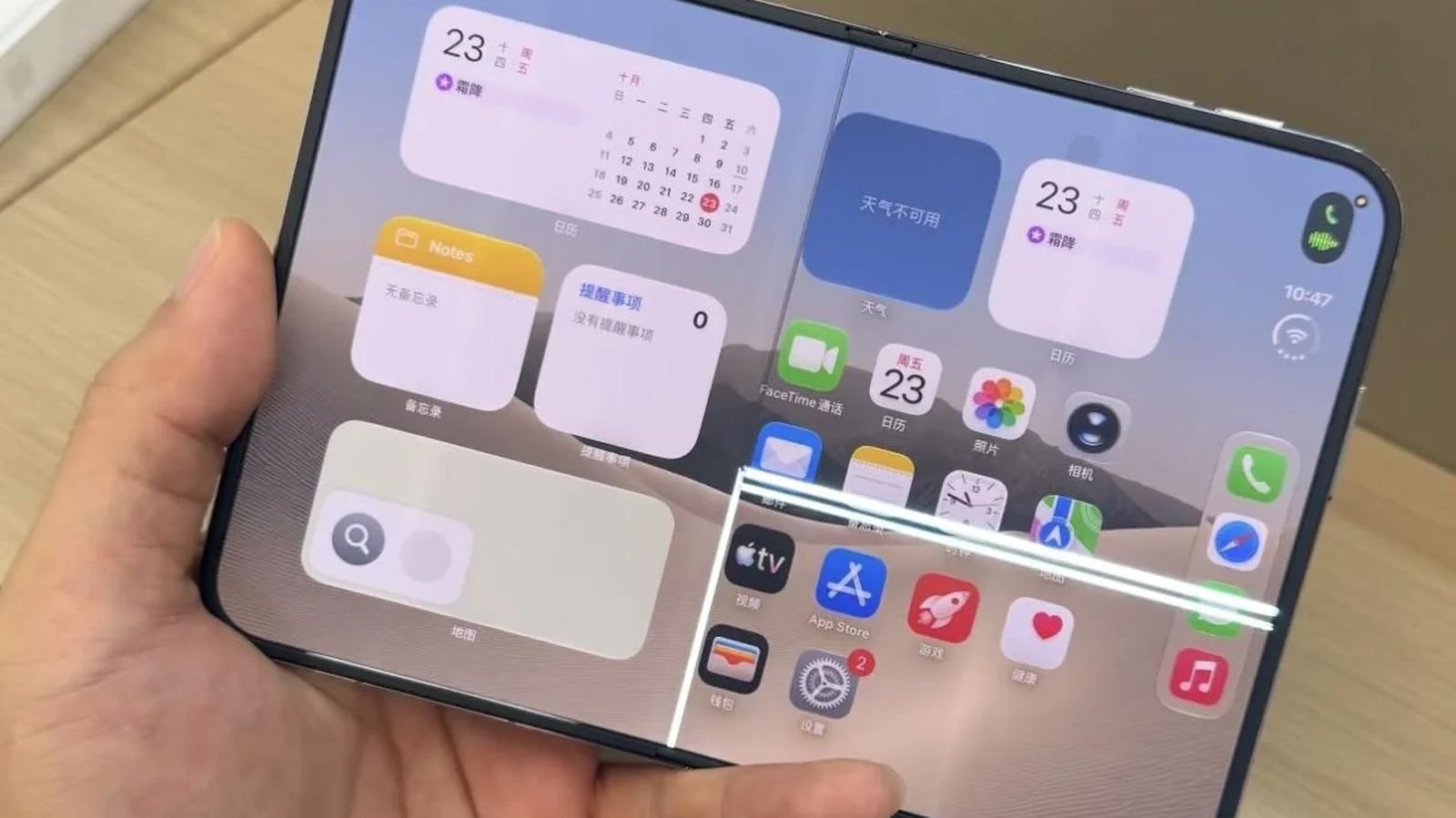
The reports that prompted the statement followed a pattern. Owners described vertical lines of dead or bright pixels along the fold, sometimes paired with a horizontal band across the right half of the inner screen, after a handful of open-and-close cycles. Some arrived within hours of unboxing. Demo units in Chinese stores, where the phone went on sale ahead of the United States, showed the same damage.
Apple had not commented when those reports spread last week. It had published a support document that walked owners through hinge interference, dust, and a display replacement, and noted that no software update fixes a hinge problem. Retail handling varied: most owners who brought a cracked phone to a store left with a replacement, while others were told the damage was accidental and quoted $999 for an out-of-warranty inner display.
The $999 figure is the part that travels. A repair priced near the cost of the device turns a warranty dispute into a purchase decision, and it gives a store employee an enormous amount of discretion over an outcome the customer cannot appeal. Two cases, in Shanghai and Jacksonville, circulated widely for exactly that reason.
Independent analysis has pointed at geometry rather than at debris alone. iFixit built a model of the hinge and compared it with photographs of failed displays; its conclusion placed the fractures near the transition from the cable channel to the central hinge support, where several edges meet and the support of a very thin display changes as it bends. Grit in the hinge, which several owners described as a crunching sensation before the crack, would concentrate stress at the same point.
That distinction decides what happens next. A batch problem can be quarantined: stop shipping from the affected lot, replace units in the field, keep the line running. A design problem in the hinge cannot be fixed by a service program, because the replacement part has the same geometry as the one that failed.
Apple’s history offers a menu. The butterfly keyboard produced a four-year repair program in 2018 after two years of complaints. AirPods Pro owners got a service program for crackling. Some iPhone display faults have been handled through quiet warranty extensions that were never announced as programs. The company generally acts when the volume is measurable and the legal exposure is quantifiable, and it generally acts late.
Consumer law sets the floor in the markets where the phone sells. The European Union’s two-year legal guarantee puts the burden on the seller to show a fault was not present at delivery during the first year. China’s three-guarantee rules require repair, replacement or refund within defined windows. In the United States the written warranty governs, and “accidental damage” is the exception Apple’s retail staff are trained to identify. A statement that routes owners to AppleCare without defining accidental damage leaves that judgment exactly where it was.
The commercial math is asymmetric. Apple sold through its initial allocation of the Duo quickly, and demand for a first foldable concentrates among buyers who are also the most vocal when something breaks. Returns are accepted for two weeks, hinge failures from normal use fall under the one-year warranty, so the near-term cost is replacement units rather than lost reputation alone. The longer-term cost lands on the second generation, where buyers will ask whether the hinge changed and whether the repair price came down.
There is also a category problem. Foldables have shipped for seven years, and every one of them has been judged on whether the hinge survives a pocket. Samsung’s first Galaxy Fold was pulled from reviewers in 2019 when debris entered through gaps in the display protector, and the company delayed the launch for months while it sealed the mechanism. The failure mode Apple is dealing with is not identical, but the lesson is: the hinge is the product, and a display that cracks at the fold is the one failure a folding phone cannot absorb.
Apple has three levers and has used none of them yet beyond the statement. It can extend warranty coverage quietly. It can slow shipments from an affected production lot while engineering finishes its review. It can revise the hinge in a running change, which is what every phone maker does and no phone maker announces. What it cannot do is describe the failures as rare without saying how many units it has shipped, and it will not say that.
The statement answers the question owners were asking last week: whether Apple would treat this as their problem. It does. The open question is the one the statement was written to avoid, which is whether the phone that shipped in the first batch has a defect Apple can replace its way out of, or one it will have to engineer away.