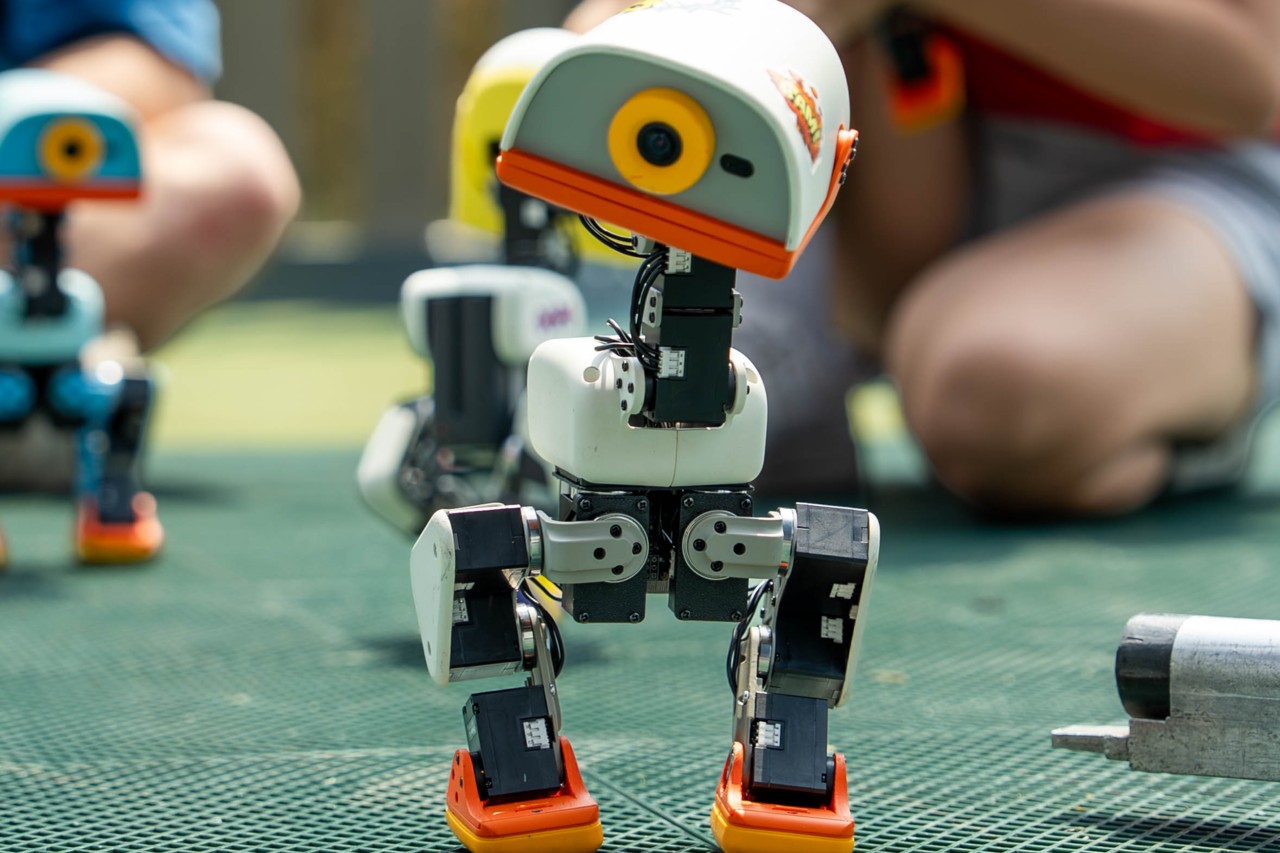
The duck stands about 25 centimeters tall. It walks with a waddle, quacks on cue, and when it tips over on a tabletop it pushes itself upright and keeps going. Pollen Robotics, the Bordeaux startup that built it, calls it Microduck.
Until August it was a curiosity for people who follow small legged robots. Then Jensen Huang picked one up on stage at GTC Berlin and made it walk.
Pollen says about 15,000 orders arrived in the three days after that demonstration, on top of the 15,000 preorders it had already taken. The company now says current demand stands at 50,000 units, and that the first shipments, pushed back by the order volume, will not leave the factory until the end of this year.
The order that matters to investors was signed in Seoul on October 26, in a conference room at the headquarters of Robotis Co. in Gangseo-gu. Kim Byeong-soo, the Robotis chief executive, and Matthieu Lapeyre, Pollen’s co-founder, signed a supply contract for roughly 750,000 actuators, the small motor-and-gearbox modules that move a robot’s joints.
The arithmetic behind the number is simple. Each Microduck carries 15 Robotis actuators, so 50,000 ducks require 750,000 of them. The contract is worth about 3.5 billion won, or roughly $2.4 million, according to the company. That works out to a little under 4,700 won an actuator, about $3.20, which is a wholesale price and a fraction of what the same part costs a hobbyist at retail.
For Robotis, the money is not the point. The company was founded in Seoul in 1999 and listed on the KOSDAQ exchange in 2018, and its Dynamixel line, which packs a motor, reducer, encoder, driver and network interface into a single housing, has been the default actuator in university robotics labs for two decades. Its robots have been research platforms: the DARwIn-OP humanoid, the OP3, the full-size THORMANG.
What it has lacked is a consumer product with volume behind it. A duck that pulls 50,000 orders gives Robotis something rarer than revenue, which is evidence that its parts can survive a factory line rather than a lab bench.
“We have used ROBOTIS’s self-developed robot actuator DYNAMIXEL for a long time and confirmed that it offers high reliability even in a small size,” Lapeyre said, according to the Korean press. Pollen also tested the actuators in Reachy Mini, its small desktop robot, before committing to the duck.
The reason a toy duck can move a supply chain is that Microduck is not really a toy. It is a biped with neural-network policies running at 50 hertz on an onboard computer, a camera, an inertial sensor and a speaker, sold as a way for developers to train and inspect walking behavior without building a robot from scratch. Pollen’s pitch is that you play with the trained behaviors first, then open the software and retrain them.
That is a hardware business dressed as a software business, and it explains the order pattern. Hobbyists bought the first batch. The second wave came from people who saw a compact, cheap platform for legged locomotion research and wanted one before the queue got longer.
The wider context is a scramble for actuation capacity. Humanoid programs at every large manufacturer run into the same bottleneck: joints are the expensive, heavy, reliability-critical part of the bill of materials, and the suppliers who can hold tolerances at volume are few. Korea has spent the past three years trying to convert its motor and gear expertise into that role. Robotis is one of the smaller names in that effort, and the duck put it on a stage it could not have bought.
Pollen expects actuator demand to reach at least 1 million units next year, which would be a third more than the current contract covers. Kim said the deal matters because it makes Robotis widely known, and that the two companies are discussing technical cooperation beyond parts supply.
There are reasons to discount the enthusiasm. The duck’s bill of materials is public enough that independent builders have published their own versions, some of them substituting cheaper Chinese servos for the Dynamixel parts. At $3.20 a unit on the OEM contract, the gap between Korean and Chinese pricing is thin, and a customer that can reprint the chassis can also re-source the joints.
There is also the matter of what happens after the queue clears. A robot that sells because a chip executive held it on stage is selling on novelty, and novelty decays faster than a supply contract. Pollen has not disclosed how much of the order book has been paid in full, and it has already pushed back its original shipping schedule once.
What Robotis has bought with the contract is a claim on the next conversation. When a humanoid maker in Korea, Japan or the United States sits down to qualify a joint supplier, it will ask who shipped 750,000 units to a French startup in a single order. The answer is now on the record, along with a delivery deadline at the end of the year that will show whether the factory can keep the promise the stage made.