The flight landed on Friday night and no announcement preceded it. By Saturday morning, Sam Altman was in Yongin, south of Seoul, in a room with about 50 Samsung executives drawn from the group’s electronics, finance and biotechnology businesses, according to Samsung.
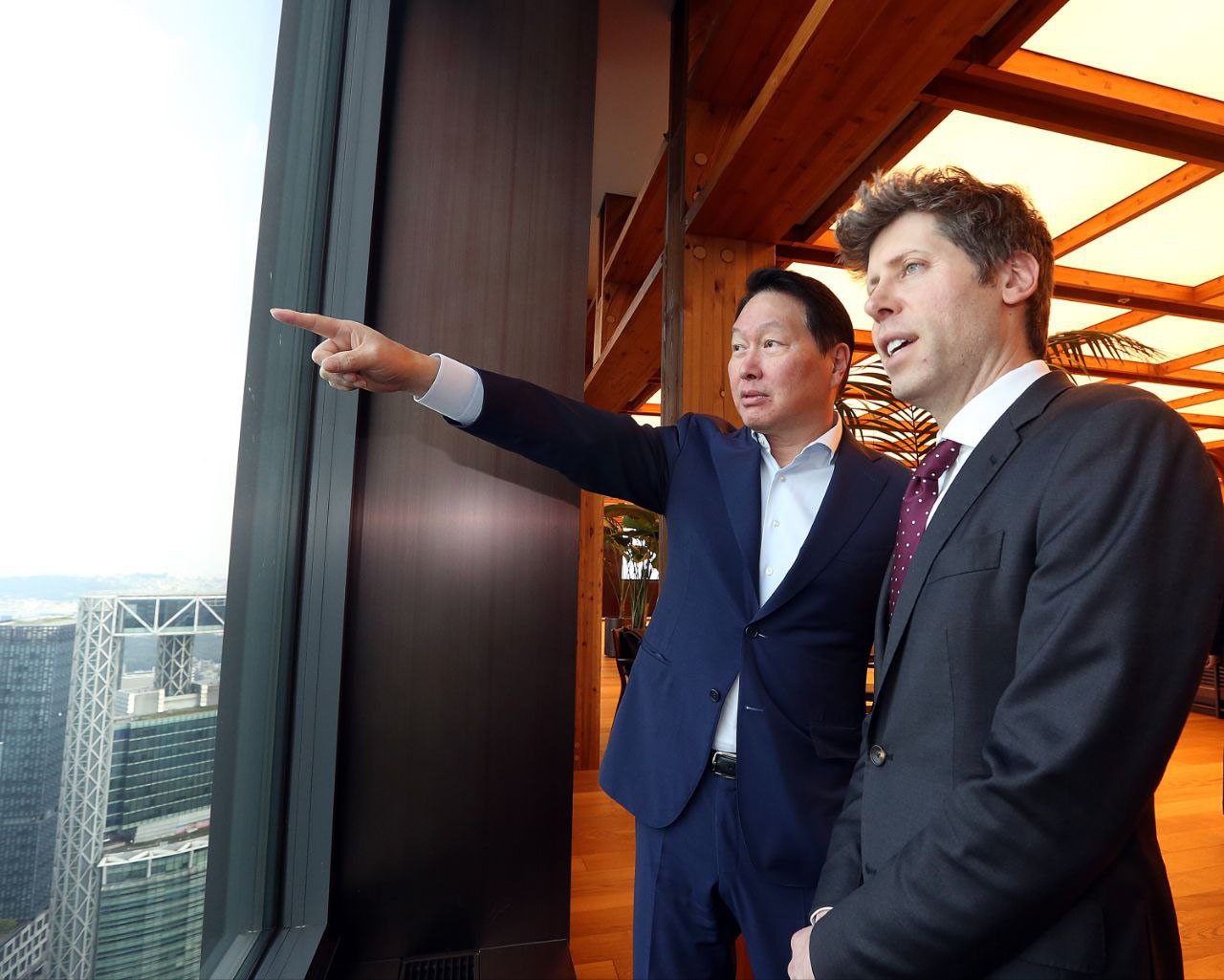
The OpenAI chief executive left the country the same day. Between the two, he had lunch with SK Group Chairman Chey Tae-won, with senior executives from SK hynix and SK Telecom at the table, according to South Korean media reports. SK hynix told CNBC it could not confirm the meeting. Neither side published an agenda or a number.
What the visit was about is not in dispute. The two Korean companies make the memory that every accelerator needs and neither can do without, and both have already sold the output they will produce for years. Samsung said last week that its high-bandwidth memory production for 2027 is sold out. SK hynix said its DRAM and HBM output is effectively accounted for through 2029, counting signed contracts and volumes still under negotiation.
That is the market Altman flew into. TrendForce expects the blended average selling price of HBM to rise 121% in 2027 from 2026, driven by tight supply and a heavier mix of HBM4 rather than by an across-the-board increase. DRAM supply is running 1% to 2% short of demand this year and the gap is expected to widen next year. The two Korean firms held roughly 63% of global DRAM revenue in the second quarter and about 83% of HBM revenue, according to Counterpoint Research.
Their order books show what that concentration means in practice. Samsung has signed long-term agreements with 10 major customers and is negotiating with 10 more, and it aims to place 60% to 70% of its capacity under such contracts by 2030. SK hynix has 14. “Customers are requesting more than twice the volume we can supply,” Kim Ki-tae, the company’s head of HBM sales and marketing, said on its earnings call.
Against that, OpenAI’s position is that of a buyer with a projection and no contract. In October 2025 the company signed preliminary Stargate agreements with Samsung and SK that outlined demand equivalent to 900,000 DRAM wafer starts a month. That figure was a production target, not a binding order, and it has not been converted into one.
Samsung’s own account of Saturday’s meeting was broad: the two sides discussed the direction of AI development, potential business opportunities and how AI changes corporate decision-making. Korean media reported that HBM supply and data centre cooperation were on the agenda, which is what the Stargate letter of intent covers. No new supply agreement was announced, and none was expected to be: in a market where allocation is decided years ahead, a visit is a relationship, not a transaction.
The relationship has a second track. Samsung affiliates and SK Telecom agreed last year to explore AI data centres in Korea with OpenAI, and those projects remain short of committed budgets and construction dates. “Building a data centre involves more considerations than we initially expected,” OpenAI’s Korea chief, Kim Kyoung-hoon, said in September, citing changing technical requirements.
Money is the constraint on that track. OpenAI has been raising capital at a valuation of $1.25 trillion after scaling back an earlier plan pitched at $1.4 trillion, according to people familiar with the matter, and the company’s infrastructure commitments now run through multiple suppliers and jurisdictions. Every dollar committed to a Korean data centre is a dollar not committed to one in Texas or Abu Dhabi, where Altman signed energy and investment agreements earlier in the week.
The memory bill is also rising faster than the models assumed. A training cluster’s HBM content is measured in terabytes and priced per stack; a 121% increase in blended HBM pricing lands directly in the cost of compute that OpenAI resells. The company has been designing custom accelerators with Broadcom, which reduces dependence on Nvidia but not on the memory that sits beside the chip.
That is why the suppliers set the terms, and why the visits keep happening. AMD’s Lisa Su travelled to Seoul earlier this month to discuss additional HBM supply, saying it was important to plan three to five years ahead with partners. Altman’s trip follows a July meeting with Samsung Executive Chairman Jay Y. Lee in San Francisco and an October 2025 visit that produced the Stargate announcements with President Lee Jae Myung present.
There is an awkward subtext. Altman said on a podcast before the trip that memory sitting inside personal computers is often underused and that data centres could use it more intensively, remarks that drew criticism because OpenAI’s own services depend on concentrated compute. The comment did not travel well to a country whose two largest companies are deciding who receives allocation.
For Samsung the visit had value beyond memory. A group-wide session with the chief executive of the world’s most visible AI company is a signal to its own customers and shareholders that it sits inside the buildout rather than beside it, and Samsung has been pushing an internal AI transformation agenda that needs external partners to be credible.
For SK hynix, whose New York listing has widened its shareholder base, the meeting is a data point for investors who have spent a month worrying about the durability of memory pricing. Its shares have fallen sharply from their highs even as profits set records, which is the market’s way of asking whether 2029 is a floor or a peak.
What to watch is a signature. A binding multi-year agreement with volumes, a pricing mechanism and a deposit would tell investors that OpenAI has converted a projection into inventory, and would tell the memory makers that their next fab has a tenant. Until one appears, the flights to Seoul will continue, and the answer to the question Altman came with will stay in the suppliers’ hands.