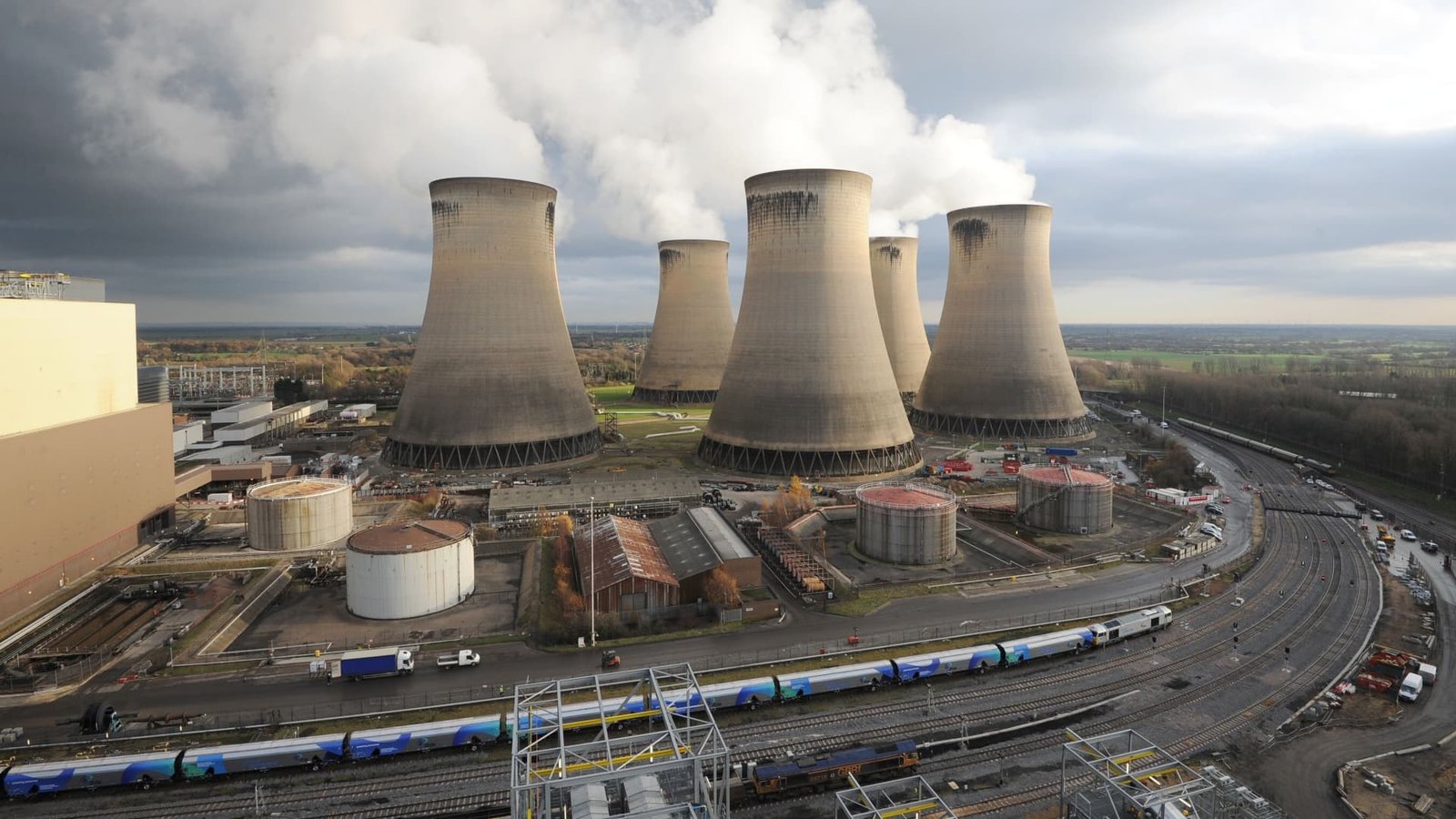
For half a century the flat land beside the River Ouse in North Yorkshire has done one thing: burn fuel and send electricity south. First coal, hauled in by rail. Then wood pellets shipped across the Atlantic. Now the fields around the power station are being surveyed for a different sort of load, one that consumes power instead of producing it.
Drax, the British generator that owns the site, said on Nov. 3 that it would work with Brookfield and an AI infrastructure platform called Radiant to develop data centers on the estate. The first phase is planned at up to 100 megawatts, targeted to come online in the first quarter of 2028. A further 500 megawatts would follow between 2028 and 2031, with an eventual goal above one gigawatt.
Brookfield estimates that total investment, including the semiconductors inside the buildings, could exceed £20 billion, or about $26.8 billion. The first phase alone is expected to cost £2.5 billion. None of that money is committed yet. The partners still need planning consent, regulatory approvals, a grid connection and, most importantly, tenants willing to sign for capacity years before the halls are built.
Investors treated the announcement as a vote on the land rather than the project. Drax shares rose 8.8% in early London trading, a notable move for a company whose stock has been yoked to the politics of biomass subsidy and the cost of its own conversion.
The appeal is easy to state. Drax sits on a high-voltage connection that already exists, on a site with cooling water, heavy transport access and a long history of industrial use. Grid queues in Britain stretch for years, and access to a live connection has become one of the scarcest assets in the AI buildout. A campus that can plug into an existing substation skips the part of the schedule that usually slips.
The complication is that the connection was built for a generator, not for a customer that draws power around the clock. Data centers want firm capacity and they want it flat. A power station’s output can be dialed up or down; a rack of accelerators training a model cannot wait for the wind to drop. The first phase of 100 megawatts is small precisely because it can lean on what the site already has, while the later phases depend on network upgrades that have not been approved.
The third partner is the least known of the group. It is described as an AI infrastructure platform, a category that has multiplied in the past two years as investors concluded that the binding constraint on artificial intelligence is no longer software but floor space, transformers and cooling. Brookfield has been assembling one of the largest data-center portfolios in the industry and has told investors it sees the sector as an extension of its core business of owning long-lived assets with contracted revenue.
The British government has been trying to shorten the path for projects like this one. Ministers have designated growth zones where planning and grid access are meant to move faster, arguing that the country’s research base and legal system give it an edge in attracting compute. Those zones have mostly been sited near existing infrastructure, and a former coal plant with a substation attached fits the template.
Local politics will decide more than the model economics. The site sits in a rural county where the power station has long been both the largest employer and the largest source of complaint. A data center is quieter than a turbine hall but it draws water and it draws power, and it produces very few jobs relative to the acreage it occupies. Campaign groups that have spent years arguing over Drax’s wood-pellet supply chain now have a second reason to file objections.
Drax’s own future is unresolved in a way that complicates the pitch. The company has been negotiating with the government over support for a carbon capture project at the site, a scheme that would let it keep burning biomass while burying the emissions. A decision has been slow in coming, and the economics of the plant without it are thin. Renting land to a tenant with a twenty-year horizon is a useful hedge for a company whose main revenue line depends on a subsidy regime that could change with a single budget.
For Brookfield, the calculation is more familiar. The firm has spent a decade buying infrastructure with predictable cash flows and selling stakes in it to pension funds that want duration. Data centers fit that model only if the tenant is creditworthy and the lease is long. That is why the announcement reads as a sequence of options rather than a commitment: 100 megawatts, then 500, then a gigawatt, each tranche contingent on the one before.
The final investment decision has not been taken. Until it is, the fields beside the Ouse remain farmland with a power station next door, and the project remains a plan with a price tag attached by the partner that would like to finance it.