The site went quiet before anyone announced it. Construction crews at Micron’s new memory fab in Taoyuan have largely stopped work, according to Bloomberg, which cited people familiar with the matter.
The plant is a $4.5 billion project and one of the facilities the company is counting on to supply memory for AI systems, a market where demand has outrun every forecast made about it. Work has not stopped entirely, and no timeline has been given for a restart. Micron did not respond to a request for comment.
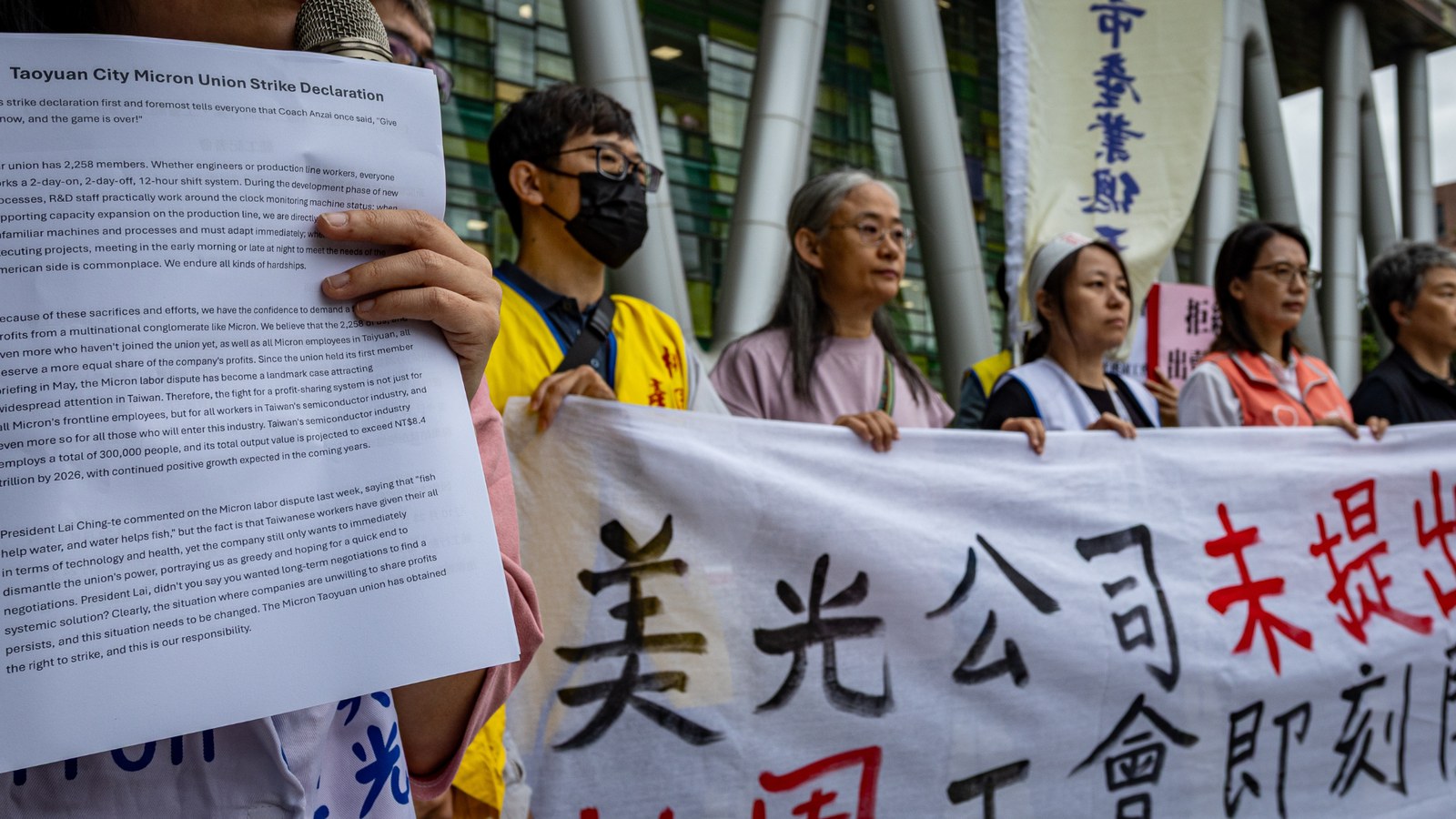
The reason, as Bloomberg described it, is not financing or demand. Management is concerned that an agreement reached with the local union could be overturned, and the company has told local officials and at least one supplier about the decision. Reuters, relaying the report, said it could not independently verify the account.
That is a thin set of facts to hang a story on, and the thinness is itself the news. A company does not halt a multibillion dollar fab because a labour agreement is inconvenient. It halts when the agreement’s durability has become a variable it cannot model, and when the cost of being wrong is paid in years rather than quarters.
The economics of a memory plant explain the sensitivity. A DRAM fab costs billions, takes years to bring up, and produces a commodity whose price is set by supply and demand across an entire industry rather than by anything the operator does. The difference between a good year and a bad one is often the difference between starting production on schedule and starting it eighteen months late, when the cycle has turned and the wafers are worth less than the silicon they were cut from.
Taiwan is where Micron’s DRAM business largely lives. The company’s presence on the island came through its acquisition of Inotera, a Taiwanese DRAM venture it eventually bought outright, and the sites it absorbed became the base for its advanced DRAM production. Taoyuan is one of those sites. A pause there is not a pause in a peripheral market.
The labour dimension is unusual for this industry and worth spelling out. Memory fabs are among the most automated factories built by humans, and the workforce that matters is not large. It is specialised: process engineers, equipment technicians, people who can diagnose a chamber that has drifted out of spec at three in the morning. Those people are hard to hire and, once organised, hard to replace. A union agreement at a site under construction sets the terms for the workforce that will run it, and if management believes those terms can be reopened by a change in local politics or a legal challenge, the plant’s operating cost becomes a range rather than a number.
For a business that plans capacity three years ahead, a range is worse than a high number.
There is a wider context that makes the pause awkward. Memory prices have been climbing on demand from AI servers, where the quantity of DRAM and high-bandwidth memory per system is several times what a general purpose server carries. Micron, along with Samsung and SK Hynix, has been shifting capacity toward those products and away from the consumer DRAM that fills laptops. Every wafer moved to a high-bandwidth stack is a wafer not making commodity chips, and the industry has been willing to make that trade because the margins are better.
That trade only works if the new capacity arrives. A pause at a plant meant to supply it tightens a market that is already tight, and the effect shows up first in contract negotiations for the following year, where buyers who expected more supply discover they are bidding against each other for less.
The signal to Taiwan’s government is equally pointed. The island has spent years courting semiconductor investment as a matter of national strategy, and the pitch has been reliability: rule of law, skilled labour, a supply chain that works. A company telling local officials it is worried about the durability of a labour agreement is a company testing whether that pitch holds when the terms get expensive.
The signal to Micron’s competitors is simpler. Samsung and SK Hynix now have a year in which one of the three suppliers is not adding the capacity it said it would. Neither will announce that they are pleased. Both will price accordingly.
None of this is settled. The report is attributed to people familiar with the matter, the company will not discuss it, and the pause has no stated end. A restart could be announced next month, and the whole episode would read as a negotiating tactic rather than a decision. Companies do use construction stoppages that way, and unions know it.
What remains is a question the memory industry has been avoiding since the last downcycle: when the demand for AI memory is being met by fabs that take three years to build in places with contested labour politics, how much of the shortage is a shortage of silicon and how much is a shortage of certainty?