
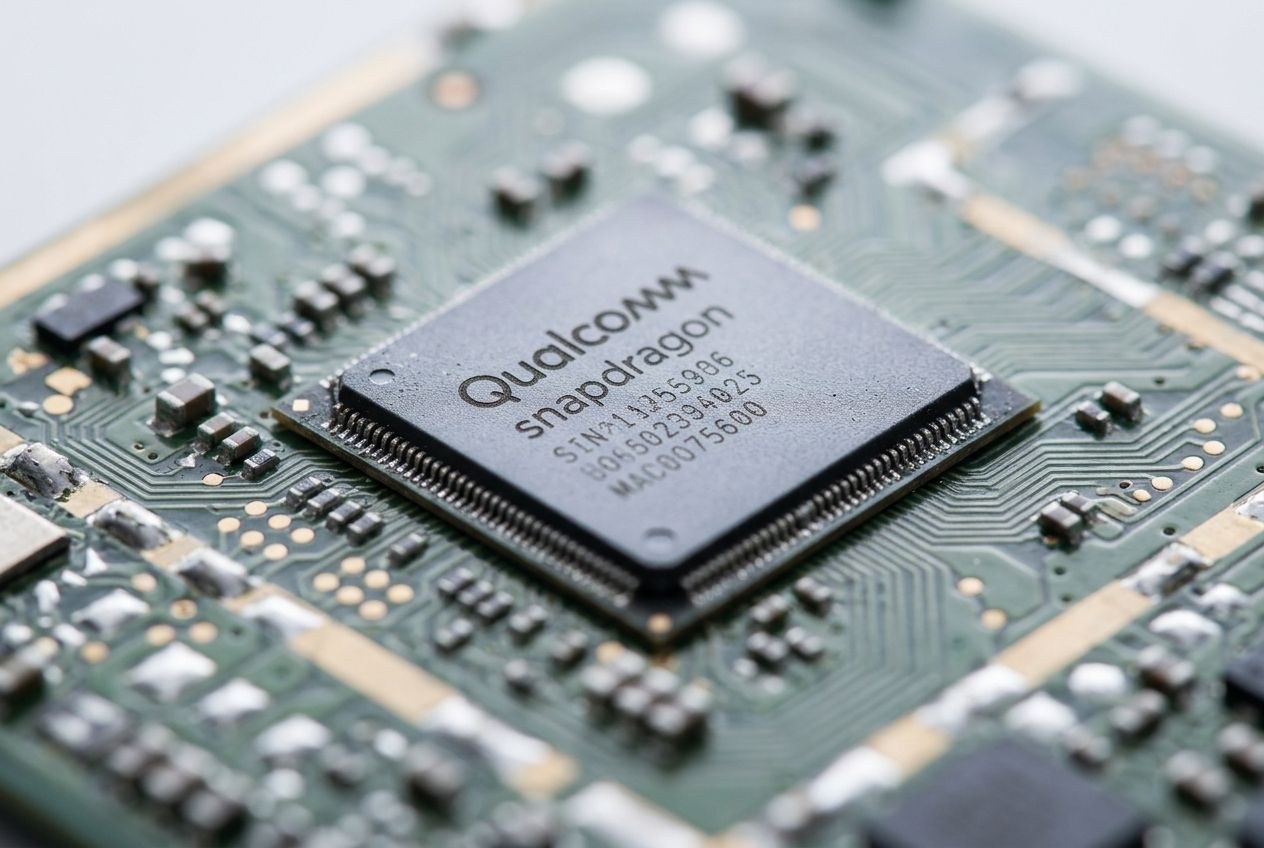
The numbers Qualcomm reported on November 4 were, narrowly, better than expected. The forecast that arrived with them was not, and investors treated the second number as the more important one.
The San Diego chip maker said adjusted revenue for its fiscal fourth quarter fell 7% to $10.44 billion, with adjusted earnings of $2.17 a share. Both figures came in slightly above the estimates analysts had circulated before the release. For the December quarter the company guided to earnings of $2.15 to $2.35 a share on revenue of $10.4 billion to $11.2 billion, below the $2.27 and $10.48 billion that analysts had modeled. The shares fell 7% in after-hours trading.
The gap between the two halves of the release is the handset business. Revenue from chips sold into phones fell 26% to $5.14 billion, a decline steep enough to erase most of what the rest of the company added. Chief Executive Cristiano Amon told investors that tight supply was the main cause rather than a collapse in demand, a distinction that carries real weight for how the next two quarters are read. A company short of components can recover the revenue when supply loosens. A company whose customers have stopped ordering cannot, and the distinction is the difference between a quarter that gets revised upward and one that gets revised down.
Supply constraints of that kind rarely arrive alone. Memory prices have climbed through the year, and a handset carries a fixed bill of materials in which memory is one of the largest line items after the processor itself. Component costs of that sort are usually negotiated with phone makers on annual cycles, which leaves a chip supplier little room to pass a jump in input prices through to the selling price on short notice. The result is a squeeze that shows up in gross margin before it shows up in revenue, and Qualcomm’s guidance implies both.
Then there is the part of the story investors have been paying for. Data center revenue was $650 million in the quarter, a sum that rounds to a rounding error against the $5 billion the company says it will reach in fiscal 2027. Getting from one number to the other requires roughly eightfold growth in four quarters, a trajectory that would be unusual even for a business starting from a small base with a product customers already want.
Qualcomm has spent several years arguing that inference, the work of running trained models rather than training them, will migrate toward devices and toward cheaper accelerators sold on power efficiency rather than raw throughput. That argument has produced designs and customer announcements. What it has not produced, so far, is a revenue line large enough to offset a handset decline of this size. The company has not broken out which customers are behind the $650 million, and the absence of that detail is itself a signal about how concentrated the business remains.
The handset outlook does not help. Qualcomm expects the phone market to be flat in 2027, which is a polite way of saying it expects no growth from the business that still supplies the overwhelming majority of its profit. Flat markets reward share gains rather than patience, and the company is defending its position against Chinese handset makers building their own silicon and against a customer base that has grown more careful about component costs as memory has become more expensive.
The licensing arm remains the quiet support under all of this. Qualcomm collects royalties on handsets regardless of whose processor sits inside them, which means the licensing business earns whether or not the chip business wins a design. That structure has funded years of investment in markets the company did not yet serve, and it is why a 26% decline in handset chip revenue does not threaten the balance sheet the way it would at a pure component vendor.
The strategic question is timing. Every dollar of data center revenue Qualcomm books in 2027 has to be sold against a competitor with a software ecosystem that customers have already built around, and against a set of hyperscale buyers who are themselves under pressure to justify what they spend on computing. A supplier arriving late with a cheaper part can win on cost. It rarely wins on preference.
Management will point to the pipeline and to design wins that convert over the next year. Investors will look at the December guidance, which suggests the phone business has another two quarters of contraction ahead of it, and ask how much of the $5 billion target depends on customers who have not yet committed to volume.
That is the arithmetic the market will spend the next quarter working through. Qualcomm can absorb a weak December. What it cannot absorb is a weak December followed by a data center number that grows more slowly than the slide promised, because the two together would leave the company with a shrinking business funding an unproven one. Amon has one more quarter in which the story holds without proof.



