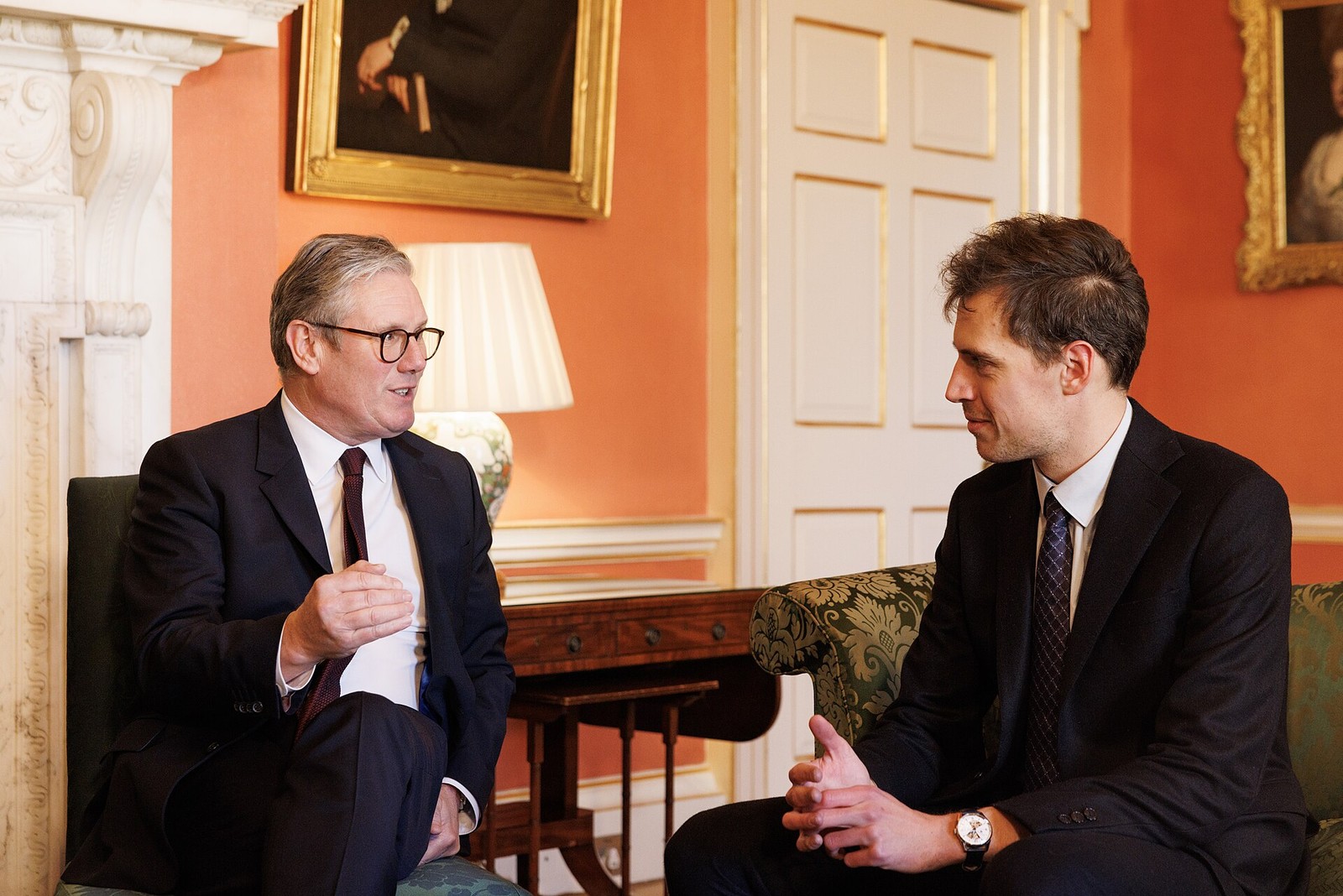
Arthur Mensch was asked directly where Mistral AI would list if it went public, and he answered in one sentence. The natural place, he said, is Europe. He then added the qualification that matters to anyone building a model around the company’s share price: not this year, but the preparations are under way.
The remarks came at Semafor’s Silicon Valley and the World event on Tuesday, in a conversation that ranged from listing venues to the politics of artificial intelligence in France. Mistral, based in Paris, is one of the few European companies building foundation models from scratch, and has positioned itself as a supplier of open-weight systems for governments and companies that do not want their data processed by an American vendor.
The case for a European listing rests on the company’s shareholder base and its customers. Mensch said most of Mistral’s investors are European and about half of its customers are too, a combination that argues for listing where the people who already own the story are allowed to trade it. The case against is capital. Arm, Spotify and Klarna all chose New York, drawn by deeper pools of money and higher valuations than European exchanges have offered technology companies.
Mensch did not pretend the tension was resolved. He described Europe as the natural location rather than the obvious one, and left open the possibility that a dual structure or a later decision could change the answer. What he ruled out was speed. A listing this year, he said, is not happening.
The company’s pitch depends on a distinction that has become sharper over the past two years. Closed American models are powerful and opaque. Open Chinese models are cheap and, for many European buyers, politically difficult to adopt. Mistral sells something in between: weights a customer can run inside its own perimeter, with a French company’s name on the contract.
That positioning has been helped by European policy. Public procurement rules, data-residency requirements and the general preference of ministries for suppliers they can summon to a meeting in Brussels have all favored domestic vendors. Mistral has also drawn backing from ASML, the Dutch equipment maker, which led a funding round that gave the company one of the largest war chests in Europe.
The political half of the conversation was less comfortable. France holds a presidential election next year, and Mensch said he had met most of the candidates to explain how the industry works. Many of them, he said, are not technical, and will need to become more so, because the next five years of policy will be technical in ways that previous rounds were not.
He was more pointed about the country’s recent unrest, which he linked to anxiety among young people about employment. Part of the anguish, he said, comes from artificial intelligence changing what jobs will exist. He criticized companies that have stopped hiring junior staff because of the technology, arguing that young workers trained with these tools will use them better than anyone and create value with them.
That argument is not disinterested. Mistral sells to enterprises that are making exactly the hiring decisions he was describing, and a vendor that tells its customers to keep hiring graduates is asking them to absorb cost in the name of a longer payoff.
Mistral’s revenue comes from three places: licensing weights to companies that want to run models on their own hardware, a paid application layer for businesses that would rather buy a product than build one, and government contracts. Only the second looks like conventional software, with recurring subscriptions and gross margins that improve with scale. The first is closer to a publishing business, and the third runs on procurement cycles measured in years.
On the American side of the industry, Mensch offered a view that will travel. Asked about Nvidia, he said he would welcome Jensen Huang back at the chip company, a reference to the leadership vacuum created by Huang’s departure. Nvidia has been run since then by an interim chief executive, Colette Kress, while the board searches for a permanent replacement.
For Mistral the question is whether open-weight models can support a business at the scale its investors paid for. Training runs are expensive, and the customers most likely to want weights they can host are often the ones with the smallest budgets. The company has answered by selling into regulated sectors and governments, where the alternative is not a cheaper American model but a procurement process that cannot buy one.
Mensch did not discuss revenue or margins, and the company does not publish them. He did not name a valuation, a lead underwriter or a timetable beyond the exclusion of this year. Those absences are ordinary before a listing and telling in their own way: a company that is genuinely preparing for a public market usually has less to say about it than one that is thinking aloud.
What he did say was that Europe would remain supportive regardless of who wins the election, and that support is needed. For a company whose product is partly a claim about where data should live, that sentence is the strategy. The listing, when it comes, will be the test of whether the claim can be priced.