
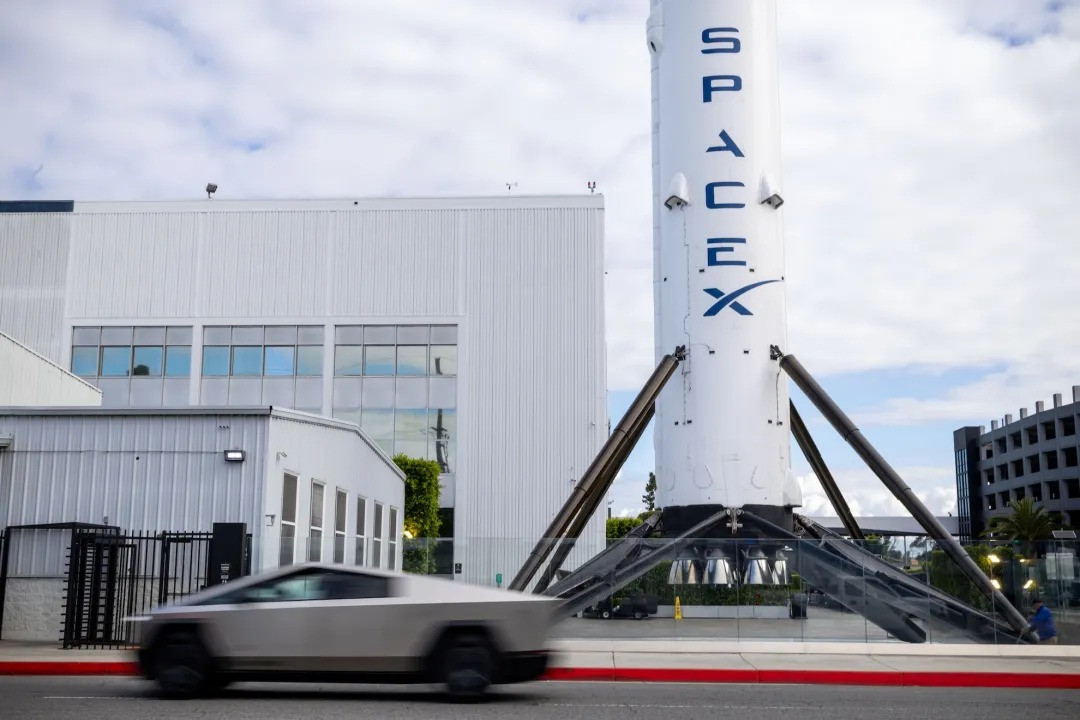
The question came at the DealBook Summit on Tuesday in the plainest form available: would Tesla and SpaceX be better off as one company?
Elon Musk’s answer was conditional. They do not need to be tied together, he said, but together they would probably be better. He then named two obstacles, and neither of them is a matter of engineering.
The first is a shareholder vote. A combination would need approval from Tesla’s holders, and Mr. Musk said that vote might not pass. The second concerns his own compensation. He said his options should not vest automatically because a merger happened. The award, in his account, should answer to Tesla’s operating results and to nothing else.
That second condition is the more revealing one, because the award he was describing is not a conventional grant.
Tesla’s shareholders approved a pay package in November 2025 that gives Mr. Musk up to 423.7 million restricted shares, delivered in twelve tranches. Each tranche pairs a market-value threshold with an operating goal. The first unlocks at a $2 trillion valuation; the last requires $8.5 trillion. The goals in between run through vehicle output, robotaxi service, humanoid robot production, paid driver-assistance subscriptions and adjusted earnings.
The structure was built to answer a specific complaint. Tesla’s previous award, granted in 2018, was struck down by a Delaware court that found the process behind it defective. The company litigated for two years, returned the package to a shareholder vote, and moved its incorporation to Texas. The replacement was written to survive that kind of challenge: no salary, no cash bonus, no time-based vesting, and a board argument that the only way Mr. Musk collects is by creating value other holders also capture.
Against that record, his remark about a merger reads less like humility than like arithmetic. A combination that converted Tesla equity into shares of an entity holding rockets and a satellite network would change the denominator in every one of those twelve tests. A valuation threshold could be met for reasons that have nothing to do with cars, and a chief executive would collect for a rally he did not produce. Mr. Musk said he did not want the award to work that way.
The vote is the harder problem, and it is not one he can solve by argument. Tesla’s shareholder base is dominated by index funds that vote with the board on routine matters and by retail holders who bought the autonomy story. A merger asks both groups to accept something they did not choose: exposure to a launch business with capital needs measured in billions and a satellite network whose economics are still being priced.
Funds tracking the major benchmarks would have little discretion. Their mandates require them to hold whatever the combined company becomes, subject to governance screens written for ordinary corporations. A charter that concentrates control in one holder tests those screens, and several large managers have policies that would force a review. That review is a slow process, and it happens after the vote rather than before it.
There is a simpler reason the question keeps returning. Tesla’s automotive business has spent two years defending margins while its growth depends on price cuts, and the spending that supports its valuation sits in projects that will not produce revenue for years. SpaceX has the opposite profile: a launch business that consumes cash, a broadband business that generates it, and private investors who have funded both at rising marks. Putting them on one balance sheet would give the capital-hungry side access to a public currency and give the public side a growth story.
Whether that is good for holders depends on the exchange ratio, which nobody has published, and on who runs the result. Mr. Musk controls both companies through stakes that are large without being majorities. A combined entity would need a charter, a board and a set of related-party rules covering transactions between the company and the other businesses he owns. Those documents, not the valuation, decide how minority holders fare.
Mr. Musk has been close to this position before. His attempt to take Tesla private in 2018 collapsed within weeks, and the funding claim that preceded it drew regulatory scrutiny that outlasted the deal. Investors who held through that episode tend to discount any transaction he describes in public before it is signed.
The two conditions he set out on Tuesday are also the two a board cannot engineer around. A shareholder vote requires holders to agree, and a performance award requires results rather than structure. By separating them from the merger question, Mr. Musk put the burden where it belongs: on the operating record, which is the same test the pay package already applies.
He did not say when a decision might come, and he did not describe terms. What he described was a preference with a price attached, which is a different thing from a plan.



