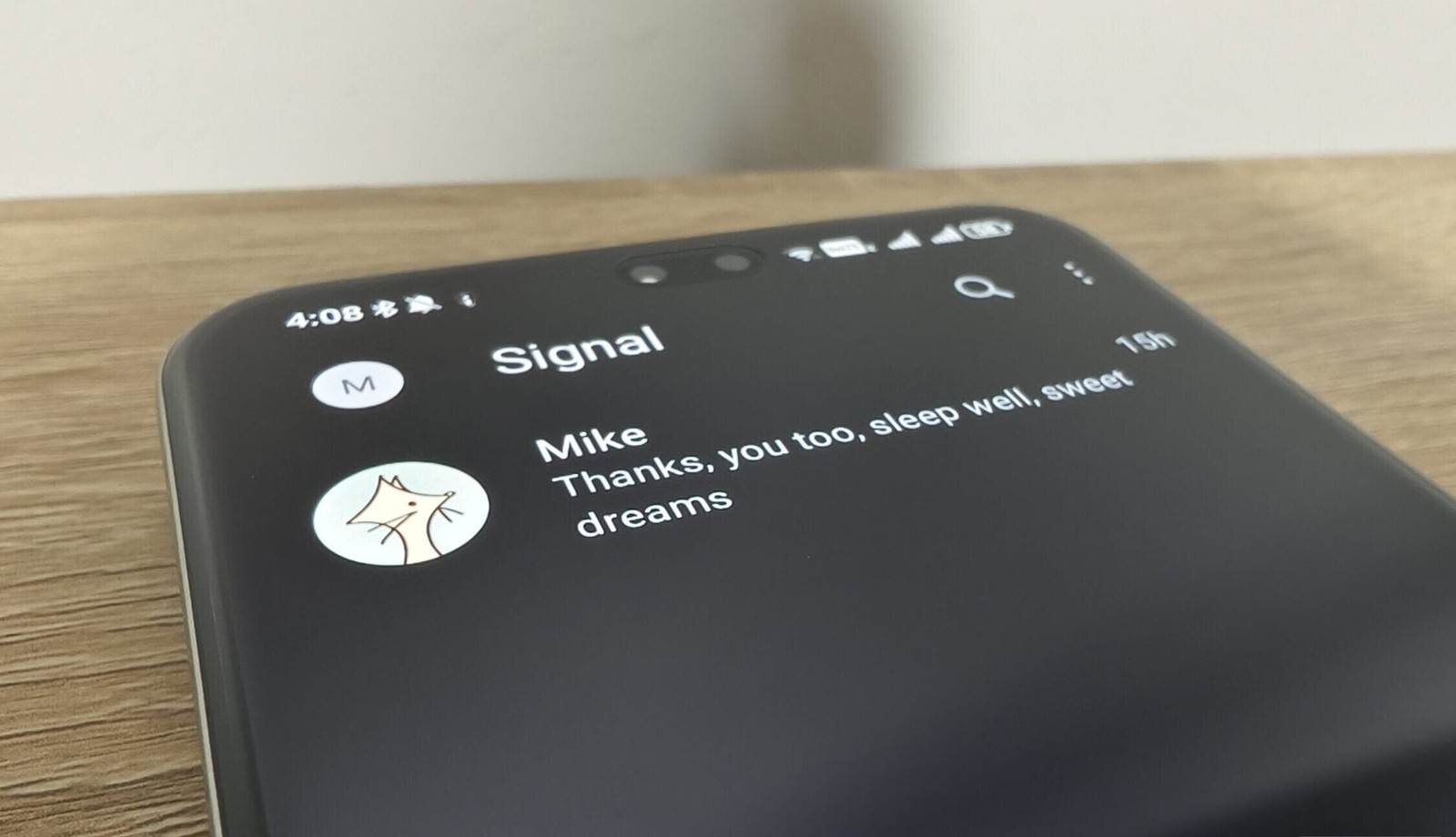
Meredith Whittaker, president of the Signal Foundation, published a blog post on Nov. 20 that read less like a release note than a warning. Signal, the encrypted messenger she runs, had changed its default settings so that the AI assistants built into iPhones and Android phones can no longer capture what appears on a Signal chat screen. The change targets screen awareness, the capability Apple has built into Siri AI and Google into Gemini, which lets an assistant look at whatever is displayed and act on it.
Why should anyone who does not use Signal care? Because the same capability sits on top of every app on the phone. An assistant that can read the screen can read a bank balance, a patient portal, a lawyer’s email and a conversation with a source. That is the feature, as advertised. It is also, as Signal describes it, a channel that carries conversation content off the device and into a place the app cannot see. Signal built its reputation on knowing as little as possible about its users. A system layer that reads the screen removes the app’s ability to keep that promise, no matter what the app does with the data.
The mechanics are worth spelling out plainly. Assistants get screen access in two ways: through an accessibility interface that reports what is drawn, or by taking screenshots and reading them with an image model. A user grants permission once, usually during setup, and the grant then applies broadly and quietly. Signal’s response is to deny the capture at the source rather than argue about what happens to it afterward. On iOS 27, screenshots taken inside the app were already blocked, and a new switch in settings blocks Siri AI specifically. On Android, the app now turns on screen security automatically when it detects an assistant reading the display, which blanks the content in the capture.
The blog post is candid about the gaps. Signal said the protection is incomplete. On macOS the app cannot reliably stop a system-level reader, and the company said so rather than claiming a fix it does not have. It repeated a request it has made before: Apple, Google and Microsoft should offer an application-level way to opt out, so an app can declare itself off limits and have that declaration enforced by the operating system.
The platform companies frame these assistants differently. Screen awareness is presented as a feature a user turns on, one that can be turned off, with as much processing as possible happening on the device. That account is not dishonest, and it is also not a security guarantee, because the trust it asks for is trust in a preference rather than in a mechanism. Signal’s argument requires nobody to be acting in bad faith. It requires only that the assistant do what it was built to do, at the moment a user asks it to look at the screen while a private conversation is open.
Signal can act this way because of how it is built. It is a nonprofit with a small staff, no advertising business and no reason to keep a platform partner happy, which is why it can ship a defensive default on a Thursday and explain it in a blog post rather than a press call. A messenger owned by an advertising company could not make the same move without arguing with the maker of the operating system it depends on.
There are rules underneath this, and they do not help yet. European law treats inference about a person as regulated processing, and an assistant that summarizes a conversation is inferring. Enforcement, however, arrives after deployment, usually years after, and in the form of a finding rather than a patch. A settings change is faster. It is also unilateral, which is the point and also the limit.
Signal has been in this position before. It fought over message metadata, over phone numbers as identifiers and over a backup design that made encrypted storage opt-in. Each time it argued that the protocol is not the product, and that the surrounding system decides whether the promise holds. A phone whose operating system can look at any screen is that argument expressed in hardware, and it is harder to answer with a button.
There is a counterargument worth taking seriously: the assistant only sees what the user points it at, and a chat that refuses to be photographed breaks legitimate uses, such as accessibility tools that read text aloud for people who cannot see it. Signal’s answer, implied rather than stated, is that a per-app switch solves both cases, since the user decides which apps cannot be captured and the operating system enforces the choice. That places the decision with the platform, which is where it started.
The toggle shipped on by default, which means most users now have protection they did not ask for and will never notice. Whether it keeps working depends on three companies with their own reasons to make screen awareness universal, and on an enforcement mechanism that does not exist yet. The post ends with the request. As of publication, none of the three had answered it.