
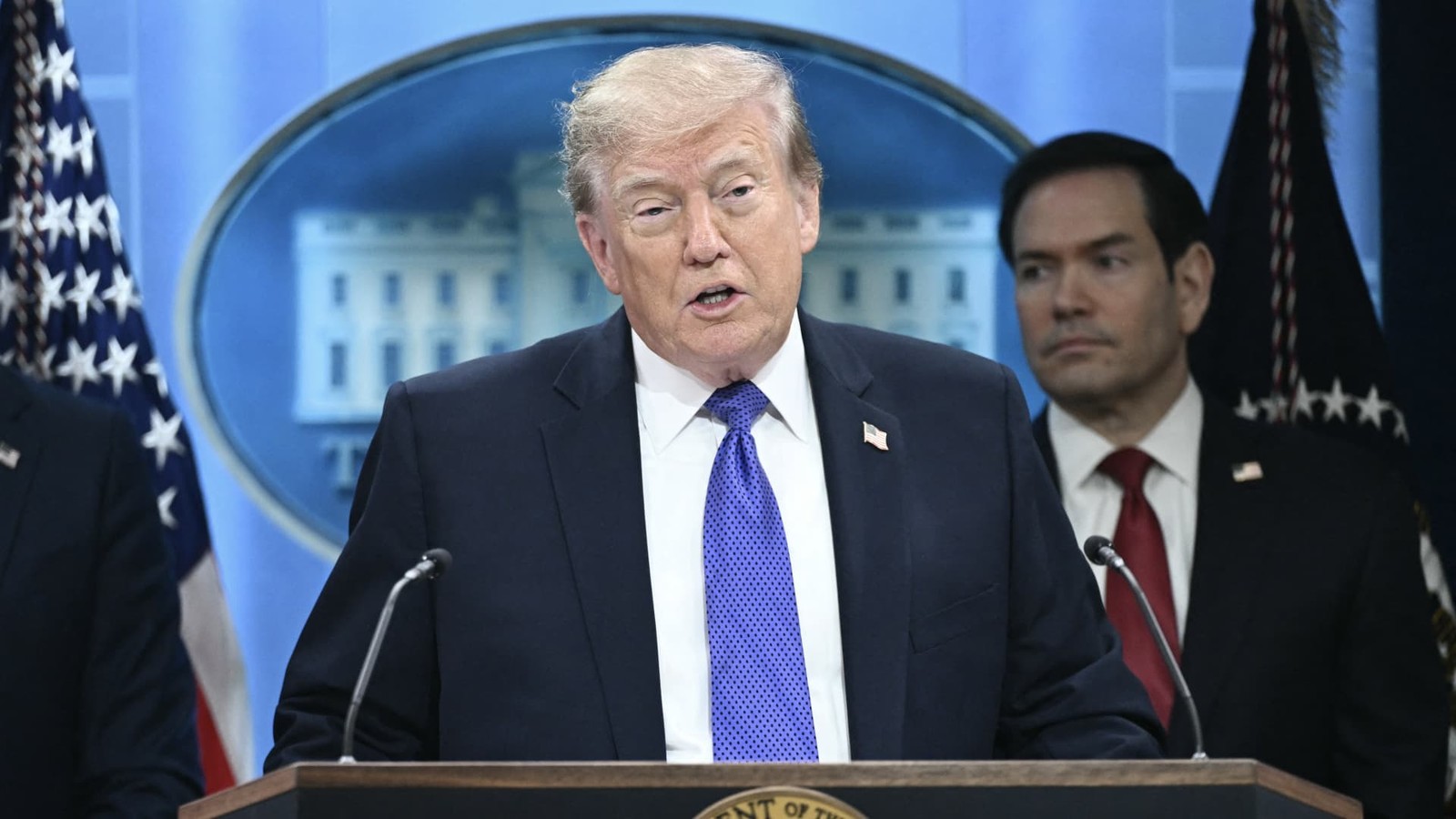
The siting of a data centre has become a tax question, after President Donald Trump said companies that build AI computing capacity outside the United States would face a large levy.
He offered no rate, no legal basis and no timetable. Speaking at an event at the White House on Nov 20, he said the tax would fall on companies that put AI data centres beyond the country’s borders, and did not describe how it would be assessed or who would collect it. No implementing rules have been published, and the companies most affected have not responded.
The significance lies in what a data centre is. It is a fifteen-year bet on a jurisdiction: a power contract, a water supply, planning permission, fibre routes, a workforce of technicians. By the time a tax bill arrives, the concrete is poured and the accelerators are installed. A levy announced after the decision is not a deterrent so much as a charge on a decision already taken, which is why the reaction from operators will focus on whether the threat is durable rather than on its size.
The sums at stake are large. Microsoft, Amazon, Google, Meta and Oracle have together committed hundreds of billions of dollars to computing capacity this year, in buildings measured in hundreds of megawatts and campuses that draw as much power as a mid-sized city. The companies do not break out how much of that lands abroad, but the answer matters: Ireland, Malaysia, Singapore, the Gulf and India all host capacity built for regional customers.
Those commitments are contractual. A hyperscaler that signs a fifteen-year power purchase agreement in Johor or a land lease outside Dublin has booked an obligation that a change in tax treatment cannot undo, and the accounting for it runs through depreciation schedules that stretch past the next presidential term. That asymmetry, between a promise made in a speech and a promise made in a contract, is the reason the industry’s first response is usually silence.
The domestic side of the equation is tightening anyway. States and cities have been slow to approve new data centres, and local objections have shifted from noise and sightlines to electricity prices and water consumption. A handful of state regulators have rewritten the tariffs that very large electricity customers pay, on the argument that households should not subsidise load growth that serves out-of-state shareholders. In parts of the country, a new campus now needs a political case as well as a grid connection.
Read against that, the threat has an internal logic. If approvals at home are slow and expensive, a tax on building abroad makes the domestic path relatively cheaper without ever subsidising it. That is a familiar instrument in trade policy, where a penalty on the foreign option does the work of an incentive at home.
Whether it can be built is another matter. Tax law in the United States is written by Congress, and a president speaking at an event is not a statute. A levy aimed at offshore investment would have to be defined: a tax on the foreign subsidiary, an excise on imported compute, or a condition attached to a permit. Each version raises different questions, and the versions that reach furthest run into treaty obligations and the rules that govern subsidies.
The companies have an argument of their own. A cloud region in Frankfurt exists because European customers and European regulators require their data to stay in Europe, and a bank that cannot store records abroad will not buy capacity in Virginia at any price. A tax on foreign construction would therefore penalise compliance with data protection law, which is an awkward position for an administration that has spent the year complaining about European tech rules.
Investors have treated the remark as noise so far. The shares of the largest operators moved little, and analysts who model capital spending have not changed their forecasts. The more interesting question is how a project finance team prices the risk. Power purchase agreements in Ireland and Malaysia are written for fifteen years; a tax that could be repealed in two makes the back half of those contracts unbankable at the current spread. A credible tax on overseas capacity raises the cost of capital for those projects, and a company choosing between a site in Texas and a site in Johor does not need certainty about the rate to change its order of preference.
The wider shift is that computing has become a strategic asset in the way that semiconductor manufacturing did five years ago. Once a government treats the location of a factory as a security question, it starts to treat the location of a server hall the same way, and the instruments it reaches for are export controls, subsidies and tax. The remark fits that pattern more closely than it fits any revenue estimate.
Congress has not been asked to vote on anything, and the departments that would draft a rule have said nothing. In the absence of a text, lobbyists on both sides will spend the coming weeks arguing about what the president meant, which is itself a form of pressure that a threat provides and a statute does not.
Nothing has changed in law, and the practical effect this quarter is close to zero. What has changed is a planning assumption. Companies that were treating geography as a cost line now have to treat it as a political variable, and the ones with the largest overseas pipelines will be the first to say publicly what that costs them.



