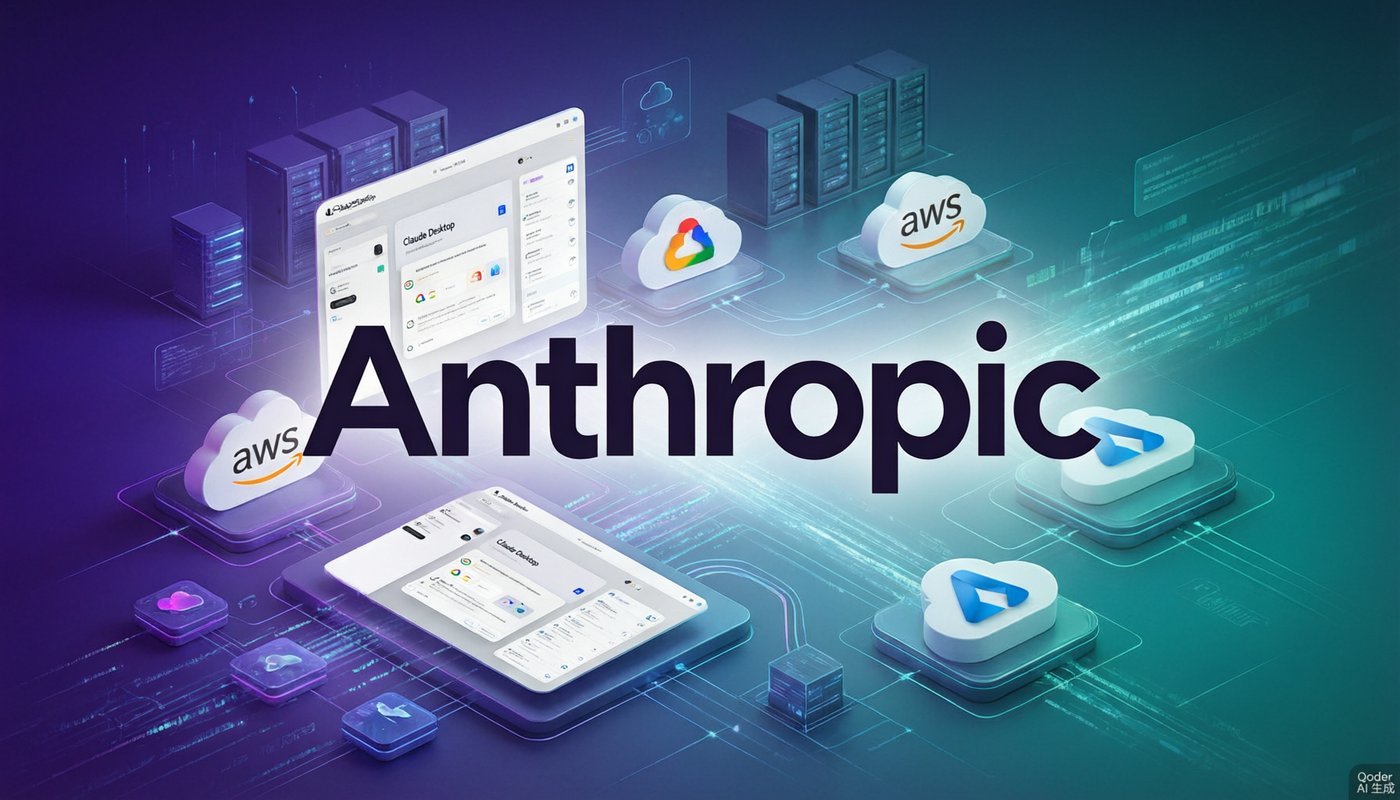
SAN FRANCISCO — Anthropic is making its desktop assistant available through Amazon Web Services, Google Cloud and Microsoft Azure Foundry, opening the Claude Desktop beta on all three major enterprise platforms at once. The simultaneous launch, announced Tuesday, is the company’s most aggressive move yet to put its models in front of corporate customers through the channels they already use.
The same day, Anthropic said it is expanding its partnership with Amazon to 5 gigawatts of computing capacity, deepening a relationship that already makes AWS the primary home of Claude’s training and inference. The two announcements together describe Anthropic’s strategy: secure the infrastructure, then flood the distribution channels. From models to data centers to cloud marketplaces, the company is trying to make Claude as easy to buy as any other piece of enterprise software.
The cloud distribution matters because that is where enterprise software is actually purchased. Companies that standardize on AWS or Azure are reluctant to add vendors outside their preferred platforms, and an assistant available only through one channel would have been limited to a fraction of the market. By landing on all three clouds, Anthropic ensures that Claude is an option in every major procurement conversation, analysts said.
The Amazon relationship remains the center of gravity. Amazon has invested billions in Anthropic and has made Claude the centerpiece of its Bedrock AI platform, and the expansion to 5 gigawatts of compute reflects the scale of training demand. The new capacity, delivered over the next several years, is designed to support models that are far larger than today’s, a signal that Anthropic is planning for the next generation of AI rather than optimizing the current one.
The multi-cloud strategy carries a tension that Anthropic has navigated carefully. Microsoft and Google are both competitors with their own AI products, and Amazon’s rival cloud, yet Anthropic has chosen to make Claude available on all three. The company has said the decision reflects customer demand, and that being a neutral provider of AI models is more valuable than being a partisan of one platform. Whether Amazon is comfortable with that posture is a question analysts have raised, but the expanded compute commitment suggests the partnership remains intact.
Claude’s enterprise traction has grown steadily. The assistant has won a reputation among developers and professionals for careful, well-structured responses, and Anthropic has said enterprise adoption is its fastest-growing segment. The cloud launch removes the friction of separate sign-ups and procurement processes, and the desktop beta gives employees a native application that works alongside the web product.
The competitive stakes are clear. OpenAI has distribution through Microsoft’s products, and Google has Gemini embedded across its own enterprise stack. Anthropic’s path has been to build its own relationships, and the three-cloud launch is the most direct challenge yet to the assumption that the enterprise AI market will settle into two camps. Analysts said the move effectively makes Claude the default alternative in any cloud procurement where a second model is being considered.
The capacity expansion also answers a practical question that has dogged AI startups: whether they can secure enough computing power to keep training larger models. Compute has become the scarce resource of the industry, and the 5-gigawatt commitment gives Anthropic a runway that most rivals cannot match. The scale is comparable to what the largest hyperscale operators build for their own use, and it signals that Amazon sees Anthropic as a long-term partner rather than a portfolio investment.
For enterprises, the immediate effect is choice. A company running on Google Cloud can now adopt Claude without changing providers, and a Microsoft shop can test Claude alongside Copilot without leaving Azure. The beta program, which begins with a limited set of customers, will determine whether the product meets the demands of large organizations, and Anthropic has said it will expand capacity as demand grows.
The desktop product itself is a response to how knowledge workers actually use AI. ChatGPT has had a desktop application for years, and Google has pushed Gemini into its operating systems, but Claude has been available mostly through browsers and developer tools. The desktop beta changes that, giving users a native application that can sit alongside their other work software, with features designed for the long, careful sessions that enterprise users run. Anthropic has said the application will be updated regularly as the beta progresses, and the company is asking enterprise customers to help shape the product before its full release.
The distribution math favors Anthropic in an unusual way. The company does not own a search engine, a major cloud or an operating system, and its route to users has been through partners, which makes the three-cloud launch a necessity rather than a luxury. The same constraint, however, makes Anthropic a safer choice for enterprises that do not want to commit to a single platform, and the company has leaned into that positioning, describing itself as the independent alternative in a market of vertically integrated giants. The strategy carries risk: if the big clouds ever decide to promote their own models over Claude’s, Anthropic’s distribution could narrow as quickly as it expanded. For now, the company’s response has been to sign up with all of them and let the market decide.
The company’s trajectory is now defined by two commitments: to compute and to distribution. Both are expensive, and both assume that the enterprise market for AI assistants will keep growing for years. The announcements on Tuesday were Anthropic’s way of saying it believes that bet is worth making at a scale its rivals will have to answer.